

Retail replenishment plays a central role in effective retail inventory management, shaping how retailers balance product availability, cost control, and customer expectations. It determines how quickly and accurately products return to shelves once demand starts to deplete inventory, and directly influences service levels, cash flow, and operational efficiency.
While replenishment is often discussed as a general inventory discipline, retail replenishment introduces additional complexity. Retailers must respond to short demand cycles, frequent promotions, multiple sales channels, and tight service level expectations. Decisions are often made at SKU and location level, with limited tolerance for error.
A clear understanding of retail replenishment helps retailers make better inventory decisions across the entire value chain. When replenishment is well understood and correctly applied, it supports both day-to-day execution and longer-term planning.
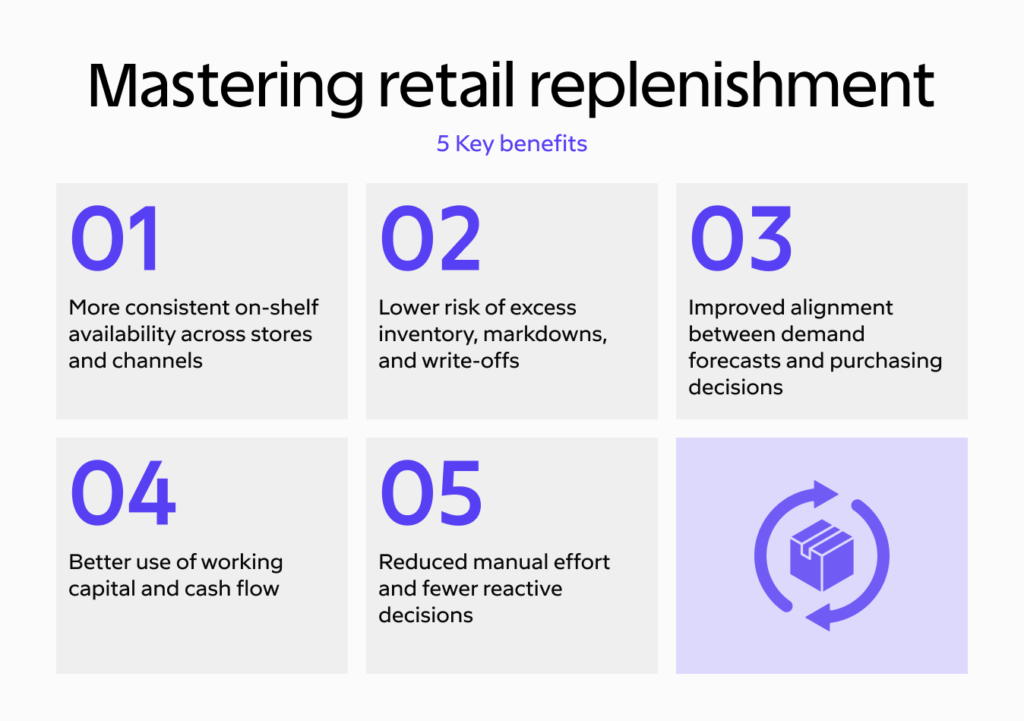
Benefits of understanding retail replenishment include:
- More consistent on-shelf availability across stores and channels
- Lower risk of excess inventory, markdowns, and write-offs
- Improved alignment between demand forecasts and purchasing decisions
- Better use of working capital and cash flow
- Reduced manual effort and fewer reactive decisions
What is retail replenishment?
Retail replenishment is the process of restocking products across stores, distribution centres, or fulfilment locations to maintain optimal on-shelf availability. Its purpose is to ensure products are available where customers expect them, without creating excess inventory elsewhere in the network.
Retail replenishment is highly execution-driven. It translates demand signals into frequent, operational decisions that affect store availability directly. Unlike broader inventory planning processes, replenishment must work with shorter time horizons and react quickly to change driven by promotions, seasonality, or shifting customer behaviour.
For a broader explanation of replenishment principles and mechanics, see our guide to stock replenishment and how it works. Retail replenishment builds on those foundations, but applies them in a more volatile, customer-facing environment.
Why retail replenishment is so important
Retail replenishment has an immediate and visible impact on performance. When it works well, customers find what they need, margins are protected, and inventory stays balanced. When it fails, the consequences escalate quickly.
Avoid stockouts
Stockouts in retail often result in immediate lost sales, as customers switch brands, stores, or channels rather than waiting. Repeated availability issues also weaken trust and long-term loyalty. Effective replenishment helps maintain consistent availability even when demand fluctuates across locations or channels.
Avoid overstocking
Excess stock increases holding costs and ties up working capital. In retail, it also raises the risk of markdowns, write-offs, or waste, especially for seasonal or perishable products. Strong replenishment logic helps prevent over-ordering while still supporting availability targets.
Improve inventory visibility
Retail replenishment depends on accurate inventory data across stores, warehouses, and in-transit stock. Improved visibility reduces guesswork and enables more confident, consistent ordering decisions across the network.
Optimise cash flow and reduce costs
Inventory represents a significant financial commitment. Retail replenishment aligns stock levels more closely with actual demand, freeing capital that would otherwise be locked in slow-moving or excess inventory.
Support customer satisfaction
Customers expect products to be available when and where they shop. Retail replenishment directly supports service level performance across both physical and digital channels, influencing overall brand perception.
Manage short product lifecycles
Retail assortments change frequently due to trends, seasons, and promotions. Replenishment planning ensures inventory builds up and winds down in line with product lifecycles, reducing end-of-season risk.
Enable data-driven and AI-supported planning
Modern retail replenishment increasingly relies on forecasting, optimisation, and automation. Structured replenishment rules create the foundation for effective use of advanced analytics and AI.
Reduce manual effort
Manual ordering is time-consuming and error-prone. Automated replenishment reduces administrative workload, allowing teams to focus on exceptions, supplier collaboration, and strategic decisions.
Common challenges in retail replenishment
Retail replenishment operates in an environment shaped by uncertainty on both demand and supply sides.
Managing demand variability and seasonality
Promotions, weather, trends, and external events can rapidly change demand patterns. Retail replenishment must adjust quickly, often at store or SKU level, to avoid availability gaps or excess stock.
Dealing with supply chain disruptions
Delays, shortages, and capacity constraints can disrupt even well-planned replenishment cycles. Without continuous monitoring and adjustment, these disruptions quickly translate into stockouts or overstock.
Balancing inventory across multiple channels
Retailers often serve physical stores, ecommerce, and wholesale customers from shared inventory pools. Poor coordination between channels leads to imbalance, with surplus stock in one channel and shortages in another.
Responding to sustainability pressures
Retailers face increasing pressure to reduce waste, excess stock, and unnecessary transport. Replenishment decisions play a critical role in meeting sustainability goals without compromising availability.
Retail replenishment strategies
Retailers rarely rely on a single replenishment method. Different strategies are applied depending on product behaviour, demand volatility, and operational constraints.
Reorder point strategy
The reorder point strategy triggers replenishment when inventory falls below a calculated threshold. This threshold typically includes expected demand during lead time plus safety stock. It works well for stable, fast-moving products with predictable demand.
Top-off strategy
Top-off replenishment restores inventory to a predefined target level, often aligned with shelf capacity or display requirements. It is commonly used in stores with regular delivery cycles and limited storage space.
Just-in-time strategy
Just-in-time replenishment aims to minimise inventory by aligning deliveries closely with demand. While efficient, it requires reliable suppliers, short lead times, and accurate forecasts, making it harder to apply broadly in retail.
Periodic review strategy
Periodic replenishment reviews inventory at fixed intervals, such as weekly or bi-weekly. Orders are placed to cover expected demand until the next review, offering simplicity at the cost of reduced responsiveness.
Demand-driven strategy
Demand-driven replenishment continuously adjusts order quantities and timing based on forecast updates and real-time sales data. This approach supports volatile demand patterns and dynamic assortments.
Opportunistic replenishment
Opportunistic replenishment takes advantage of favourable conditions such as transport consolidation or temporary supplier incentives, while remaining within inventory constraints.
Combining replenishment methods in practice
In reality, most retailers do not rely on a single replenishment strategy. Different products, categories, and locations often require different approaches at the same time.
Fast-moving, stable items may follow a reorder point strategy, while seasonal or promotional products are managed through demand-driven or top-off replenishment. Periodic reviews can support slower-moving items, while opportunistic replenishment helps optimise transport or supplier conditions.
Retail replenishment works best when these methods are combined within a single framework. This allows retailers to apply the right logic at SKU or location level, while maintaining overall control and consistency without increasing manual workload.
How replenishment differs across retail, wholesale, and manufacturing
Replenishment varies significantly depending on the business model and operational priorities.
| Aspect | Retail replenishment | Wholesale replenishment | Manufacturing replenishment |
| Primary focus | On-shelf availability and customer demand | Order fulfilment and customer contracts | Production continuity and material availability |
| Demand pattern | Highly variable, promotion- and season-driven | More stable, order-driven | Planned and forecast-based |
| Replenishment frequency | High and continuous | Moderate and batch-oriented | Scheduled and plan-driven |
| Inventory location | Stores, DCs, fulfilment centres | Warehouses and DCs | Raw materials, WIP, finished goods |
| Key risks | Stockouts, markdowns, waste | Missed deliveries, excess stock | Line stoppages, material shortages |
| Decision horizon | Short-term and operational | Medium-term | Medium- to long-term |
How retail replenishment fits into the supply chain
Retail replenishment acts as the execution layer between demand planning and supply. It converts forecasts and inventory targets into concrete purchasing and distribution decisions.
Replenishment decisions influence supplier orders, production schedules, and logistics capacity. At the same time, supplier lead times, minimum order quantities, and reliability shape what replenishment is feasible.
When replenishment is closely aligned with upstream planning, retailers reduce firefighting, improve service levels, and limit demand amplification across the supply chain.
How AGR supports smarter retail replenishment
AGR helps retailers move from reactive ordering to structured, data-driven retail replenishment that scales across products, locations, and channels. Instead of relying on manual rules, spreadsheets, or last-minute interventions, retailers gain a clear, system-supported framework for making consistent replenishment decisions.
AGR enables retailers to:
- Move from reactive to structured, data-driven replenishment
Decisions are driven by demand forecasts, inventory targets, and service level objectives rather than urgent firefighting. - Improve inventory visibility across stores, DCs, and channels
A consolidated view of inventory positions and future requirements highlights risks early and supports better prioritisation. - Apply replenishment rules by product, location, and channel
Different products behave differently. AGR supports granular replenishment logic without adding complexity. - Reduce manual effort and errors through automation
Automated recommendations and exception-based workflows save time and reduce ordering mistakes. - Maintain availability while controlling overstock and costs
Demand, lead times, and safety stock are balanced dynamically to protect service levels without excess buffers.
Together, these capabilities support stronger retail inventory management and more resilient replenishment performance.
Ready to improve your retail replenishment?
👉 Book a demo
👉 Explore AGR’s retail inventory solutions
FAQs about retail replenishment
What is retail replenishment?
Retail replenishment is the process of restocking products across retail locations to maintain availability while controlling inventory costs.
Why is retail replenishment important?
It helps prevent stockouts and excess inventory, supports cash flow, and improves customer satisfaction.
How does retail replenishment work?
It uses demand data, inventory levels, and lead times to determine when and how much stock to reorder.
What is an example of replenishment?
Automatically reordering fast-selling items when store inventory drops below a defined threshold is a common example.
What is the cost of retail replenishment?
Costs include purchasing, transport, holding inventory, and potential markdowns. Effective replenishment reduces unnecessary costs.
Can AGR help with retail replenishment?
Yes. AGR provides forecasting, optimisation, and automated replenishment capabilities tailored to retail environments.