


Keeping the right products available at the right time is vital for customer satisfaction and profitability. Stock replenishment ensures that inventory levels are maintained efficiently so businesses can meet demand without overstocking or tying up capital unnecessarily.
What is stock replenishment?
Stock replenishment is the process of refilling inventory as items are sold or used. It ensures that stock levels are restored to meet future demand without interruption. In retail and distribution, it might mean ordering more of a popular product when stock falls below a specific threshold, while in manufacturing it could involve sourcing components just before they are needed for production.
The goal is simple: balance supply with demand. Effective replenishment prevents costly stockouts and avoids excess stock that can sit idle in warehouses.
Why stock replenishment matters in inventory management
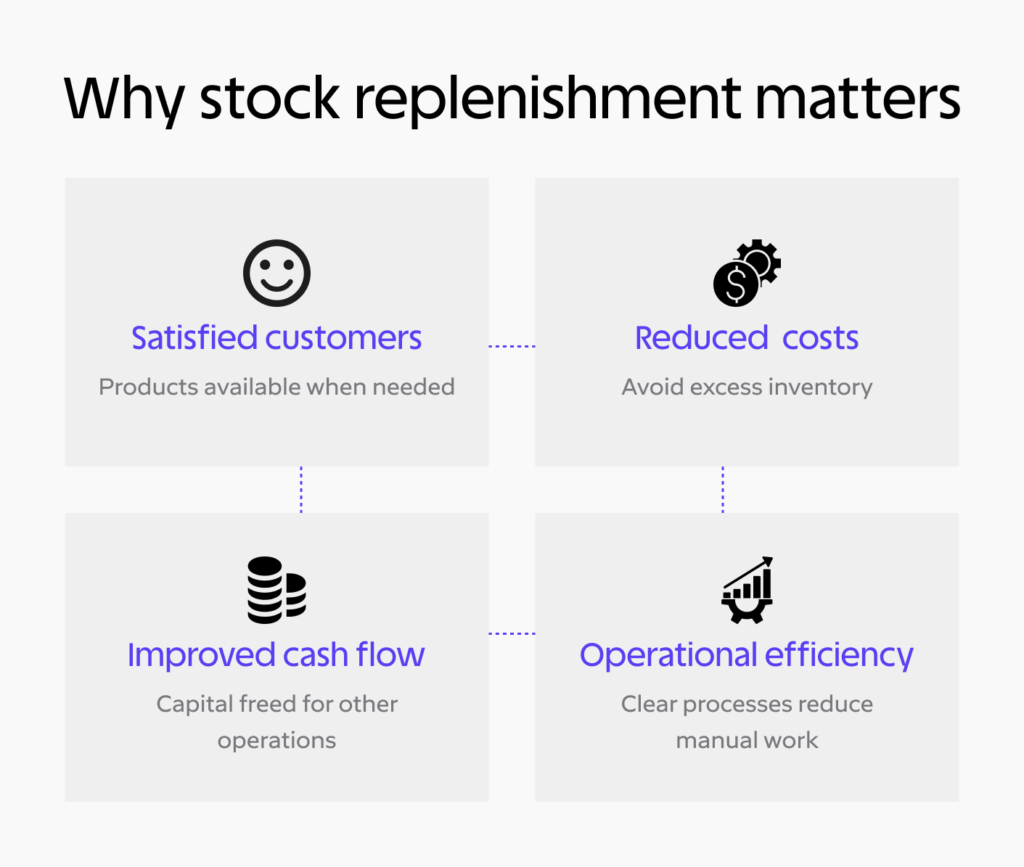
Replenishment is central to efficient inventory management because it maintains service levels and optimises resources. When done well, it leads to:
- Satisfied customers: Products are available when and where they are needed.
- Reduced holding costs: Businesses avoid tying up cash in excess inventory.
- Improved cash flow: Capital is freed up for other operations.
- Operational efficiency: Clear reorder processes reduce manual work and decision delays.
For many businesses, replenishment is where inventory planning meets execution.
How the stock replenishment process works
An effective replenishment process follows several key steps that ensure continuity and accuracy. Each step builds on the previous one to keep stock flowing smoothly through the supply chain.
Monitor inventory levels
Regular monitoring ensures visibility of stock across locations. Automated systems make it easier to track item movement and detect when quantities fall below target. This visibility helps teams respond quickly to changes in demand and prevents small discrepancies from growing into costly stockouts.
Set reorder points
Reorder points define when replenishment should begin. They are calculated based on demand forecasts, lead times, and safety stock requirements. Setting accurate reorder points allows businesses to act proactively instead of reacting when stock runs out.
Forecast customer demand
Forecasting helps anticipate future sales so replenishment is proactive, not reactive. Accurate demand forecasting minimises both shortages and overstock. A well-tuned forecast also improves supplier collaboration by ensuring purchase orders are timed and sized to match upcoming needs.
Create and process orders
Once thresholds are reached, purchase or transfer orders are created. Automation helps streamline approvals, supplier communication, and order tracking. Clear workflows reduce administrative effort and ensure that every order aligns with agreed budgets and timelines.
Receive and store new stock
Incoming stock is verified, recorded, and stored efficiently. Proper labelling and system updates keep inventory data accurate and ready for the next cycle. Well-organised receiving procedures also reduce bottlenecks and help maintain consistent service levels across all locations.
Common stock replenishment methods
Businesses use different approaches depending on product type, demand pattern, and supply chain complexity.
Periodic replenishment
Inventory is reviewed at set intervals, such as weekly or monthly. This method suits businesses with predictable sales but may lead to short-term shortages if demand spikes between reviews.
On-demand replenishment
Stock is reordered only when items are sold or used. It works best for high-value or slow-moving products where excess inventory would tie up too much capital.
Top-off replenishment
Common in warehouse management, this method involves restocking picking locations before they run out, ensuring consistent order fulfilment during busy periods.
Lean-time replenishment
Popular in just-in-time (JIT) systems, this method focuses on replenishing only what is needed for immediate production or delivery, reducing waste and storage costs.
Best practices for effective replenishment
To build a reliable and efficient replenishment process, companies should:
Use data, not guesswork
Data-driven decisions based on sales history, seasonality, and customer trends ensure more accurate replenishment cycles. Reliable data helps identify demand patterns early, so stock levels can be adjusted before problems arise.
Keep safety stock
Maintaining a buffer stock protects against demand surges, supplier delays, or transport issues that could otherwise halt operations. Safety stock acts as an insurance policy that keeps customers satisfied even when supply conditions change unexpectedly.
Review performance continuously
Regularly assess key performance indicators such as service level, stock turn, and fill rate. This ongoing review highlights trends and makes it easier to fine-tune replenishment strategies over time.
Leverage automation and smart tools
Modern software eliminates manual errors and provides real-time visibility. Automated replenishment frees up planners’ time to focus on value-adding tasks such as supplier relationships and long-term forecasting improvements.
Real-world examples of effective stock replenishment
Successful replenishment looks different for every business, but the goal is always the same — the right stock, in the right place, at the right time. AGR customers across industries have achieved that balance by replacing manual processes with smarter, data-driven planning.
Sæther: Inventory transformation in a complex market
As one of Scandinavia’s leading beauty distributors, Sæther faced the challenge of managing thousands of fast-moving products across multiple brands and markets. With AGR, they transformed manual ordering into a streamlined replenishment process, gaining better control, fewer stockouts, and a clearer view of product performance.
Ole Lynggaard Copenhagen: precision for luxury retail
For high-end jeweller Ole Lynggaard Copenhagen precision and availability are everything. AGR’s replenishment tools ensure the right collections are in the right stores at the right time, supporting consistent customer experiences and protecting brand reputation.
Rosendahl Copenhagen: balancing production and demand
Homeware leader Rosendahl Copenhagen used AGR to bring visibility to their entire product range, synchronising production and replenishment with real demand. The result was lower stock levels, shorter lead times, and a more efficient supply chain overall.
Each of these companies shows that effective replenishment is not only about refilling shelves — it’s about building resilience, improving service levels, and freeing up resources for growth.
How AGR supports smarter replenishment
AGR helps businesses turn replenishment into a strategic advantage. Its advanced planning engine combines real-time data, demand forecasting, and supplier insights to automate replenishment across all warehouses and product lines.
With AGR’s automated ordering, companies can remove manual work and human error from the process. The system automatically recommends and places orders based on demand forecasts, stock levels, and supplier lead times. This ensures that replenishment decisions are always data-driven and aligned with business goals.
The result is faster decision-making, fewer stockouts, and balanced inventory levels across the entire supply chain. AGR provides full visibility from planning to ordering so teams can focus on strategic improvements instead of routine admin.
Stock replenishment vs. inventory forecasting
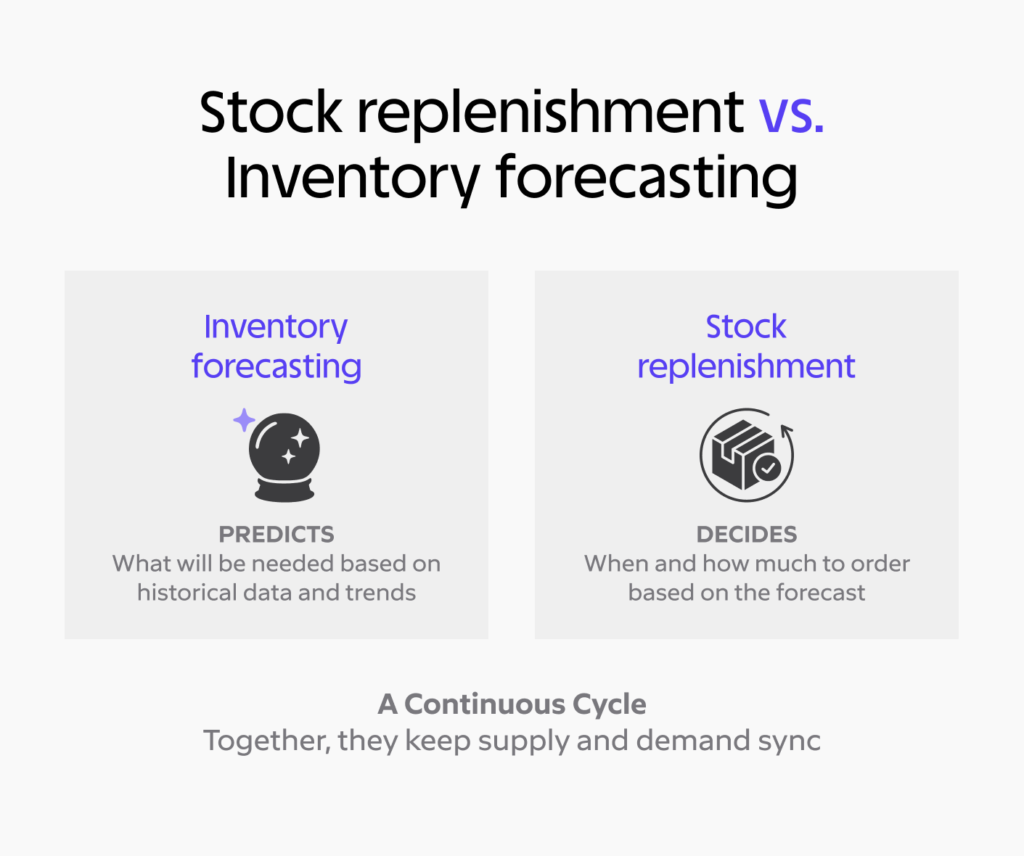
Although related, replenishment and forecasting serve different purposes. Forecasting predicts what will be needed based on historical data and trends. Replenishment uses that forecast to decide when and how much to order. Together, they form a continuous cycle that keeps supply and demand in sync.
FAQs about stock replenishment
What is stock replenishment?
It is the process of restocking products to maintain optimal inventory levels and meet customer demand.
Why is stock replenishment important?
It ensures product availability, reduces the risk of lost sales, and keeps storage and cash flow efficient.
How does stock replenishment work?
Businesses monitor inventory, forecast demand, set reorder points, and automate purchase or transfer orders when thresholds are reached.
What are the main types of stock replenishment methods?
The most common methods include periodic, on-demand, top-off, and lean-time replenishment.
How often should stock be replenished?
The frequency depends on product demand, lead times, and available storage capacity.
How can technology improve the replenishment process?
Software solutions automate tracking, forecasting, and order creation, ensuring accuracy and consistency across the supply chain.