


Inventory is one of the largest investments in any retail, wholesale, or distribution business. Yet many companies still struggle to understand whether that investment is actually delivering returns. That is where GMROI comes in.
Gross Margin Return on Investment, or GMROI, measures how much profit you earn for every pound tied up in inventory. It connects margin performance with inventory efficiency, giving a clear view of how well your stock is working for your business. It also helps bridge the gap between finance and operations by aligning profitability with inventory decisions.
In this guide, we break down what GMROI is, how to calculate it, and how to improve it with practical, data-driven strategies. The goal is to help you turn inventory from a cost centre into a measurable driver of profit.
What is GMROI? (Gross margin return on investment)
GMROI is a financial and operational metric that shows how effectively your inventory generates profit. It provides a clear link between how much you invest in stock and what you get back in return.
In simple terms, it answers one question:
For every pound invested in inventory, how much gross profit do you earn?
- A high GMROI means your inventory is performing well and generating strong returns
- A low GMROI means capital is tied up in stock that is not delivering sufficient profit
This makes GMROI especially valuable for inventory-heavy businesses where stock represents a significant portion of working capital. It is particularly relevant in industries where margins are tight and inventory turnover is critical to success.
Why GMROI matters
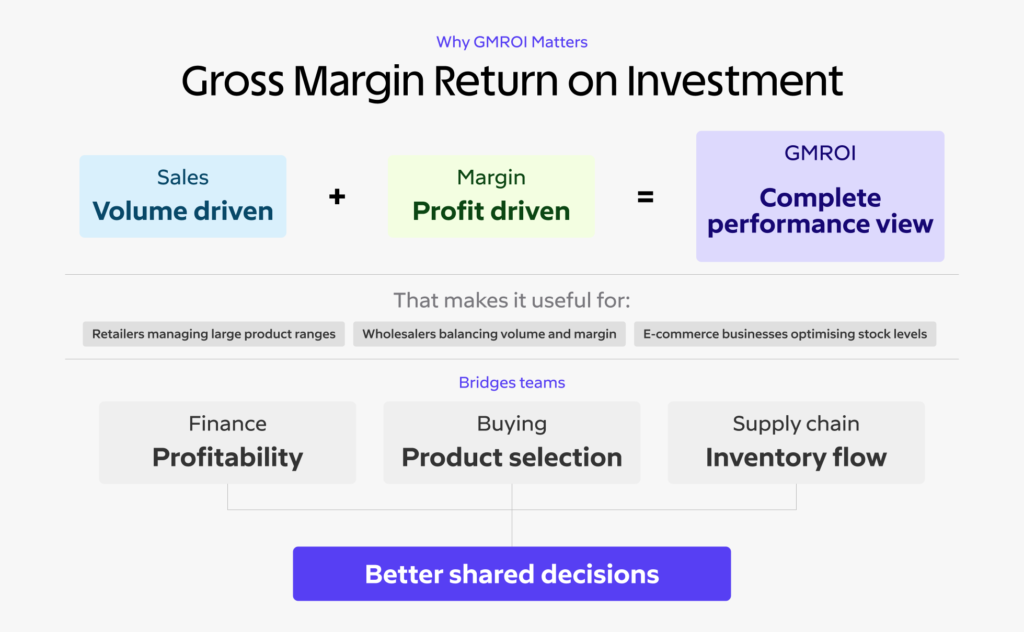
Unlike standalone metrics such as sales or margin, GMROI combines both. It gives a more complete view of performance by linking profitability with inventory investment. This allows teams to move beyond volume-driven thinking and focus on value creation.
That makes it useful for:
- Retailers managing large product ranges
- Wholesalers balancing volume and margin
- E-commerce businesses optimising stock levels
It also supports better cross-functional decision-making between finance, buying, and supply chain teams.
GMROI formula
The GMROI formula is straightforward:
GMROI = Gross profit / Average inventory cost
To understand it properly, you need to break down each component. Each part of the formula reflects a different aspect of inventory performance.
Gross profit
Gross profit is the difference between revenue and the cost of goods sold (COGS):
Gross profit = Revenue – COGS
This reflects how much profit you make from selling your products before operating expenses. It is a direct indicator of how efficiently you convert sales into profit.
Average inventory cost
Average inventory cost represents the average value of stock held during a given period. It captures how much capital is consistently tied up in inventory.
It is typically calculated as:
(Beginning inventory + Ending inventory) / 2
This gives a realistic view of how much capital is tied up in stock over time. Using an average avoids distortions caused by seasonal fluctuations or one-off stock changes.
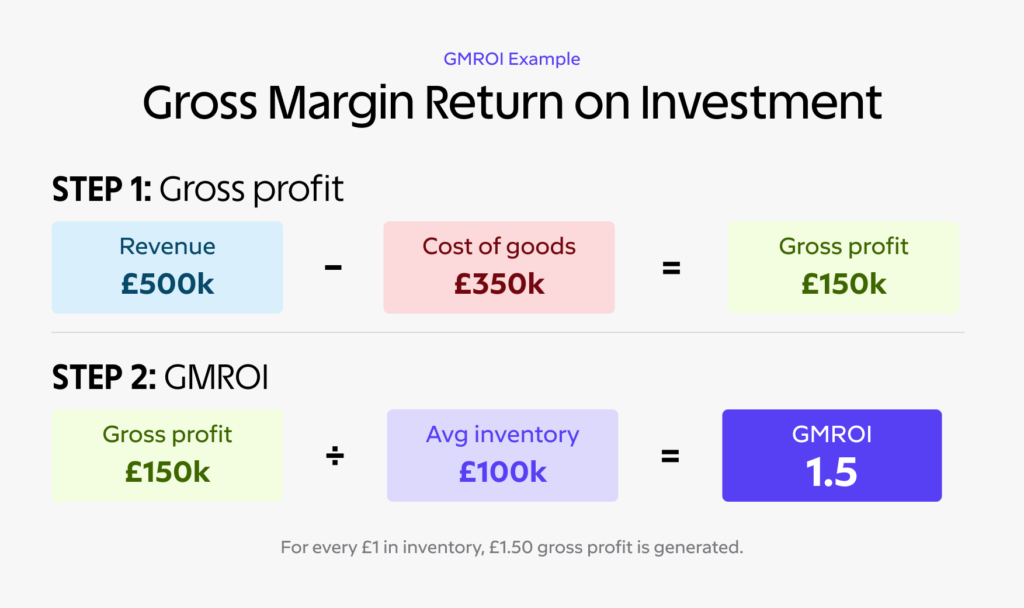
Example calculation
Let’s make this tangible. A practical example helps show how GMROI works in real business scenarios.
A retailer reports:
- Revenue: £500,000
- Cost of goods sold: £350,000
- Average inventory cost: £100,000
Step 1: Calculate gross profit
Gross profit = £500,000 – £350,000 = £150,000. This represents the total profit generated from product sales before overheads.
Step 2: Calculate GMROI
GMROI = £150,000 / £100,000 = 1.5. This ratio shows the return generated relative to the inventory investment.
What does this mean?
For every £1 invested in inventory, the business generates £1.50 in gross profit. This gives a clear indication of how effectively inventory is being used to generate returns.
That is a useful benchmark, but whether it is “good” depends on your industry, margins, and inventory strategy. It should always be interpreted in the context of your business model and market conditions.
Why GMROI matters for inventory management
GMROI is not just a financial metric. It is a practical decision-making tool. It helps translate data into clear actions that improve performance.
1. It shows inventory profitability
Many businesses track sales and margin separately. GMROI combines them to reveal whether inventory is actually delivering value. This makes it easier to identify where profit is being created or lost.
A product with high sales but low margin may still underperform when inventory costs are considered. GMROI brings that hidden inefficiency into focus.
2. It helps prioritise SKUs
Not all products contribute equally to profitability. Some drive revenue, while others tie up capital without sufficient return.
GMROI allows you to identify:
- High-performing SKUs that deserve more investment
- Low-performing SKUs that tie up capital
This supports smarter assortment planning and SKU rationalisation. It also enables more confident decisions about delisting or promoting products.
3. It improves capital allocation
Inventory is working capital. Every pound tied up in stock is a pound that cannot be used elsewhere. Managing this efficiently is key to business growth.
GMROI helps you:
- Reallocate investment to better-performing products
- Reduce excess stock
- Improve overall financial efficiency
This leads to stronger cash flow and more agile decision-making.
How to improve GMROI
Improving GMROI is about increasing profit while reducing the capital tied up in inventory. The most effective strategies focus on both sides of the equation. Small improvements across multiple areas can create a significant overall impact.
Improve pricing and margins
Higher margins directly increase GMROI. Even incremental changes can have a measurable effect.
This can be achieved by:
- Reviewing pricing strategies
- Reducing discounting where possible
- Negotiating better supplier costs
Even small improvements in margin can have a significant impact. Over time, these gains compound across your entire product range.
Reduce excess inventory
Excess stock is one of the biggest drivers of low GMROI. It ties up capital without generating returns.
When inventory sits unsold, it increases holding costs and ties up cash without generating returns. It can also lead to markdowns and write-offs.
Focus on:
- Identifying slow-moving and obsolete items
- Clearing excess stock through promotions
- Adjusting purchasing decisions
This helps free up capital and improve overall inventory efficiency.
Improve demand forecasting
Accurate forecasting reduces both overstocking and stockouts. It creates a more balanced inventory position.
Better forecasts allow you to:
- Align inventory with actual demand
- Reduce safety stock levels without increasing risk
- Improve stock turnover
This is one of the most powerful levers for improving GMROI. It ensures that inventory investment is based on data rather than guesswork.
Optimise product mix
Not all products contribute equally to profitability. Some products drive margin, while others dilute it.
By analysing GMROI at SKU or category level, you can:
- Focus on high-return products
- Reduce or eliminate underperforming items
- Build a more profitable assortment
This leads to a leaner, more efficient product portfolio.
Increase inventory turnover
Faster inventory movement improves GMROI by reducing the average inventory cost. It ensures that capital is not sitting idle.
This can be achieved through:
- Better replenishment strategies
- Improved demand planning
- Shorter lead times
Higher turnover means more frequent returns on the same investment.
Common mistakes when using GMROI
GMROI is powerful, but only when used correctly. Misinterpretation can lead to poor decisions.
Ignoring time periods
GMROI should always be analysed over consistent time periods. Comparisons only make sense when the timeframe is aligned.
Comparing monthly and yearly figures without context can lead to misleading conclusions. Seasonal businesses are especially vulnerable to this mistake.
Not segmenting by SKU or category
A single overall GMROI hides important insights. Aggregated data often masks underperformance.
To get real value, you need to analyse:
- Product categories
- Individual SKUs
- Channels or locations
Granular analysis reveals where action is needed most.
Comparing across industries
There is no universal “good” GMROI. Benchmarks vary widely depending on business type.
Different industries have different:
- Margin structures
- Inventory turnover rates
- Business models
Benchmarking should always be done within your own sector. Context is essential for meaningful comparisons.
How inventory software improves GMROI
Improving GMROI manually is difficult. It requires accurate data, continuous monitoring, and the ability to act quickly. Manual processes often fall short as complexity increases.
This is where inventory optimisation software makes a difference. It enables scalable, data-driven decision-making.
Real-time inventory insights
Gain full visibility into:
- Stock levels
- Sales performance
- SKU profitability
This allows faster and more informed decisions. It also reduces reliance on outdated or incomplete data.
Forecasting and demand planning
Advanced forecasting tools help align inventory with demand, reducing both excess stock and missed sales. This improves both availability and efficiency.
Reducing dead stock
By identifying slow-moving items early, you can take action before they become a financial burden. This prevents long-term capital lock-in.
SKU-level performance tracking
Analyse GMROI at a granular level to optimise your product mix and maximise returns. This ensures every SKU earns its place in your assortment.
With the right tools, GMROI becomes more than a metric. It becomes a driver of continuous improvement. It also creates a foundation for more advanced inventory optimisation strategies.
Final thoughts
GMROI brings clarity to one of the most important questions in inventory management: is your stock actually making money? It provides a practical way to measure and improve performance.
By combining margin and inventory efficiency, it gives a clear, actionable view of performance. More importantly, it highlights where to focus.
Improve forecasting, optimise your product mix, reduce excess stock, and track performance at a granular level. That is how you turn GMROI from a metric into a competitive advantage. Over time, this approach drives stronger profitability and more resilient operations.
If you want to improve GMROI at scale, it starts with better forecasting. Explore how AGR’s demand forecasting and planning solution helps you align inventory with real demand, reduce excess stock, and maximise returns on every pound invested.
FAQ
What does GMROI tell you?
GMROI shows how much gross profit you generate for every pound invested in inventory. It helps assess inventory efficiency and profitability. It is often used to compare performance across products or categories.
Is a high GMROI always good?
Generally, yes. A higher GMROI indicates better performance. However, extremely high values may also signal understocking or missed sales opportunities. Balance is key to maintaining both profitability and availability.
What is the difference between GMROI and ROI?
GMROI focuses specifically on inventory investment, while ROI measures returns on any type of investment. GMROI is therefore more relevant for operational decision-making in inventory-heavy businesses.
How often should you calculate GMROI?
Most businesses calculate GMROI monthly or quarterly. Regular tracking helps identify trends and respond quickly to performance changes. More frequent analysis can be useful in fast-moving environments.