


Retail is one of the most data-driven industries in the world. From pricing and promotions to supply chain planning and store performance, nearly every decision depends on measurable insights. Retail metrics provide the framework that helps businesses understand what is happening across their operations and how to improve results.
Retailers track dozens of performance indicators across sales, operations, customers, and supply chains. However, the most influential metrics often relate to inventory. Inventory is typically the largest asset on a retailer’s balance sheet and directly affects cash flow, product availability, and profitability.
This guide explains what retail metrics are, why they matter, and which inventory KPIs retailers should prioritise to improve operational performance and financial outcomes. The structure follows the framework outlined in the AGR retail metrics content brief.
What are retail metrics?
Retail metrics are measurable indicators used to evaluate how effectively a retail business operates. They help organisations track performance, identify inefficiencies, and guide strategic decisions.
Retail metrics typically fall into four main categories:
- Sales performance metrics
- Customer metrics
- Store operations efficiency metrics
- Inventory performance metrics
These categories include many commonly used retail KPIs such as inventory turnover, conversion rate, average transaction value, and sales per square foot.
Retail organisations usually track these indicators through analytics dashboards that combine data from point-of-sale systems, ERP platforms, and inventory management software.
Why retail metrics matter more than ever
Retail has become significantly more complex over the past decade. Omnichannel commerce, global supply chain disruptions, and rising operational costs make data-driven decision-making essential.
Several trends explain why retail metrics are now central to business success.
Omnichannel demand
Retailers now operate across multiple channels, including physical stores, ecommerce platforms, marketplaces, and social commerce. Each channel generates different demand patterns that must be monitored and analysed.
Metrics help retailers understand how inventory should be distributed across these channels.
Supply chain volatility
Global supply chains remain vulnerable to disruptions caused by transportation delays, supplier shortages, and geopolitical events. Retailers need performance indicators that highlight supply risks and inventory imbalances.
Margin pressure
Retail margins are often tight. Even small operational inefficiencies can significantly affect profitability. Metrics allow businesses to identify areas where processes can be improved.
Data-driven planning
Retail leaders increasingly rely on analytics tools to guide forecasting, replenishment, and assortment decisions. Metrics provide the data foundation for those planning models.
Core categories of retail performance metrics
Retail organisations track many different KPIs, but most fall into a few major categories.
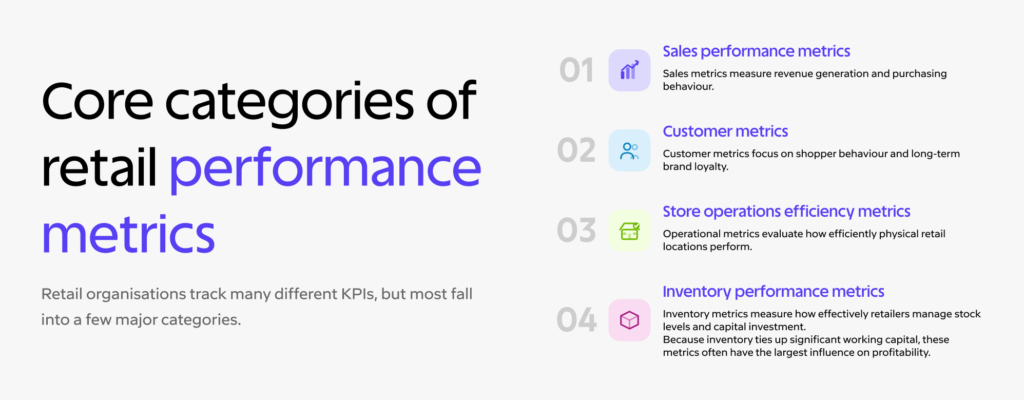
Sales performance metrics
Sales metrics measure revenue generation and purchasing behaviour.
Examples include:
- Total revenue
- Sales growth rate
- Conversion rate
- Average transaction value (ATV)
- Units per transaction (UPT)
These indicators help retailers understand how effectively they convert customer traffic into purchases.
Customer metrics
Customer metrics focus on shopper behaviour and long-term brand loyalty.
Examples include:
- Customer lifetime value (CLV)
- Customer retention rate
- Net promoter score (NPS)
- Customer acquisition cost (CAC)
These metrics reveal how effectively retailers attract, retain, and engage customers.
Store operations efficiency metrics
Operational metrics evaluate how efficiently physical retail locations perform.
Examples include:
- Sales per square foot
- Foot traffic
- Labour productivity
- Shrinkage rate
These indicators help retailers optimise staffing levels, store layouts, and operational processes.
Inventory performance metrics
Inventory metrics measure how effectively retailers manage stock levels and capital investment.
Because inventory ties up significant working capital, these metrics often have the largest influence on profitability.
Key inventory metrics include:
- Inventory turnover
- Sell-through rate
- Gross margin return on inventory investment (GMROI)
- Days inventory outstanding (DIO)
- Stock-to-sales ratio
The following section explores these inventory-focused metrics in more detail.
The most important inventory metrics in retail
Inventory metrics provide a direct view of how efficiently a retailer converts stock into sales. When inventory metrics are healthy, businesses typically experience stronger cash flow, higher availability, and improved profitability.
Inventory turnover
Inventory turnover measures how often a retailer sells and replaces its inventory within a given period.
The formula is typically:
Inventory turnover = Cost of goods sold / Average inventory
A higher turnover ratio generally indicates strong demand and efficient inventory management. A low turnover ratio may suggest excess stock, weak demand, or inefficient purchasing decisions.
Retailers rely on this metric to identify slow-moving items, optimise purchasing decisions, and improve capital efficiency. You can explore the detailed explanation, calculations, and examples in AGR’s guide to the inventory turnover ratio.
Monitoring turnover helps retailers understand whether stock is moving at a healthy pace and whether product assortments align with customer demand.
Sell-through rate
Sell-through rate measures how much of the inventory received during a specific period is actually sold.
The formula typically looks like this:
Sell-through rate = Units sold / Units received
Retailers often track sell-through during product launches, seasonal campaigns, or promotional periods.
High sell-through rates indicate strong demand and effective product selection. Low sell-through rates may signal overstocking, poor demand forecasting, or weak merchandising decisions.
Gross margin return on inventory investment (GMROI)
Gross margin return on inventory investment, or GMROI, measures how much profit a retailer generates for every unit of currency invested in inventory.
The formula is:
GMROI = Gross margin / Average inventory cost
This metric connects two critical elements of retail performance: margins and inventory efficiency.
A high GMROI indicates that inventory investments generate strong returns. A low GMROI may suggest pricing problems, inefficient assortment planning, or excess stock levels.
Days inventory outstanding (DIO)
Days inventory outstanding measures how long inventory remains in stock before it is sold.
The formula is:
DIO = (Average inventory / Cost of goods sold) × Number of days
DIO provides a time-based view of inventory movement. Lower values generally indicate faster inventory turnover and more efficient stock management.
Many retailers track DIO alongside inventory turnover because the two metrics provide complementary insights. While turnover measures how frequently inventory cycles through the business, DIO shows how long products remain in storage.
For a deeper explanation of the formula and practical use cases, see AGR’s guide to days inventory outstanding and how to calculate it.
Stock-to-sales ratio
The stock-to-sales ratio compares the amount of inventory available with expected sales.
It is typically calculated as:
Stock-to-sales ratio = Inventory value / Sales value
Retailers use this metric when planning purchasing decisions and seasonal inventory strategies. A high ratio may indicate overstocking, while a low ratio suggests a risk of stockouts.
How to choose the right retail metrics for your business
Tracking too many metrics can create confusion. Instead of measuring everything, retailers should focus on KPIs that directly support business goals.
Several principles help businesses prioritise the right metrics.
Align metrics with business objectives
Retail metrics should support clear strategic goals. For example:
- Growth-focused retailers prioritise revenue and conversion metrics
- Efficiency-focused organisations prioritise inventory turnover and operational KPIs
- Customer-centric brands focus on retention and satisfaction metrics
Focus on controllable metrics
Retailers gain the most value from metrics they can influence through operational decisions. Inventory metrics often fall into this category because purchasing, forecasting, and replenishment decisions directly affect them.
Combine financial and operational KPIs
Financial indicators provide an overview of profitability, while operational metrics reveal the drivers behind those results.
For example, declining margins may be linked to declining sell-through rates or excessive inventory levels.
Monitor trends rather than snapshots
Metrics become more meaningful when analysed over time. Trend analysis reveals patterns in customer demand, seasonality, and operational performance.
Regular reporting cycles help retailers detect problems early and respond quickly.
Common challenges when tracking retail metrics
Although retail metrics provide valuable insights, many organisations struggle to track them effectively.
Data silos
Retail data often exists across multiple systems including ERP platforms, warehouse management systems, and point-of-sale software. Without integration, building a unified performance view becomes difficult.
Inconsistent reporting definitions
Different departments may use slightly different definitions for the same KPI. This leads to confusion and inconsistent decision-making.
Limited real-time visibility
Retail environments change rapidly. If reporting is delayed, decisions may be based on outdated data.
Difficulty turning insights into action
Collecting data alone does not improve performance. Retailers must translate metrics into operational decisions that improve forecasting, purchasing, and replenishment.
Turning retail metrics into action with inventory optimisation
Retail metrics provide visibility into performance, but improvement requires action.
Modern inventory optimisation platforms combine forecasting models, automation, and analytics to help retailers act on the insights their metrics reveal.
For example, demand forecasting tools use historical sales data and predictive models to improve planning accuracy. According to NetSuite, inventory management KPIs help businesses identify inefficiencies and optimise stock levels across the supply chain.
Advanced analytics tools also allow businesses to create new calculated metrics from existing data. AGR’s InsightsPro platform, for example, enables users to build computed columns that combine multiple variables into new performance indicators, helping teams make faster and more informed decisions.
With integrated analytics and forecasting capabilities, retailers can move beyond static reporting and begin proactively optimising inventory levels, purchasing strategies, and replenishment planning.
Key takeaways
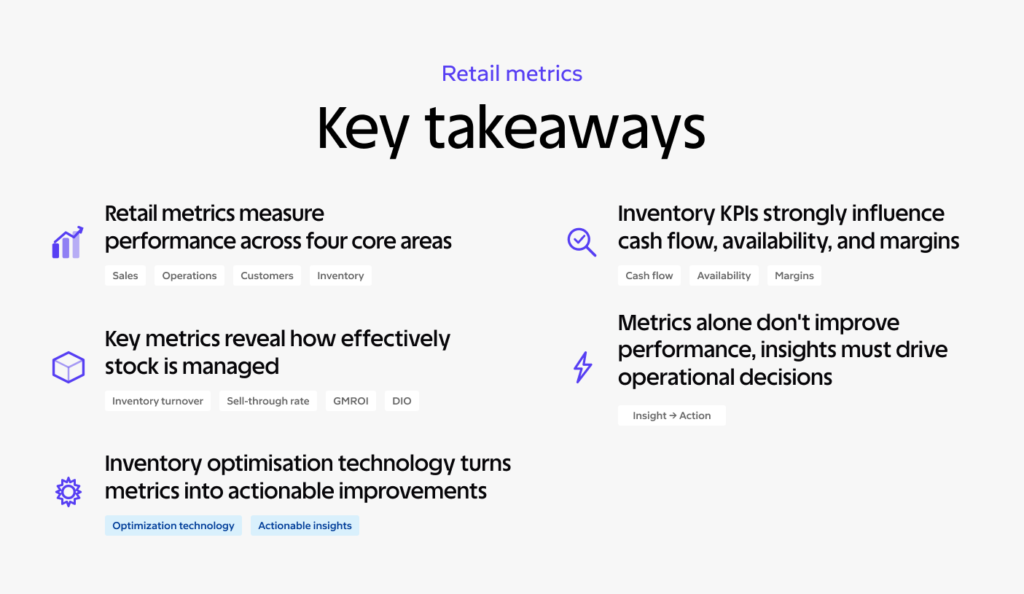
Retail metrics provide the foundation for data-driven retail operations. While retailers track many indicators, inventory metrics often have the greatest impact on profitability and operational efficiency.
Key insights include:
- Retail metrics measure performance across sales, operations, customers, and inventory
- Inventory KPIs strongly influence cash flow, availability, and margins
- Metrics such as inventory turnover, sell-through rate, GMROI, and DIO reveal how effectively stock is managed
- Metrics alone do not improve performance. Businesses must translate insights into operational decisions
- Inventory optimisation technology helps retailers turn performance metrics into actionable improvements
Retailers that consistently monitor and optimise their metrics gain stronger control over their operations, improve forecasting accuracy, and build more resilient supply chains.
FAQ
What are retail metrics?
Retail metrics are measurable indicators used to track performance in areas such as sales, customer behaviour, store operations, and inventory management.
What are the most important retail performance metrics?
Important retail metrics include revenue growth, conversion rate, inventory turnover, sell-through rate, and gross margin return on inventory investment.
Why are inventory metrics important in retail?
Inventory metrics help retailers optimise stock levels, reduce excess inventory, prevent stockouts, and improve profitability.
How do retail store operations efficiency metrics improve performance?
Operational metrics such as sales per square foot and labour productivity help retailers optimise store layouts, staffing levels, and store operations.
Which retail metrics directly impact profitability?
Metrics such as GMROI, inventory turnover, sell-through rate, and stock-to-sales ratio directly affect profitability because they determine how efficiently inventory investments generate revenue.