

Choosing the right products, in the right quantities, in the right locations is one of the most important decisions a retailer makes. Assortment planning sits at the centre of this process. It determines which products are available to customers, how inventory is allocated across stores or channels, and how effectively retailers convert inventory into sales.
Without structured assortment planning, retailers risk carrying too many slow-moving products, missing demand for popular items, and tying up working capital in the wrong inventory.
In this guide, we explain what assortment planning in retail means, how the process works, and how modern planning software helps retailers optimise product selection, inventory allocation, and profitability.
What is assortment planning in retail?
Assortment planning in retail is the process of selecting the right mix of products to sell, determining how many units to stock, and deciding where those products should be available across stores, regions, or online channels.
In practical terms, assortment planning answers questions such as:
- Which products should we carry?
- How many variations (sizes, colours, styles) should we offer?
- How should inventory be distributed across stores or regions?
- When should products be introduced or phased out?
Retailers make these decisions based on factors such as historical sales, customer preferences, market trends, pricing, and supply chain constraints.
It is also closely related to assortment strategy, which focuses on how retailers structure product variety to appeal to their target market and maximise sales performance. Investopedia explains how assortment strategies influence customer perception and purchasing behaviour.
It is important to distinguish assortment planning from related processes:
- Merchandise planning focuses on financial planning and budgeting for product categories.
- Demand planning forecasts how much customers will buy.
- Replenishment planning determines when and how to restock products.
Assortment planning connects these processes by defining which products should exist in the first place.
Example of assortment planning in retail
A fashion retailer planning its autumn collection may analyse previous seasonal sales and customer preferences. Based on this data, planners might decide to:
– Offer 5 jacket styles
– Provide 4 colour variations per style
– Allocate larger inventory volumes to colder regions
This approach ensures stores carry products that match local demand patterns and seasonal trends, improving sell-through rates and reducing excess inventory
Industry definitions often describe assortment planning as determining the variety of products a retailer offers, including variations such as colours and sizes. This concept is explained in more detail in this overview from Indeed.
Why assortment planning matters for retail performance
Retail success depends on selling the right products at the right time. Poor assortment decisions quickly lead to lost sales, excess inventory, and reduced margins.
Structured assortment planning helps retailers improve several key aspects of their operations.
Improve inventory productivity
A well-designed assortment ensures that inventory investment is concentrated on products that actually sell.
Retailers can reduce slow-moving stock and improve metrics such as inventory turnover.
Prevent stockouts and overstocks
When assortments are aligned with demand patterns, retailers avoid two common problems:
- Popular products selling out too quickly
- Unpopular products remaining unsold
Balanced assortments help stabilise inventory levels across the supply chain.
Increase profit margins
Assortment planning allows retailers to prioritise high-margin or high-demand products while reducing low-performing SKUs.
This improves profitability and reduces markdowns.
Support omnichannel retail
Modern retail operates across stores, e-commerce platforms, and marketplaces. Assortment planning ensures the right products appear in the right channels.
For example:
- Stores may focus on local preferences
- Online channels can offer broader assortments
- Flagship locations may carry deeper inventory
Key components of an effective assortment strategy
Retail assortments are not random collections of products. They are structured according to several strategic principles.
Product breadth vs depth
Assortment breadth refers to how many product categories a retailer offers. Depth refers to how many variations exist within each category.
Examples:
- Wide assortment: Many product categories but limited variations.
- Deep assortment: Fewer categories but many options within each.
Retailers must balance both depending on their strategy.
Localisation
Customer preferences vary by region. Localised assortments allow retailers to tailor product selections to specific markets.
For example:
- Cold-weather clothing in northern regions
- Seasonal products aligned with local climate or events
Seasonality
Retail assortments change throughout the year to match seasonal demand patterns.
Examples include:
- Fashion collections
- Holiday merchandise
- Seasonal food or outdoor products
Customer segmentation
Different customer groups have different needs and price expectations.
Retailers often design assortments to serve:
- Budget customers
- Premium customers
- Niche markets
SKU rationalisation
Too many products increase operational complexity. Retailers regularly analyse SKU performance and remove underperforming items. This improves inventory efficiency and simplifies planning.
Store clustering
Stores with similar characteristics are grouped into clusters. Retailers then design assortments for each cluster rather than each store individually. This approach simplifies planning while still enabling localisation.
Retail assortment planning process
Retail assortment planning typically follows a structured workflow that combines data analysis with strategic decision-making.
1. Collect and analyse data
The process starts with analysing relevant data such as:
- historical sales
- inventory levels
- customer preferences
- supplier lead times
- seasonal demand patterns
Data quality is critical. Inaccurate data can lead to incorrect assortment decisions.
2. Forecast demand
Next, retailers forecast future demand using historical data and predictive models.
Forecasts help planners estimate how many units will sell across different products and locations.
3. Select and optimise SKUs
Retailers evaluate which products should remain in the assortment and which should be removed or added.
Common evaluation criteria include:
- sales performance
- margins
- customer demand
- product lifecycle stage
4. Allocate inventory by location or channel
Once products are selected, retailers determine where inventory should be distributed.
This may include:
- store-specific allocations
- regional distribution centres
- e-commerce channels
Allocation decisions aim to place inventory where demand is highest.
5. Execute and merchandise
At this stage, the assortment plan becomes operational.
Retail teams:
- order products
- distribute inventory
- arrange merchandise in stores
- publish product listings online
6. Monitor and adjust continuously
Assortment planning is not a one-time activity.
Retailers continuously track performance metrics such as:
- sell-through rates
- inventory turnover
- inventory days on hand
These insights help refine future assortment decisions.
Types of retail assortment strategies
Retailers use several assortment strategies depending on their market position and customer expectations.
| Assortment strategy | Description | Typical use case / example |
| Wide assortment | Offers many product categories with limited variations in each category | Supermarkets and large general retailers |
| Deep assortment | Offers many variations within a single product category | Specialist retailers, e.g. sports stores with many shoe options |
| Localised assortment | Tailors product selection to regional demand and customer preferences | Retail chains operating across multiple regions |
| Seasonal assortment | Adjusts product range throughout the year based on seasonal demand | Holiday items, seasonal fashion collections |
| Mass-market assortment | Offers a broad range of products aimed at a wide customer base | General retailers targeting large, diverse audiences |
How assortment planning connects to retail replenishment
Assortment planning and replenishment are closely linked.
Assortment planning defines which products should be available. Replenishment ensures those products remain in stock.
The operational flow typically follows this sequence:
Assortment → Demand → Replenishment → Availability → Sales
If assortment planning is incorrect, replenishment processes cannot fix the underlying problem.
For example:
- If the wrong products are selected, replenishment will simply keep ordering unwanted inventory.
- If demand forecasts are inaccurate, replenishment may cause stockouts or excess stock.
Effective retailers integrate assortment planning with replenishment strategies such as reorder points and safety stock policies.
How assortment planning software improves decision-making
Many retailers still rely on spreadsheets to plan assortments. While spreadsheets work for small datasets, they struggle with large product catalogues and multiple store locations.
Assortment planning software provides several advantages.
Real-time inventory visibility
Retailers gain visibility into stock levels across all stores, warehouses, and sales channels.
AI-driven forecasting
Modern planning tools use predictive analytics to improve forecast accuracy and detect demand shifts.
Automated replenishment alignment
Software ensures that replenishment decisions align with assortment strategies.
Scenario planning and simulation
Retailers can test different assortment scenarios before committing to them.
Example:
- adding a new product category
- adjusting assortment depth
- testing regional variations
Store-level optimisation
Software helps retailers allocate products more precisely based on local demand patterns.
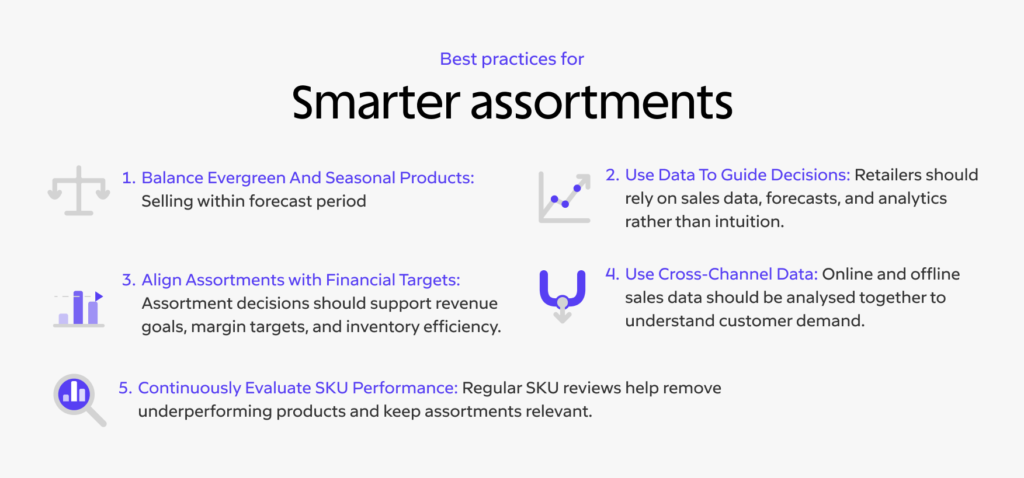
Best practices for optimising retail assortments
Retailers can improve assortment performance by following several practical guidelines.
| Best practice | Description |
|---|---|
| Balance evergreen and seasonal products | Combine stable core products with seasonal or trend-driven items |
| Use data to guide decisions | Base decisions on sales data, forecasts, and analytics rather than intuition |
| Align assortments with financial targets | Ensure assortment decisions support revenue, margins, and inventory efficiency |
| Use cross-channel data | Analyse online and offline sales data together to understand demand |
| Continuously evaluate SKU performance | Regularly review SKUs to remove underperforming products and stay relevant |
Common assortment planning challenges (and how to solve them)
Even experienced retailers face difficulties when managing assortments.
| Challenge | Description | Solution |
|---|---|---|
| Too many SKUs | Large assortments increase operational complexity and risk | Perform regular SKU rationalisation |
| Demand uncertainty | Changing customer preferences make forecasting difficult | Combine forecasting models with real-time sales data |
| Supply chain variability | Supplier delays or disruptions affect product availability | Improve supplier visibility and lead-time management |
| Manual planning limitations | Spreadsheets are slow and prone to errors at scale | Adopt integrated planning software |
How AGR helps retailers optimise assortment planning
Effective assortment planning requires accurate data, reliable forecasting, and integrated supply chain planning.
AGR helps retailers:
- analyse product performance across stores and channels
- forecast demand using advanced analytics
- optimise SKU selection and inventory allocation
- align assortment planning with automated replenishment
By combining forecasting, replenishment, and inventory optimisation in one platform, AGR enables retailers to make smarter assortment decisions while reducing stockouts and excess inventory.
If you want to see how data-driven planning can transform your retail operations, book a demo with AGR today.
FAQ
What is assortment planning in retail?
Assortment planning is the process of selecting which products a retailer should sell, how many variations to offer, and how inventory should be allocated across stores or channels.
What is the assortment planning process?
The process typically includes analysing sales data, forecasting demand, selecting products, allocating inventory by location, executing the plan, and monitoring performance.
Why is assortment planning important?
Assortment planning helps retailers offer the right products to customers while reducing excess inventory, preventing stockouts, and improving profitability.
What does assortment planning software do?
Assortment planning software helps retailers analyse product performance, forecast demand, optimise SKU selection, and align inventory planning with replenishment strategies.