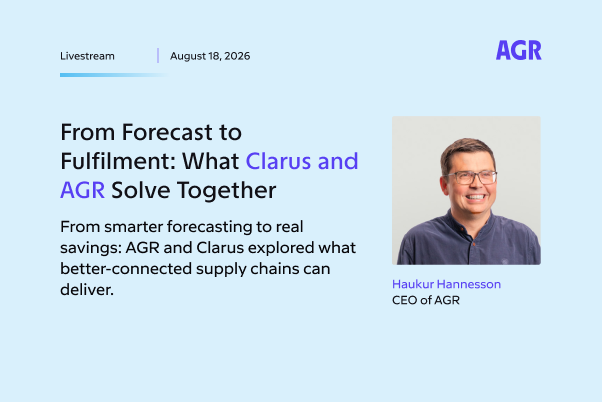

AGR CEO Haukur Hannesson recently joined Clarus CEO Dan Walsh for a Clarity in Conversation livestream exploring the journey from forecast to fulfilment and how better data, AI and connected systems are changing supply chain management.
The discussion looked at some of the gaps that still exist between forecasting, purchasing and warehouse operations, alongside the rapid development of AI in supply chain planning and what it means for the people making supply chain decisions.
Topics covered included:
- Connecting forecasting, purchasing and warehouse operations
- Using data to balance availability with inventory investment
- The growing role of AI in day-to-day supply chain decisions
- Using AI to forecast demand for new products
- How AI assistants are moving from answering questions to working with live business data
- The potential of Model Context Protocol (MCP) to connect people, AI and supply chain systems
- Building a tangible business case for better inventory planning
Breaking down supply chain silos
One of the key themes was that supply chain problems don’t always come from poor planning within an individual team. Often, it’s the gaps between teams that create the problem.
Haukur shared examples of businesses where purchasing teams have only become aware of an upcoming promotion when they see it advertised. By that point, supplier lead times can make it impossible to get the necessary stock into the warehouse in time.
The same issue can happen further downstream. Purchasing may optimise replenishment based on demand, but the warehouse might not have the capacity to receive all those orders at once.
Better systems and data can help connect those decisions, but Haukur stressed that technology isn’t the whole answer. Clear communication and processes between departments matter too.
AI still needs the human touch
AI in supply chain planning naturally became a major part of the conversation, particularly given how much has changed since Haukur last joined the Clarus team six months earlier.
AGR’s AI assistant, Finn, has already moved from helping users find general information and documentation to working with their own inventory data. Users can now ask questions about their stock in natural language, such as whether they have enough of a particular product or sufficient inventory for an upcoming seasonal period.
AGR is also applying AI directly to forecasting. Haukur discussed the challenge of predicting demand for new products, where there is no sales history for traditional statistical models to work from. AI can use the characteristics of a new item and patterns from similar products to create an initial forecast, which then adapts as real sales data becomes available.
But as AI takes on more of the analysis, Haukur believes human expertise remains essential.
“When this is done right, you use the data, use the AI to calculate the need and calculate when to react,” he explained. “But then you always need a human touch on top of it.”
People still bring information and context that the calculations don’t necessarily capture – from customer conversations and upcoming activity to knowledge of what’s happening elsewhere in the business.
The opportunity, then, isn’t to remove people from supply chain planning. It’s to automate more of the heavy lifting and give planners better information, so they can spend more time applying their expertise where it makes the biggest difference.
Making the value tangible
The conversation also came back to the business case for better inventory planning.
Haukur grouped the potential return into three areas: automation, inventory holding costs and service levels. He gave the example of a business holding £10 million in inventory. If improved planning could reduce that stock by 20% while maintaining the same service level, the business would release £2 million from inventory.
Using a 25% annual holding-cost rule of thumb, that reduction represents a potential £500,000 annual saving – before considering the value of staff time saved through automation or the impact better availability can have on sales and customer retention.
It’s a useful reminder of the bigger theme behind the discussion. New technology, AI and greater connectivity are changing how supply chains operate, but the objective remains familiar: have the right stock available when it’s needed, keep inventory investment under control, and give people the information they need to make better decisions.