


Supply chain disruptions are no longer edge cases. Geopolitical tension, extreme weather, supplier insolvencies, and sudden demand shifts regularly interrupt the flow of goods, pushing many organisations to rethink how exposed they are to single points of failure. For many organisations, reliance on a single supplier has proven to be a structural weakness. Dual sourcing is one of the most practical ways to address that risk without overhauling the entire supply chain.
This article explains what dual sourcing is, how it works in practice, its benefits and risks, and when it makes sense for your business. It also outlines proven strategies, real-world examples, and practical tips to help you decide whether dual sourcing should be part of your resilience playbook.
Dual sourcing: What is it?
Dual sourcing is a supply chain strategy where a business sources the same product, component, or raw material from two different suppliers. The objective is to reduce dependency on a single source rather than to split volume evenly.
In practice, dual sourcing can apply across different parts of the supply chain, including:
- Raw materials and components
- Finished goods
- Packaging and consumables
- Critical spare parts
By qualifying more than one supplier for the same item, businesses build in redundancy. If one supplier becomes constrained, delayed, or unavailable, the second supplier helps maintain continuity of supply and reduces the operational impact of disruption.
This thinking became more prominent during the COVID-19 pandemic, when many organisations were exposed to the risks of single sourcing. According to McKinsey, 81 percent of supply chain leaders reported implementing dual sourcing by 2022, up from 55 percent in 2020. Their research also shows that most supply chain leaders expect multi-sourcing strategies to remain central as they rebalance cost efficiency with resilience.
Dual sourcing vs single sourcing
Single sourcing relies on one supplier for a given item. It often delivers lower unit costs, simpler processes, and stronger supplier relationships. The trade-off is exposure to disruption.
Dual sourcing introduces an additional supplier to reduce that exposure. While it adds some complexity, it significantly lowers the operational and financial risk associated with supplier failure, capacity shortages, or regional disruption.
How does dual sourcing work?
In a dual sourcing model, a business qualifies two suppliers that can deliver the same specification at acceptable quality and lead times. Orders are allocated between them based on predefined rules such as cost, capacity, service level, or risk profile.
Common approaches include:
- Primary and secondary supplier, where most volume goes to one supplier and a smaller share keeps the second supplier active
- Split sourcing, where volume is intentionally shared
- Contingency sourcing, where the second supplier is activated only when disruption occurs
Effective dual sourcing relies on clear supplier data, transparent performance metrics, and well-defined switching rules. In mature setups, switching between suppliers can be automated based on lead time changes, service levels, or availability signals.
Benefits of dual sourcing
Dual sourcing is not just a risk mitigation tactic. When executed well, it delivers operational and commercial advantages.
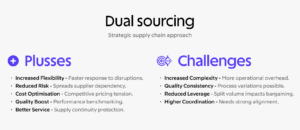
Increased flexibility
With more than one qualified supplier, businesses can respond faster to disruptions, demand spikes, or lead time changes. Flexibility becomes a built-in capability rather than a reactive scramble.
Reduced dependency on a single supplier
Supplier concentration risk is one of the most common causes of supply chain failure. Dual sourcing spreads that risk and reduces the impact of supplier-specific issues such as strikes, financial distress, or capacity constraints.
Cost optimisation
Maintaining more than one supplier introduces competitive tension. This can support better pricing, improved terms, and more balanced negotiations over time, especially when total cost of ownership is considered.
Improved quality and performance
Suppliers that know they are not the sole source are often more motivated to maintain quality, delivery reliability, and service levels. Performance benchmarking becomes easier when two suppliers deliver comparable products.
Stronger customer service
Continuity of supply directly affects service levels. Dual sourcing helps protect availability, reduce stockouts, and maintain customer trust during periods of disruption.
Risks and challenges of dual sourcing
While dual sourcing is often presented as a resilience silver bullet, it introduces trade-offs that must be actively managed.
Despite its advantages, dual sourcing is not without trade-offs. Understanding the risks is key to deciding when it makes sense.
Increased complexity
Managing multiple suppliers adds operational overhead. Planning, procurement, quality assurance, and data management all become more complex.
Quality consistency
Even with identical specifications, suppliers may differ in processes or tolerances. Without strong quality governance, variation can creep in.
Reduced supplier leverage
Splitting volume can reduce bargaining power with individual suppliers, particularly if total volumes are modest.
Higher coordination requirements
Dual sourcing requires better master data, clearer processes, and stronger cross-functional alignment. Without these foundations, complexity can outweigh benefits.
Dual sourcing strategies and best practices
Dual sourcing succeeds only when it is supported by clear data, governance, and system integration. Dual sourcing delivers the most value when it is implemented deliberately rather than reactively. Successful organisations treat it as an ongoing sourcing discipline, supported by data, governance, and regular review.
The following strategies and best practices help ensure dual sourcing improves resilience without introducing unnecessary complexity.
Diversify suppliers beyond simple duplication
True resilience comes from meaningful diversification. Using two suppliers located in the same region, exposed to the same logistics routes or regulatory environment, limits the protective effect of dual sourcing.
When possible, suppliers should differ across dimensions such as geography, production footprint, and upstream dependencies. This reduces the likelihood that a single disruption affects both sources simultaneously.
Perform structured supplier risk assessments
Dual sourcing decisions should be grounded in risk analysis, not just price comparison. Key risk factors to assess include:
- Financial stability and ownership structure
- Capacity flexibility and scalability
- Historical delivery and service performance
- Exposure to geopolitical, regulatory, or climate risk
Regular risk reviews ensure sourcing strategies stay aligned with a changing external environment.
Standardise specifications and processes
The easier it is to shift volume between suppliers, the more effective dual sourcing becomes. Standardised product specifications, packaging requirements, and quality criteria reduce switching friction and minimise disruption during supplier transitions.
Clear documentation and shared standards also simplify onboarding new suppliers when needed.
Balance volume allocation deliberately
Dual sourcing does not require equal order allocation. Many organisations designate a primary supplier for efficiency and cost, while allocating a smaller but consistent share of volume to a secondary supplier.
This approach keeps the secondary supplier operational and familiar with requirements, making it easier to scale up quickly if conditions change.
Consider total cost of ownership, not unit price
Lower unit prices can mask higher downstream costs. Effective dual sourcing decisions account for total cost of ownership, including:
- Lead time variability and buffer stock requirements
- Transport and customs costs
- Minimum order quantities and batch constraints
- Working capital impact
A holistic view often reveals that apparent cost differences narrow significantly when risk and volatility are considered.
Monitor supplier performance continuously
Dual sourcing works best when supplier performance is transparent and measurable. Tracking metrics such as service level, lead time reliability, quality issues, and responsiveness enables objective comparisons and informed reallocation decisions.
Performance reviews should be ongoing rather than event-driven.
Use planning and ERP systems to support execution
Managing multiple suppliers manually increases complexity and error risk. Integrated planning and ERP systems provide visibility into demand, inventory, lead times, and supplier constraints, making dual sourcing operationally manageable.
With the right systems in place, switching between suppliers becomes a controlled decision rather than an emergency response. This mirrors ERP-led recommendations that stress visibility, planning discipline, and supplier data as prerequisites for effective dual sourcing.
When should your business consider dual sourcing?
Dual sourcing is not a universal solution. It tends to make the most sense when:
- Supply disruption would cause significant revenue or service impact
- Components or products have long or volatile lead times
- Demand variability is high
- Supplier concentration risk is material
- Alternatives suppliers exist at acceptable quality levels
For low-risk, low-impact items, single sourcing may remain the more efficient option. The key is segmentation, not blanket application.
Examples of dual sourcing in practice
Many global brands rely on dual sourcing to protect scale and continuity.
- Apple sources components such as chips and displays from multiple suppliers to reduce dependency and increase negotiating power.
- Tesla uses dual and multi-sourcing for critical components to support rapid scaling and mitigate production risk.
- IKEA works with multiple suppliers across regions to balance cost efficiency with supply resilience.
These examples highlight a common theme. Dual sourcing supports growth as much as it supports risk management.
AGR helps businesses manage multiple suppliers with a clear, end-to-end view of demand, inventory, and supply performance. This system-led approach reflects broader ERP best practices, such as those described in NetSuite’s dual sourcing guidance, where visibility and planning coordination are critical to making multi-supplier strategies work at scale. If you want to explore how this works in practice, you can learn more on our supplier and inventory planning pages.
FAQ about dual sourcing
What is the meaning of dual sourcing?
Dual sourcing is a strategy where a business sources the same product or material from two different suppliers to reduce dependency and risk.
What are the benefits of dual sourcing?
Key benefits include improved resilience, greater flexibility, reduced supplier risk, better service continuity, and potential cost optimisation.
What is the difference between single sourcing and dual sourcing?
Single sourcing relies on one supplier, offering simplicity and scale benefits. Dual sourcing adds a second supplier to reduce risk and improve resilience.
What is an example of dual sourcing?
A manufacturer sourcing the same component from one supplier in Europe and another in Asia is a common example of dual sourcing.