


Days Inventory Outstanding (DIO) is a key metric for understanding how efficiently a business moves stock through its supply chain. It measures how many days inventory remains on hand before being sold and provides a clear view of working capital performance, stock health, and operational efficiency.
A well managed DIO strengthens cash flow, reduces holding costs, and creates a more resilient supply chain. This guide explains what DIO means, how to calculate it, what high or low values indicate, and how to improve it with better planning and tools.
What is days inventory outstanding?
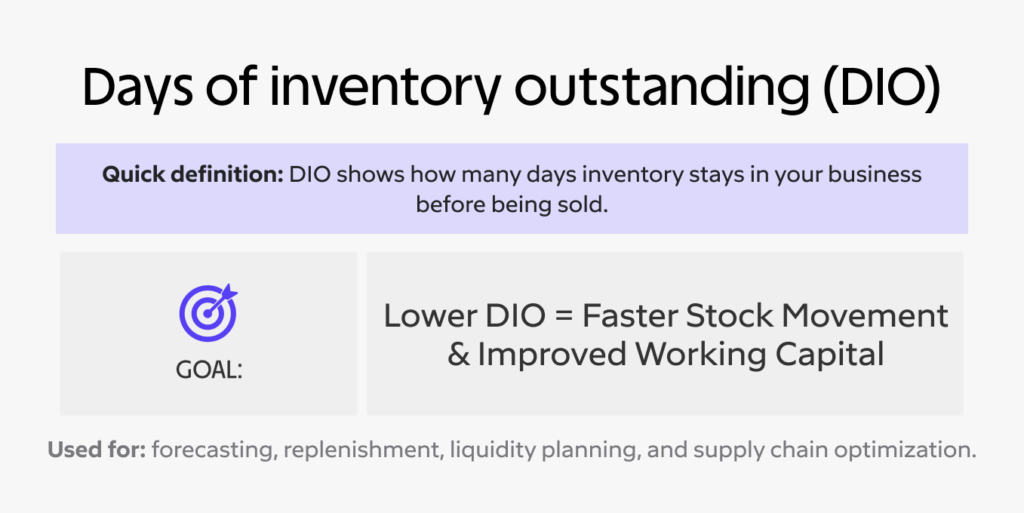
Days Inventory Outstanding measures the average number of days stock remains in storage before it is converted into sales. It shows how quickly a business sells through its inventory and how effectively it balances demand, supply, and replenishment.
A lower DIO usually indicates strong stock rotation, efficient planning, and healthy demand. A higher DIO suggests excess stock, slow moving items, or underlying issues in forecasting, purchasing, or supplier performance.
DIO is closely linked to the inventory turnover ratio, which you can explore further in our inventory turnover ratio guide.
Days inventory outstanding formula
The standard formula for DIO is:
DIO = (Average inventory ÷ Cost of Goods Sold) × Number of days
Where:
- Average inventory is calculated as (Opening inventory + closing inventory) ÷ 2
- Cost of Goods Sold (COGS) is used because it reflects the actual cost of stock consumed
- Number of days typically refers to 365 for a yearly measure or the number of days in the specific reporting period
This formula is widely used across industries and aligns with definitions from sources such as the Corporate Finance Institute and Investopedia.
Practical example of DIO
A wholesaler wants to calculate its DIO for the previous year.
- Opening inventory: £400,000
- Closing inventory: £600,000
- Cost of Goods Sold: £3,000,000
- Days in period: 365
Step 1: Calculate average inventory
(£400,000 + £600,000) ÷ 2 = £500,000
Step 2: Apply the DIO formula
(£500,000 ÷ £3,000,000) × 365 = 60.8 days
This means the business holds inventory for roughly 61 days before selling it.
What a high or low DIO means
High DIO
A high DIO signals that stock is sitting for longer than expected. This often indicates:
- Slow moving SKUs
- Overstocking
- Inefficient replenishment
- Longer than expected lead times
- Forecasting inaccuracies
High DIO ties up capital, increases storage costs, and raises the risk of obsolete stock.
Low DIO
A low DIO indicates fast stock movement. This is usually positive, but very low DIO may also mean:
- Insufficient safety stock
- Stockouts caused by poor availability
- Excessive reliance on reactive ordering
You can learn more about preventing stockouts in our article on how to avoid stockouts.
Days inventory outstanding vs. inventory turnover ratio
Both metrics measure how efficiently stock moves, but present the information differently:
- Inventory turnover shows how many times stock cycles through the business.
- DIO converts that cycle into days, making it easier to compare across time periods.
If turnover increases, DIO falls. If turnover slows, DIO rises. For a deeper explanation, see our inventory turnover ratio guide.
How DIO supports forecasting and supply chain planning
DIO is a practical planning input for:
- Demand forecasting, helping teams understand historic consumption rates
- Safety stock modelling, indicating how much buffer is needed
- Replenishment planning, particularly reorder points and order frequency
- Working capital management, showing how quickly the business converts stock into cash
- SKU level optimisation, helping to identify slow movers and excess stock
To strengthen your forecasting foundations, explore our guides on demand forecasting and SKU management.
Benchmarking DIO across industries
Different industries operate with very different DIO norms. This is essential when comparing performance.
| Industry | Typical DIO | Notes |
|---|---|---|
| Fashion and apparel | Low | Rapid product churn and short seasonal cycles drive lower DIO. |
| Wholesale distribution | Moderate | Stock is held to maintain service levels and availability. |
| Manufacturing | High | Batch production, long lead times, and multi-stage processes increase DIO. |
| Automotive and industrial sectors | High | Complex components and extended supplier cycles often lead to higher DIO. |
Comparisons should always be made within the same sector and business model to ensure accuracy.
How to improve days inventory outstanding
1. Improve forecast accuracy
Accurate forecasting ensures stock levels match real demand. Strong SKU level forecasting helps identify which products are driving sales and which are slow movers. Read more in our guides on SKU management and demand forecasting.
2. Strengthen replenishment rules
Review reorder points, automate purchasing, and reduce manual decision making. Our guide to stock replenishment explains how consistent rules support lower DIO.
3. Reduce overstock and slow moving items
High DIO often highlights SKUs that no longer justify their space. Use data to identify excess, promote ageing stock, or refine your assortment.
4. Collaborate closely with suppliers
Lower and more reliable lead times reduce the need for buffer stock and minimise DIO volatility. Supplier scorecards and regular reviews support stronger performance.
5. Improve product lifecycles
Structured lifecycle management helps businesses retire ageing products earlier and prevent the build-up of obsolete or low-demand items.
How AGR supports better control of DIO
AGR helps businesses improve their DIO through:
- AI driven demand forecasting for accurate planning
- Automated replenishment workflows to reduce manual errors
- Real time stock visibility across locations, SKUs, and suppliers
- Analytics dashboards for turnover, DIO, stock health, and service performance
These tools work together to strengthen inventory flow, reduce working capital, and improve profitability.
FAQ about days inventory outstanding
What is a good DIO number?
A good DIO varies by industry. It is most useful to compare against your own historical performance and similar businesses.
Is DIO the same as days on hand?
Not exactly. Some businesses use days on hand to describe forecast based inventory coverage. DIO is always historical and based on COGS.
Should small businesses track DIO?
Yes. DIO is simple to calculate and provides valuable insights into stock health and cash flow.
How often should DIO be reviewed?
Most companies review DIO monthly or quarterly. Seasonal businesses may review it more frequently.
How is DIO different from DSO?
DIO measures how long inventory is held before being sold. DSO measures how long it takes to collect payment from customers.