

At the end of a busy quarter, finance needs an inventory valuation. Operations cannot afford to stop trading for a full stock count, and store managers are already stretched. This is exactly where the retail inventory method becomes useful.
The retail inventory method gives retailers a fast way to estimate ending inventory value without conducting a physical inventory count. It has been widely used across retail for decades because it offers a practical balance between speed and accuracy.
In this guide, we explain how the retail inventory method works, the formula behind it, where it performs well, and where modern inventory systems provide a more accurate alternative. We also explore how today’s retailers combine inventory accounting with forecasting and replenishment tools to improve visibility across stores and channels.
What is the retail inventory method?
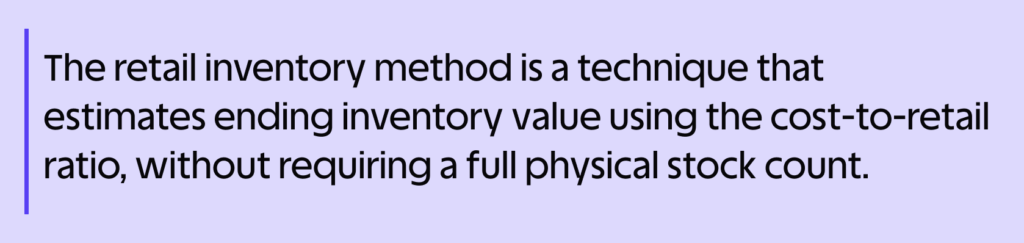
The retail inventory method, sometimes referred to as the retail method of accounting, is an inventory accounting technique used to estimate the value of ending inventory based on the relationship between the cost of goods and their retail selling price.
Instead of counting every item physically, retailers estimate inventory by applying a cost-to-retail ratio to unsold stock.
The method is particularly useful for retailers that:
- Operate multiple stores
- Need rapid inventory estimates
- Sell large volumes of products
- Work with relatively consistent markups
- Do not perform daily physical stock counts
- Operate under periodic inventory systems
Retailers often use the retail inventory method during interim accounting periods or when preparing financial statements quickly.
The goal is not to achieve perfect inventory precision. The goal is to produce a reliable estimate efficiently.
Retail inventory method formula: key components explained
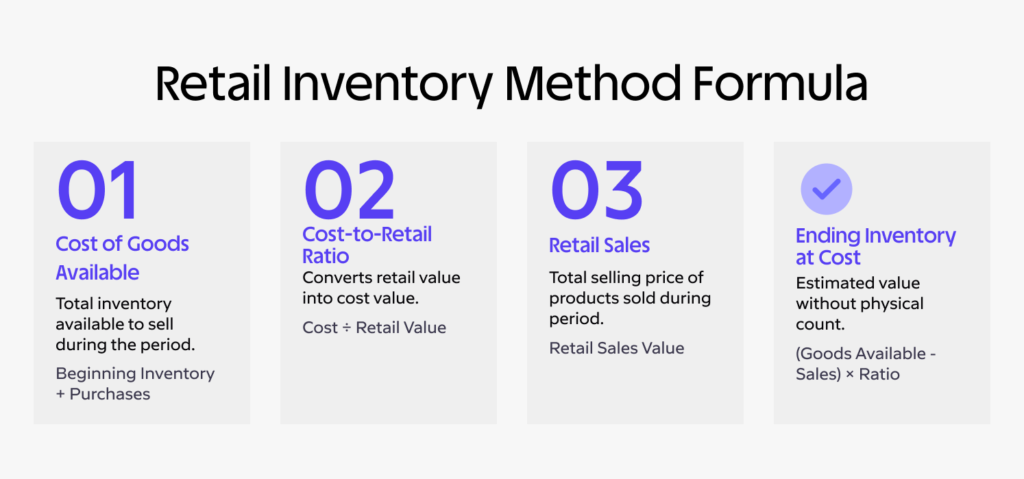
The retail inventory method relies on three main inputs:
- Cost of goods available for sale
- Cost-to-retail ratio
- Retail sales during the period
Cost of goods available for sale
This represents the total inventory available to sell during the accounting period.
The formula is:
Beginning inventory + purchases = cost of goods available for sale
For example:
- Beginning inventory: £200,000
- Additional purchases: £80,000
Cost of goods available for sale = £280,000
Cost-to-retail ratio
This ratio converts retail value into cost value.
The formula is:
Cost of goods available for sale ÷ retail value of goods available for sale
Example:
- Inventory cost value: £280,000
- Inventory retail value: £400,000
Cost-to-retail ratio = 70%
This means inventory costs represent 70% of retail selling prices.
Retail sales
Retail sales reflect the total selling price of products sold during the period.
Example:
- Retail sales during the quarter: £250,000
This figure is used to estimate how much inventory remains unsold.
How to calculate ending inventory: Step-by-step example
Let’s walk through a practical example for a mid-sized retailer.
Step 1: Calculate goods available for sale
| Item | Amount |
| Beginning inventory at cost | £120,000 |
| Purchases during period | £180,000 |
| Total goods available for sale (cost) | £300,000 |
Now calculate the retail value:
| Item | Amount |
| Retail value of beginning inventory | £170,000 |
| Retail value of purchases | £260,000 |
| Total retail value | £430,000 |
Step 2: Calculate the cost-to-retail ratio
Formula:
Cost ÷ Retail
£300,000 ÷ £430,000 = 69.8%
The retailer’s cost-to-retail ratio is approximately 70%.
Step 3: Subtract retail sales
Assume retail sales during the period equal £290,000.
Remaining inventory at retail value:
£430,000 − £290,000 = £140,000
Step 4: Convert remaining inventory to cost
Apply the cost-to-retail ratio:
£140,000 × 69.8% = £97,720
Estimated ending inventory = £97,720
This provides a quick estimate without requiring a physical count.
When should you use the retail inventory method?
The retail inventory method works best in specific operational environments.
Consistent markup structures
The method performs well when products have similar profit margins and stable pricing structures.
Retailers with highly variable markups may produce distorted estimates.
Multi-store retail operations
Retailers operating multiple locations often need fast inventory visibility between physical stock counts.
The retail inventory method provides a practical estimation shortcut across large store networks.
Period-end reporting
Finance teams frequently use the method during monthly or quarterly reporting periods when time constraints make physical counting impractical.
Businesses without perpetual inventory systems
Some smaller retailers still rely on periodic inventory tracking rather than real-time systems.
In these cases, the retail inventory method helps bridge visibility gaps between stock counts.
Retail inventory method advantages and disadvantages
The retail inventory method remains popular because it offers a fast and practical way to estimate inventory value without conducting a full physical stock count. For retailers operating multiple locations or working to tight reporting deadlines, this can save significant time and resources.
However, like any inventory valuation approach, it comes with trade-offs. While the method can provide a useful estimate for accounting purposes, it is not designed to deliver the level of accuracy, visibility, or responsiveness that modern inventory planning requires.
| Advantages | Why it matters |
|---|---|
| Fast and efficient | Retailers can estimate inventory quickly without disrupting day-to-day operations or closing stores for stock counts. |
| Lower resource requirements | The method reduces the labour, time, and administrative effort associated with full physical inventory counts. |
| Useful for interim reporting | Finance teams can generate timely inventory estimates for monthly, quarterly, or year-end reporting periods. |
| GAAP compliant | The retail inventory method is accepted under Generally Accepted Accounting Principles (GAAP) when applied correctly and consistently. |
| Accessible for growing retailers | Smaller businesses can use the method as a practical inventory valuation approach before investing in more advanced inventory management systems. |
| Disadvantages | Why it matters |
|---|---|
| Assumes consistent markups | The method becomes less accurate when products have significantly different margins or pricing structures. |
| Does not account for shrinkage accurately | Theft, damage, spoilage, and administrative errors can create discrepancies between estimated and actual inventory levels. |
| Relies on historical ratios | Retail conditions change constantly. Historical cost-to-retail ratios may not reflect current pricing, promotions, or market conditions. |
| Limited operational visibility | The method estimates inventory value but does not provide real-time SKU-level insights or inventory performance data. |
| Less effective for modern omnichannel retail | Retailers selling across stores, ecommerce channels, marketplaces, and distribution centres often require more dynamic inventory planning and replenishment capabilities. |
The retail inventory method is an effective accounting shortcut when speed is more important than precision. However, retailers seeking accurate inventory visibility, demand forecasting, and automated replenishment typically need modern inventory management and planning systems that go beyond estimation.
Retail inventory method vs. other inventory valuation methods
Retailers often compare the retail inventory method with other valuation approaches such as FIFO, LIFO, and weighted average costing.
| Method | Primary purpose | Strengths | Limitations |
| Retail inventory method | Inventory estimation | Fast and practical | Less precise |
| FIFO | Cost flow valuation | Reflects recent inventory movement | More complex |
| LIFO | Cost flow valuation | Can reduce taxable income in inflationary periods | Not accepted under IFRS |
| Weighted average cost | Cost averaging | Simple for stable inventory | Less responsive to market changes |
Retailers using FIFO often achieve stronger stock rotation and freshness management. You can learn more in our guide to FIFO inventory management.
Many retailers also combine valuation methods with broader retail inventory management strategies and performance tracking.
Beyond estimation: How modern retailers manage inventory accurately
The retail inventory method still serves a purpose. But modern retail operations increasingly require deeper visibility and more accurate planning capabilities.
Today’s retailers manage:
- Omnichannel demand
- Volatile customer behaviour
- Supplier uncertainty
- Rapid replenishment cycles
- Large SKU portfolios
An estimation method alone cannot support these challenges.
Perpetual inventory systems
Modern perpetual inventory systems update stock levels continuously based on:
- Sales transactions
- Purchase orders
- Returns
- Warehouse movements
- Transfers between locations
This creates far more accurate inventory visibility.
Demand forecasting
Retailers increasingly use forecasting systems to predict future demand patterns instead of relying only on historical accounting estimates.
Forecasting improves:
- Inventory allocation
- Replenishment timing
- Safety stock planning
- Promotional readiness
Automated replenishment
Automated replenishment tools help retailers order the right inventory at the right time based on demand signals, lead times, and inventory policies.
This reduces:
- Stockouts
- Excess inventory
- Manual ordering workload
- Forecasting delays
Inventory planning software
Modern inventory planning platforms combine:
- Forecasting
- Replenishment
- Inventory optimisation
- Supplier planning
- Analytics
- KPI monitoring
This creates a much more proactive retail inventory strategy than estimation methods alone can provide.
Retailers also increasingly track advanced retail metrics and KPIs to understand how inventory performance affects profitability, cash flow, and service levels.
How AGR supports accurate retail inventory planning
The retail inventory method helps estimate inventory value. AGR helps retailers optimise inventory decisions continuously across stores, warehouses, and sales channels.
Our platform supports retailers with:
- AI-driven demand forecasting
- Automated replenishment
- Inventory optimisation
- Multi-location inventory visibility
- Supplier planning
- Exception-based workflows
- Retail performance analytics
Rather than relying solely on retrospective inventory estimation, retailers gain forward-looking visibility into future demand and inventory risks.
This helps teams:
- Reduce stockouts
- Improve inventory turnover
- Lower excess inventory
- Free working capital
- Improve customer service levels
Modern retailers need more than inventory valuation. They need inventory intelligence.
Key takeaways
The retail inventory method remains a practical inventory estimation tool for many retailers.
It works best when:
- Markups are relatively consistent
- Rapid estimates are needed
- Physical counts are impractical
- Inventory systems are less mature
However, the method also has limitations. It cannot deliver real-time visibility, dynamic forecasting, or SKU-level planning accuracy.
Modern retailers increasingly combine accounting methods with advanced forecasting, replenishment, and inventory optimisation platforms to improve operational performance across the supply chain.
FAQ
What is the retail inventory method?
The retail inventory method is an accounting technique used to estimate ending inventory value based on the relationship between inventory cost and retail selling price.
How do you calculate ending inventory using the retail inventory method?
First calculate the cost-to-retail ratio, then subtract retail sales from the retail value of goods available for sale, and finally apply the ratio to estimate ending inventory at cost.
What are the disadvantages of the retail inventory method?
The method assumes consistent markups, may not account for shrinkage accurately, and provides estimates rather than precise inventory visibility.
When should you use the retail inventory method?
The method works best for retailers needing fast inventory estimates during accounting periods or across multiple locations with stable markup structures.
Is the retail inventory method GAAP approved?
Yes. The retail inventory method is accepted under GAAP when used appropriately and consistently.