

Service levels sit at the centre of supply chain performance. They show how reliably a business can meet customer demand, deliver orders on time and maintain the right stock at the right moment. Strong service levels support growth, reduce operational stress and build trust with customers. This guide explains how supply chain service levels work, how they are measured and how they influence inventory decisions.
What is a service level in supply chain management?
A service level is the percentage of demand a business can fulfil without delay. It is a direct measure of availability and reliability. When service levels are high, customers receive products when they need them. When service levels drop, stockouts, backorders and lost revenue follow.
In practical terms, service level reflects:
- How often an item is in stock
- How reliably orders are fulfilled
- How well inventory aligns with actual demand
Service levels help teams assess whether their planning, forecasting, replenishment and supplier performance are working effectively.
Example of a service level in practice
Imagine a wholesaler supplying cleaning products to retailers. In a typical month, customers place 1,000 order lines. If the wholesaler can fulfil 930 of those lines immediately from available stock, their service level is 93 percent. The remaining 70 lines become backorders or lost sales, highlighting where planning or supplier reliability may need improvement.
What is a service level agreement?
It is important not to confuse service levels with a service level agreement. A service level agreement (SLA) is a formal commitment between two parties, usually a business and a supplier or logistics partner. It sets expectations such as delivery accuracy, lead time consistency or order completeness. These agreements help manage supplier reliability, but they are not the same as a service level used in inventory planning.
A service level measures how well your internal supply chain meets customer demand. An SLA defines how well an external partner must perform. Both influence availability, yet they operate in different parts of the supply chain.
Why service level matters in supply chain performance
Service level is more than a KPI. It influences every stage of the supply chain. High availability keeps customers loyal, improves conversion rates and strengthens long term revenue. It also reduces firefighting across operations.
A reliable service level leads to:
- Minimises stockouts
- Improves delivery performance
- Strengthens supplier relationships
- Supports predictable demand patterns
- Reduces last minute purchases and emergency logistics
Businesses that measure and optimise service level often see a direct improvement in customer satisfaction and operational efficiency.
How service level is measured
There are several ways to calculate service level depending on the context. The most common approach is:
Service level = (Orders fulfilled in full) ÷ (Total orders placed)
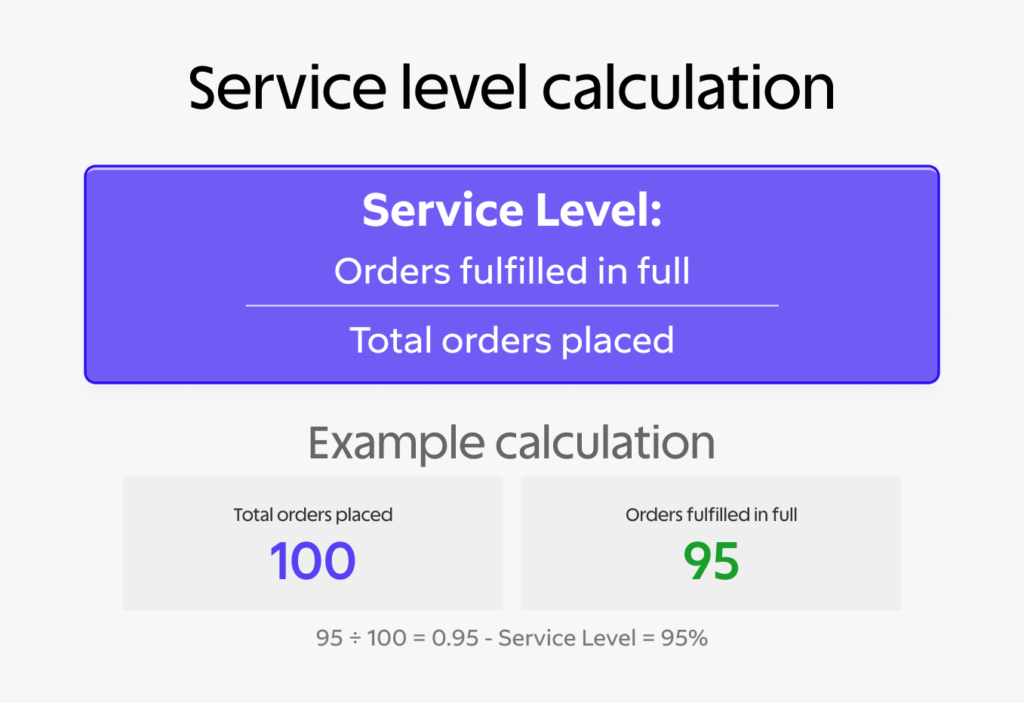
Some businesses calculate service level at SKU level, others at category, location or customer level. More advanced models use demand weighted calculations or incorporate expected stockout risk. The chosen method should match operational complexity and planning maturity.
Safety stock and its connection to service level
Service level plays a central role in determining safety stock. Higher service level targets require additional buffer stock to protect against demand variability or uncertain lead times. Lower targets reduce inventory costs but increase stockout risk.
Effective planning sets service level targets that reflect:
- Demand variability
- Supplier reliability
- Lead time consistency
- Business priorities
- Customer expectations
Modern tools, such as AGR’s demand planning and forecasting, help teams model the impact of service level decisions so they maintain enough stock without creating excess.
How service levels influence customer fulfilment
Service levels feed directly into fulfilment outcomes. A strong service level increases the likelihood that orders are shipped on time and in full. Poor service levels often create operational strain, such as last-minute expediting or unnecessary transfers between locations.
Consistent service levels lead to:
- Fewer backorders
- Improved delivery accuracy
- Faster order turnaround
- Better alignment between sales and operations
These improvements strengthen customer confidence and reduce administrative burden.
The role of suppliers in service level performance
Reliable service levels depend not only on internal operations but also on supplier performance. Late deliveries, inconsistent lead times or incomplete shipments can erode service levels even when planning is accurate.
Monitoring supplier reliability helps businesses adjust safety stock, renegotiate terms or improve collaboration. Strong supplier performance also supports initiatives like reducing lead times and stabilising replenishment cycles.
Advantages and challenges of high service levels
High service levels support customer satisfaction and operational stability, yet they also introduce increased inventory and cost pressures. The table below outlines the key advantages and challenges.
| Advantages of high service levels | Challenges of high service levels |
| Stronger customer satisfaction and loyalty | Higher inventory costs if not actively controlled |
| Increased reliability across fulfilment and logistics | Increased risk of overstocking |
| More predictable operations | Targets that are too ambitious can pressure teams |
| Better supplier performance due to clearer expectations | Difficult to maintain without accurate data and forecasting |
Setting the right target is not about choosing the highest possible number. It is about choosing a level that supports customer expectations while still protecting margins and operational health.
Common mistakes when setting service levels
Avoiding several common pitfalls helps ensure service levels are both achievable and commercially sound.
- Setting identical service levels for every product
- Ignoring demand variability or seasonality
- Relying on guesswork instead of data
- Updating targets too infrequently
- Failing to adjust for supplier lead time variability
- Using ABC analysis incorrectly or applying the same service level across all categories
Strong inventory planning requires reviewing service levels regularly and adjusting them based on new insight.
How AGR helps improve service levels
Service levels rise when businesses have clear insight into demand patterns, supplier performance and replenishment needs. AGR supports higher and more stable service levels through:
- Accurate demand forecasting
- Automated replenishment
- Real time visibility across locations
- Lead time and supplier performance tracking
- Data driven safety stock calculations
These capabilities help teams achieve reliable service levels without inflating inventory costs.
FAQ about service levels
What is a good service level in supply chain management?
This depends on the industry, customer expectations and demand variability. Many businesses operate between 90 percent and 98 percent.
How does service level differ from fill rate?
Service level measures the probability of meeting demand without a stockout. Fill rate measures the proportion of demand fulfilled immediately.
How often should service levels be reviewed?
Most businesses reassess them monthly or quarterly or whenever demand or supplier conditions change.
How can service levels be improved?
Through better forecasting, stronger supplier performance, real time visibility and more intelligent replenishment workflows.