


Scrolling through LinkedIn this week left me slightly confused.
I genuinely enjoy seeing how many people are experimenting with building intelligent software using tools like Claude and other AI coding assistants. The tech nerd in me loves seeing more people become interested in creating software. The more of these posts I see, the more one question keeps bothering me: If software can now be built this easily, what is the actual value of it?
Many of these posts showcase products built in a matter of hours. They solve real problems and are often presented as proof of how AI has lowered the barrier to building software. Which is great. But it also exposes a new tension.
If a product can be spun up quickly and replicated just as easily, the incentive to buy it rather than rebuild it yourself becomes much weaker. And that question leads directly to something I’ve been thinking about a lot lately. How does AI change the economics of software itself?
AI Changes the Economics of Software
One important reality is easy to overlook in all the excitement: while building software is becoming cheaper, the infrastructure required to run AI is not.
AI systems are extremely expensive by nature. They require massive amounts of compute, energy, and specialized hardware. Demand for AI data centers is already creating pressure across hardware supply chains. DRAM and NAND flash shortages are expected to drive laptop prices up by 35–45%, largely due to the surge in demand from AI infrastructure. We have already been experiencing this during the past weeks.
The sourcing of raw materials and the production of this hardware have been and continue to be the real bottlenecks in scaling AI usage. Those production businesses may turn out to be the real shovels of this AI boom. So while AI is making software easier to build, the systems powering that intelligence are becoming more expensive. This creates an interesting tension when thinking about the economics of AI-driven software.
When a software company introduces AI-powered features, it is effectively exposing infrastructure costs directly to the user experience. Every query, generation, or automated action carries a real compute cost behind the scenes. Rolling these capabilities into a live product environment is therefore not as straightforward as it might seem. It introduces a new type of risk. Opening up AI-powered features allows users to trigger the usage of infrastructure that the software provider is paying for.
Pricing Native AI Features
This makes the pricing strategy much more critical. AI-driven and agentic systems cannot always follow traditional SaaS pricing models. Instead, they often require iterative pricing structures, where usage patterns and cost dynamics are continuously observed and adjusted as the product evolves.
This raises an important question: How should you structure your pricing strategy, and how do you gain confidence that the price reflects the value you are actually delivering?
Pricing in AI-enabled software cannot focus solely on monitoring infrastructure usage. It must also account for the value created by the automation itself. When AI systems automate manual processes, reduce operational workload, or expose data in ways that were previously inaccessible, they create leverage far beyond the raw compute cost. The real challenge is therefore not just pricing the AI usage, but pricing the operational value the intelligence enables.
At the moment, this debate is somewhat distorted by market conditions. Large AI companies such as OpenAI and Anthropic are still heavily subsidizing usage while competing aggressively for market share. Highly competitive pricing and rapid product development are part of a race to acquire users and establish ecosystem dominance. But what happens when that competition stabilizes, and investors begin demanding profitability?
If the cost of AI infrastructure remains high while model providers begin pricing for profit, the economics of AI-powered software will inevitably shift. Software companies building on top of these models will need pricing strategies that reflect both infrastructure cost and operational value.
We are already seeing early signals of how this might evolve. For example, Intercom prices its AI support agent based on resolution rate, charging when a customer issue is actually solved. The value is not the AI interaction itself, but the operational work completed.
As AI systems move from recommendation to execution, pricing models will increasingly align with the decisions and outcomes produced by the software, rather than the number of users interacting with it.
Agents, Context, and Where Value Lives
Another challenge emerges in an increasingly agent-driven environment.
What happens if the intelligence layer no longer lives inside your software at all? New AI agents such as Perplexity’s Comet are designed to operate across the internet, interacting with websites, APIs, and software systems on behalf of users. In theory, a user could ask an external agent to retrieve data from your system, analyze it independently, and return the answer. In that scenario, your software becomes infrastructure while the value is captured somewhere else. This creates a new strategic challenge for software companies. How do you prevent agents from bypassing the intelligence layer of your product?
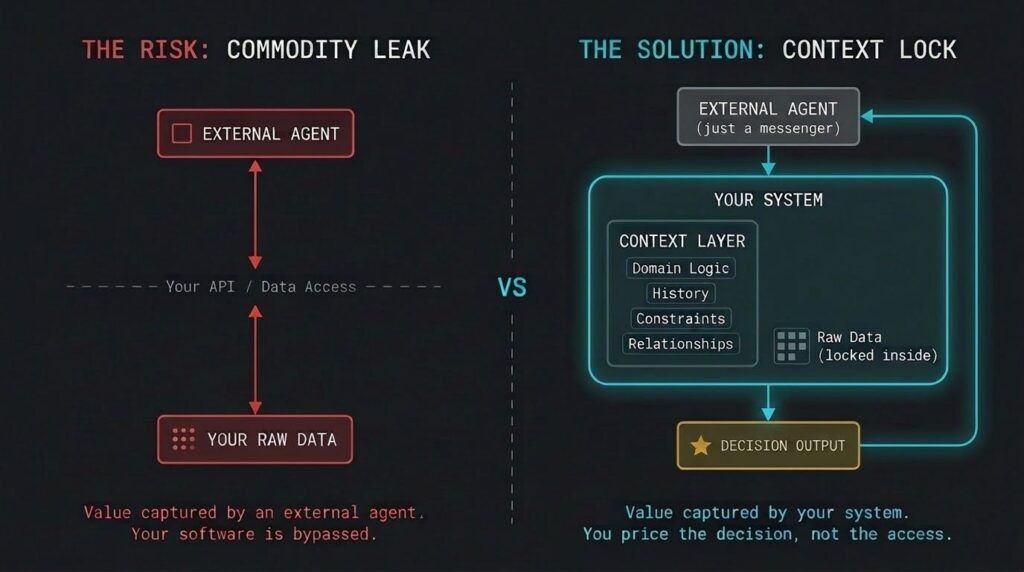
One way to think about this shift is through architecture. The diagram above shows how value can leak to external agents and how owning decision context keeps that value inside your system.
The answer may lie in something that is becoming increasingly important in the AI era: context ownership. In traditional SaaS, competitive advantage often came from features, user interfaces, or network effects.
In AI-native systems, the advantage may shift toward context. Context includes things like:
• structured operational data
• decision history
• domain-specific logic
• system state and constraints
• workflow relationships between entities
An external agent may be able to access raw data. But without the context that explains how to interpret that data, the agent cannot reliably reproduce the intelligence embedded in the system. This is why the most valuable AI software platforms will likely be those that own the decision context, not just the underlying data.
When software systems expose their state and actions in structured ways, agents can interact with them. But when the domain intelligence that interprets that state remains inside the system, the software retains control over where the real value is created. This distinction becomes extremely important when thinking about pricing.
If a system only exposes raw data, external agents may eventually capture much of the value. But if the system owns the context and decision logic, then even external agents must rely on it to produce meaningful outcomes. In that world, software companies are not simply pricing access to data or interfaces. They are pricing decisions.
I highly recommend testing the limits of your software’s agentic availability. Tools like Perplexity’s agentic browser Comet make it cheap and easy to experiment with how external agents interact with your system. Doing this quickly reveals the real value of exposing structured operational context. Comet currently costs around $167 per month and allows an agent to orchestrate workflows across the internet. If you are not careful, platforms like this may end up capturing value from the context your software exposes. The stronger strategy is to ensure that this context flows through your own system, and through the agents and pricing models you control. Context is the value driver, don’t let someone else monetize it!
Conclusion
The economics of software are entering a new phase. AI may reduce the cost of building software, but the cost of operating intelligent systems remains significant.
At the same time, agents are beginning to interact with software in new ways, forcing companies to rethink where the real value in their systems lives. In the coming years, the most successful AI-driven software companies may not simply be those that build the most features or integrate the latest models. They will be the ones who own the decision context and price the outcomes their systems produce rather than the access they provide.
I originally thought writing this article would help me settle my thoughts on this topic. Quite the opposite. It’s pushing me even deeper into the compatibility and relevance race software companies are entering today. Which probably means there’s one more article left in this series.
Next, I want to explore what it means to design software for agents rather than humans, and why that might ultimately strengthen the case for doubling down on the core value proposition your software exists to deliver.