


Wholesale still holds enormous strategic advantages. The challenge now is operational execution.
Over the past few years, wholesale inventory planning has become significantly more difficult to manage. Demand patterns shift faster than planning cycles, retailers expect higher availability with less tolerance for delays, and supplier lead times remain unpredictable while freight, energy, and labour costs continue to pressure margins. At the same time, wholesalers are handling more SKUs, more sales channels, and more operational complexity than ever before. The businesses navigating this environment most successfully are not necessarily the largest. They are the ones making faster, smarter operational decisions.
The gap between wholesalers that operate reactively and those that plan predictively is growing quickly. Companies that improve forecasting accuracy, automate replenishment, and gain visibility into inventory performance are protecting margins while improving service levels. Others remain stuck firefighting stockouts, excess inventory, and planning bottlenecks.
The wholesaler’s structural advantage hasn’t gone away
For years, predictions around direct-to-consumer commerce and marketplace expansion suggested wholesale distribution would become less relevant. That has not happened.
Wholesalers still provide value that is difficult to replicate at scale because they simplify complexity for both retailers and manufacturers. Strong distributors combine broad product assortments with established supplier relationships, logistics infrastructure, regional inventory positioning, and purchasing power that smaller operators struggle to match. They also provide delivery reliability and market expertise that help retailers keep shelves stocked without carrying the full operational burden themselves.
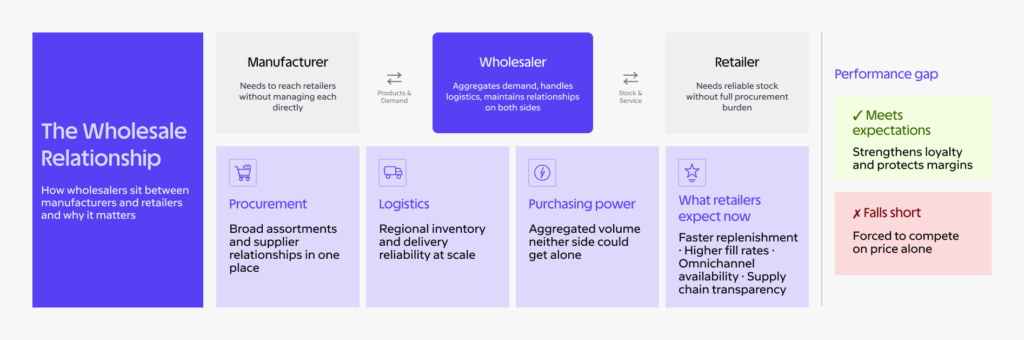
Retailers continue to depend on wholesalers because they simplify procurement and improve product availability. Manufacturers benefit too. Instead of managing fragmented customer networks directly, they can rely on wholesalers to aggregate demand, handle distribution complexity, and maintain customer relationships.
What has changed is not the relevance of wholesale, but what wholesalers need to be good at.
Operational efficiency has become a competitive differentiator. Retailers now expect faster replenishment cycles, higher fill rates, better inventory availability, accurate delivery commitments, and greater supply chain transparency. Service failures are also far more visible than they once were, particularly across omnichannel environments where customers expect consistent availability regardless of how they shop.
Wholesalers that consistently meet those expectations strengthen customer loyalty and protect margins. Those that cannot often end up competing on price alone.
The structural advantage is still there. The question is whether your planning processes, systems, and operational visibility are strong enough to use it effectively.
But the operating environment has fundamentally shifted
Modern wholesale distribution operates in a far more volatile environment than it did even five years ago. Demand has become harder to predict as consumer purchasing behaviour changes quickly across fragmented sales channels. Promotions create sharper peaks and troughs, product lifecycles continue to shorten, and products that sold consistently last quarter can suddenly slow down without warning.
At the same time, costs remain elevated. While some supply chain pressures have eased, many wholesalers still face higher transportation costs, increased supplier pricing, wage inflation, rising warehousing expenses, and ongoing working capital pressure. Margins are tighter, which leaves far less room for inventory mistakes than before.
Retailers are also becoming more demanding operationally.
Late deliveries, incomplete orders, and stockouts impact retailer performance directly. That means wholesalers are increasingly measured against strict service expectations and supplier performance targets.
Many wholesalers recognise the problem, but traditional planning methods struggle to keep up with this level of complexity. Manual forecasting, spreadsheet-based replenishment, and static inventory policies often create slow reactions and inconsistent decisions that make it difficult to adapt quickly when demand changes.
The result is a cycle most planners know well. Demand spikes unexpectedly, inventory becomes unavailable, emergency purchasing increases costs, and excess stock builds elsewhere in the business. Working capital gets tied up while planning teams spend more time firefighting than improving processes.
This environment rewards businesses that can adapt quickly using reliable operational data.
The Gap Between Reactive and Predictive Wholesalers Is Growing
One of the most significant shifts in wholesale distribution today is the widening gap between reactive and predictive operations.
Many wholesalers still rely on manual planning processes, spreadsheet-driven forecasting, fixed reorder rules, and experience-based decision-making. While these approaches may have worked in a more stable environment, they become increasingly difficult to sustain when demand patterns shift quickly, lead times fluctuate, and customer expectations continue to rise.
Reactive businesses often spend much of their time responding to problems after they occur. Stock levels are reviewed when inventory is already running low. Forecasts are updated infrequently. Planning teams focus on resolving stockouts, expediting orders, and managing exceptions rather than preventing them.
Predictive wholesalers take a different approach. They use data, forecasting technology, and automation to identify risks and opportunities before they impact service levels or profitability. Instead of relying on static inventory rules, they continuously monitor demand changes, supplier performance, lead time variability, forecast accuracy, and inventory health across their product portfolio.
This shift fundamentally changes how planning teams operate. Rather than manually managing every purchase order, planners can focus their attention on volatility, exceptions, and strategic decisions that drive business performance.
The operational impact becomes increasingly significant as businesses grow. Predictive wholesalers are often able to improve availability, reduce excess inventory, strengthen working capital performance, and make faster decisions without adding operational complexity.
| Reactive wholesaler | Predictive wholesaler |
|---|---|
| Forecasts updated periodically | Forecasts continuously refined using current data |
| Relies heavily on spreadsheets and manual processes | Uses automated forecasting and planning tools |
| Responds to stock issues after they occur | Identifies inventory risks before they impact service |
| Fixed reorder rules across products | Dynamic inventory policies based on demand and risk |
| Planner time spent firefighting | Planner time focused on exceptions and strategy |
| Limited visibility into supplier performance | Ongoing monitoring of supplier reliability and lead times |
| Higher risk of stockouts and excess inventory | Better balance between availability and inventory investment |
| Operational complexity increases with growth | Automation enables scalability without additional workload |
| Decisions driven primarily by historical performance | Decisions informed by predictive insights and future demand signals |
| Reactive customer service and replenishment | Proactive inventory and service level management |
The gap between these two operating models continues to widen because predictive businesses can manage increasing complexity without significantly increasing effort. Reactive organisations often need more people, more spreadsheets, and more manual intervention as they grow. Predictive organisations use visibility, automation, and data-driven planning to scale more efficiently.
Increasingly, that difference is becoming a key factor separating wholesalers that consistently improve profitability from those that remain trapped in a cycle of operational firefighting.
Five things the best-performing wholesalers do differently
The highest-performing wholesalers are not simply working harder. They are making better operational decisions more consistently, and several patterns appear repeatedly across successful wholesale operations.
1. They forecast at SKU level, not category level
Broad category forecasting often hides important demand variation.
Two products within the same category can behave completely differently depending on seasonality, promotions, geography, customer segment, lead times, and sales velocity. Category-level forecasting often hides these differences and creates unnecessary inventory risk.
Leading wholesalers build forecasts at SKU level because it provides significantly greater planning precision.
This approach helps wholesalers reduce stockouts on fast-moving products while avoiding excess inventory on slower items. More accurate SKU-level forecasting also improves replenishment timing and creates better inventory allocation decisions across locations and customer groups.
Granular forecasting becomes even more important as product assortments expand.
2. They treat safety stock as a dynamic variable
Many wholesalers still manage safety stock using static rules created years ago. That approach rarely reflects current demand volatility or supplier behaviour.
Strong operators continuously adjust safety stock levels based on forecast accuracy, lead time variability, supplier reliability, service level targets, and demand volatility. That creates a more balanced inventory position where stock is placed strategically instead of simply increasing buffers everywhere.
This creates a more balanced inventory position.
Instead of carrying excessive buffer stock everywhere, they place inventory strategically where risk is highest.
3. They share data upstream with suppliers
Top-performing wholesalers understand that supplier relationships improve when visibility improves.
Rather than only communicating purchase orders, leading wholesalers share forecasts, purchasing plans, demand expectations, inventory trends, and promotional activity with suppliers. This gives suppliers more time to prepare capacity and respond to changing demand conditions before disruptions become critical.
This allows suppliers to prepare capacity more effectively and reduces surprises across the supply chain.
Better visibility upstream often leads to more reliable lead times, stronger pricing negotiations, improved availability, and faster responses during disruptions.
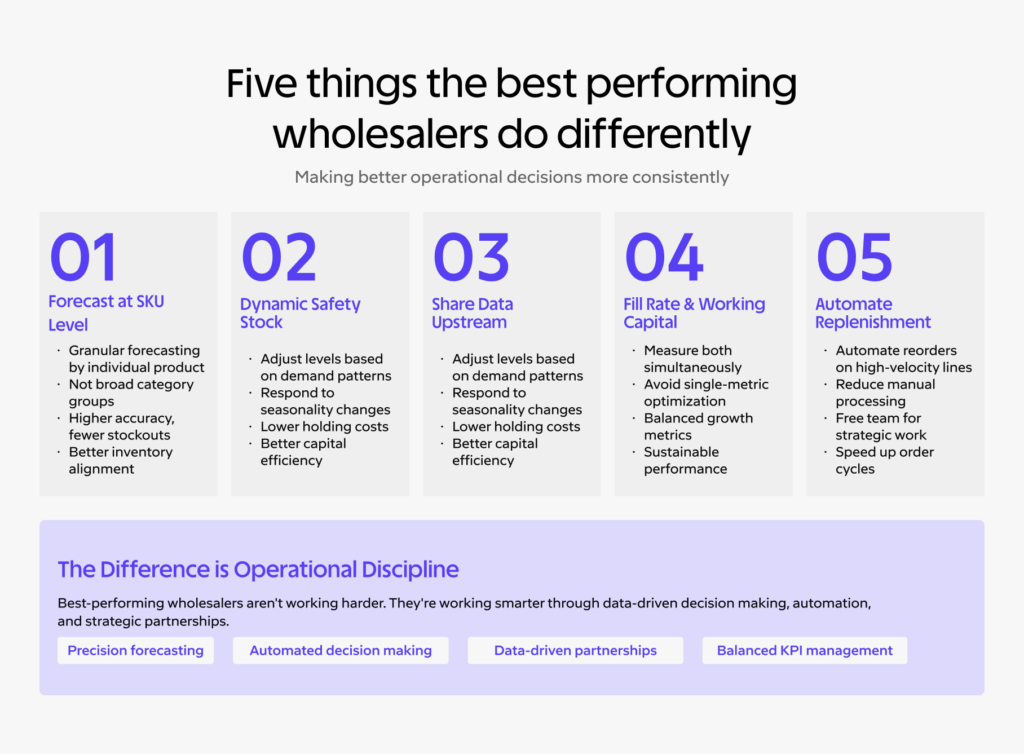
4. They measure fill rate and working capital together
Some wholesalers focus heavily on service levels without considering inventory efficiency.
Others reduce inventory aggressively and damage availability.
The strongest operators manage both metrics together.
They recognise that high fill rates and inventory productivity need to be managed together. Focusing too heavily on one side of the equation usually creates problems elsewhere in the business.
This creates healthier decision-making.
Instead of simply increasing stock everywhere, they optimise inventory based on demand behaviour, margin contribution, and supply chain risk.
The result is better service performance without unnecessary inventory growth.
5. They automate replenishment on high-velocity lines
Manual replenishment consumes enormous planner time, which is why leading wholesalers automate ordering decisions for stable, high-volume products wherever possible.
Automation allows planners to focus on volatile SKUs, supply disruptions, supplier issues, new product introductions, and other strategic inventory decisions that require human judgement. The result is better planner productivity without losing operational control.
This improves scalability while reducing repetitive manual work.
Importantly, automation does not remove planners from the process.
It gives them more time to focus on exceptions and higher-value decision-making.
What holds most wholesalers back (and it’s not willpower)
Most wholesale businesses understand the importance of better forecasting and inventory planning. The challenge is usually operational infrastructure rather than lack of awareness or effort.
Many ERP systems were designed primarily for transaction management.
| ERP systems | AGR inventory planning platform |
| Built for transactions and record-keeping | Built for predictive inventory planning |
| Static reorder rules | Dynamic, data-driven replenishment |
| Limited forecasting capabilities | AI-driven SKU-level forecasting |
| Heavy spreadsheet dependency | Automated workflows and exception management |
| Reactive reporting | Real-time inventory visibility and proactive alerts |
| Manual planning across large SKU ranges | Scalable automation for high-volume environments |
| Difficult to optimise working capital | Inventory optimisation tied to service levels and cash flow |
| Focused on operational processing | Focused on operational decision-making |
Most ERP systems handle purchasing, sales orders, invoicing, and basic inventory tracking very effectively. The problem is that they were not designed to optimise inventory under uncertainty or support predictive planning workflows.
But they are not built to optimise inventory under uncertainty.
As complexity increases, businesses often compensate with spreadsheets.
As complexity increases, spreadsheets introduce version control issues, manual errors, slow reporting cycles, limited visibility, and inconsistent planning logic. Eventually, planners spend more time maintaining files than analysing inventory risk.
Eventually, planners spend more time maintaining spreadsheets than analysing inventory risk.
This is why even experienced planning teams can struggle. The problem is rarely lack of effort. More often, it is the absence of systems designed for predictive inventory management.
Most ERP systems handle purchasing, sales orders, invoicing, and inventory tracking very effectively. Where many wholesalers struggle is in the planning layer that sits above those operational processes. Traditional ERP systems were not designed for predictive inventory management, dynamic forecasting, or automated replenishment under volatile demand conditions.
That is why many wholesalers end up relying heavily on spreadsheets to bridge the gap. As complexity grows, spreadsheets introduce manual errors, inconsistent planning logic, slow reporting cycles, and limited visibility across the supply chain. Planners spend more time maintaining files than analysing inventory risk or improving decision-making.
AGR addresses that planning gap by sitting on top of existing ERP systems rather than replacing them. It combines AI-driven demand forecasting, inventory optimisation, replenishment automation, supplier visibility, and working capital optimisation in one platform. This allows wholesalers to strengthen planning capabilities without disrupting existing operational systems.
Instead of manually reviewing every line item, teams can focus attention where it matters most. AGR customers regularly improve forecast accuracy, inventory turnover, service levels, stock availability, and planner productivity while reducing excess inventory and improving working capital efficiency.
The result is not simply more automation. It is better operational control, faster decision-making, and stronger visibility across the supply chain.
If you want to explore how AGR helps wholesalers improve forecasting, replenishment, and inventory optimisation, you can learn more about our inventory planning solutions or book a personalised demo.
Wholesalers still hold powerful competitive advantages, but the operating environment has changed. The businesses pulling ahead are not relying on instinct, spreadsheets, or reactive planning cycles. They are investing in operational intelligence that helps them make faster, more accurate decisions at scale.
See How Predictive Planning Works in Practice
The gap between reactive and predictive wholesalers is growing. Businesses that improve forecasting, inventory visibility, and replenishment planning are better positioned to protect margins, improve service levels, and respond to changing demand.
To see what that looks like in practice, read how Vital Pet Group transformed its inventory planning processes with AGR. The case study explores how the business improved forecast accuracy, reduced manual effort, and gained greater control over inventory decisions across its operation.