
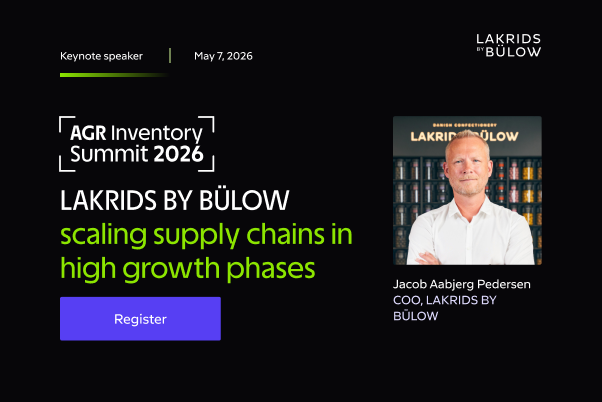
Inventory Summit 2026 – LAKRIDS BY BÜLOW
Inventory Summit session · Recorded May 2026 · 15 min watch · Speaker: Jacob Aabjerg Pedersen, COO at LAKRIDS BY BÜLOW
Scaling a global consumer brand is about far more than increasing sales. As LAKRIDS BY BÜLOW expanded into more than 40 markets, its supply chain faced rising complexity, unexpected disruptions, and growing operational demands. In this keynote, COO Jacob Aabjerg Pedersen shares how the company responded to major supply chain shocks, strengthened planning processes, and built a more resilient operation capable of supporting continued international growth.
Get instant access
Enter your details to watch the recording on demand.
- Instant access
- 15-min video
- No spam
Key takeaways
- Why supply chain complexity grows faster than revenue during periods of rapid business expansion.
- Lessons from managing major disruptions, including raw material shortages and unprecedented ingredient price increases.
- How stronger S&OP processes and clear sales ownership improve forecasting accuracy.
- Why inventory optimisation and better planning are essential for building resilience before a crisis occurs.
- Practical advice for balancing growth, operational efficiency, and customer service in a premium global brand.
What you'll learn about inventory management
About the video
Scaling a Global Supply Chain Without Losing Control
Growing internationally brings enormous opportunities, but it also introduces new levels of complexity. In this keynote, Jacob Aabjerg Pedersen, COO of LAKRIDS BY BÜLOW, shares how the premium confectionery brand has scaled into more than 40 international markets while navigating major supply chain disruptions, rapid product expansion, and increasing operational complexity.
Drawing on real experiences, including ingredient shortages, supplier challenges, and soaring raw material costs, Jacob explains why resilience must be designed into the supply chain long before a crisis occurs. He explores the importance of inventory optimisation, stronger S&OP processes, data-driven decision making, and clear ownership of demand planning to support sustainable growth.
What you will learn
- Why supply chain complexity increases as businesses expand into new markets and channels.
- How resilient inventory planning helps businesses respond to unexpected disruptions.
- The role of S&OP and forecast ownership in improving planning accuracy.
- Why operational discipline becomes increasingly important as organisations scale.
- How leading brands prepare their supply chains for future uncertainty rather than simply reacting to crises.
Chapters
Speaker

Jacob Aabjerg Pedersen is Chief Operating Officer at LAKRIDS BY BÜLOW, where he leads the company’s global supply chain and operations. With leadership experience across international food, ingredients, and consumer brands, he specialises in scaling operations, strengthening supply chain resilience, and supporting sustainable international growth.
Frequently asked questions
What is AI-driven inventory management?
AI-driven inventory management uses machine-learning models to forecast demand at SKU level, detect anomalies in sales history, and propose replenishment orders that planners can approve in one click. In AGR, AI runs continuously on ERP sales and stock data and surfaces only the exceptions that need human attention.
How is automation different from AI in inventory planning?
Automation executes rules you already defined — for example, auto-generating a purchase order when stock hits a reorder point. AI improves the rules themselves: it learns seasonality, promotions and supplier lead-time variability from historical data and updates forecasts and safety stock without manual tuning.
How long does it take to implement AGR?
Most AGR SaaS customers go live in 4–8 weeks. The standardised data model and prebuilt ERP connectors (Microsoft Dynamics 365 Business Central, NAV, SAP, NetSuite, Sage, IFS, Jeeves) remove the multi-month integration work typical of legacy supply-chain tools.
Which ERPs does AGR connect to?
AGR has prebuilt, supported connectors for Microsoft Dynamics 365 Business Central, Dynamics NAV, SAP, NetSuite, Sage, Visma, IFS and Jeeves. Other ERPs connect via REST API or flat-file integration.
What measurable results do AGR customers see?
Across AGR’s customer base, companies typically reduce inventory holding by up to 11% and cut stockouts by up to 40% within the first 12 months — based on AGR customer benchmark data, 2025.
Is AGR suitable for wholesale, retail and manufacturing?
Yes. AGR is used by 400+ companies across wholesale distribution, specialty and FMCG retail, and manufacturing with raw-material and finished-goods planning. The same forecasting and ordering engine adapts to each vertical via configuration, not custom code.
Get instant access
Enter your details to watch the recording on demand.
- Instant access
- 32-min video
- No spam
Prefer to talk to someone? Request a demo