

A backorder is an order for a product that cannot be fulfilled immediately because there isn’t enough inventory available, but which the business expects to fulfil when stock is replenished. Unlike an out-of-stock product that cannot be purchased, a backordered item remains available for customers to order.
Imagine a customer finds the product they want, adds it to their basket and heads to checkout. The product isn’t currently in stock, but instead of losing the sale, the retailer accepts the order and ships it once new inventory arrives. That’s a backorder.
Backorders can help retailers, wholesalers and manufacturers retain sales during temporary stock shortages. They can also be a deliberate inventory strategy, particularly where holding large quantities of expensive or unpredictable products would tie up unnecessary capital.
The important distinction is that the business knows the item isn’t currently available and accepts the purchase on the expectation that more stock is coming. Once inventory arrives, outstanding orders can be fulfilled.
Occasional backorders aren’t necessarily a sign of poor inventory management. Persistent or unexpected backorders are more concerning because they can indicate that demand, inventory and supply aren’t properly aligned.
Understanding why backorders happen, and managing them effectively, helps you protect customer service while keeping inventory under control.
What is a backorder item?
A backorder item is a product that is temporarily unavailable for immediate shipment but remains available for customers to purchase.
For example, imagine a wholesaler normally sells 500 units of a particular product each month. A sudden increase in orders exhausts the remaining inventory before the next supplier delivery arrives.
If another 100 customers place orders during that period, those orders become backorders. The wholesaler fulfils them when the next shipment arrives.
The product itself hasn’t been discontinued. Demand still exists, the wholesaler intends to replenish it, and customers can continue ordering it. The issue is temporary availability.
Backorder vs. out of stock: what’s the difference?
Backordered and out-of-stock products are both unavailable for immediate fulfilment, but they aren’t quite the same.
The key difference is whether the customer can still buy the product.
| Feature | Backorder | Out of stock |
|---|---|---|
| Purchasability | Customer can complete the purchase | Customer cannot complete the purchase |
| Restock timeline | Expected restock date is usually known | Restock timeline is often uncertain or unknown |
| Customer action | Waits for the item to ship later | Must find an alternative or sign up for restock alerts |
This distinction is important for inventory planning as well as the customer experience.
A backorder retains the demand signal because the customer completes the purchase. An out-of-stock item can create lost sales that are harder to measure. If a customer leaves and buys from a competitor, the transaction never appears in your sales history.
How do backorders work?
A backorder starts when a business accepts an order that it doesn’t currently have enough inventory to fulfil. From there, the order needs to remain visible and connected to incoming inventory so it can be fulfilled as soon as stock becomes available.
This makes backorder management more than simply waiting for the next delivery. Businesses need to set realistic expectations, understand how much incoming stock is already committed and keep customers informed if supply dates change.
The exact process varies between businesses, but a typical backorder follows four stages.
Order placement
The customer orders a product despite it being temporarily unavailable.
Clear information matters here. Customers should know before completing their purchase that the item is on backorder and, where possible, when it is expected to become available.
This allows the customer to make an informed choice about whether they’re willing to wait or would prefer an alternative product.
Payment processing
Payment policies vary.
Some businesses take payment when the customer places the order. Others authorise payment and only charge the customer once the product ships.
Businesses need a clear policy that complies with the payment, consumer protection and ecommerce requirements that apply to them.
Communication
The customer receives an estimated delivery date and updates if anything changes.
This stage can make the difference between a manageable delay and a poor customer experience. If a supplier pushes its delivery date back by two weeks, customers shouldn’t discover that only after their expected delivery fails to arrive.
Accurate supplier information is therefore important not only for inventory planning but also for setting reliable expectations with customers.
Fulfilment
New inventory arrives and is allocated to outstanding orders.
The warehouse picks, packs and ships the products, completing the backorders before remaining inventory becomes available for normal fulfilment.
When backorder volumes are high, allocation becomes particularly important. Incoming stock may already be committed to customers before it reaches the warehouse. Businesses therefore need visibility of both physical inventory and outstanding demand when determining what stock is genuinely available to sell.
Why do backorders happen? Common causes
Backorders occur when customer demand exceeds the inventory available for immediate fulfilment. Sometimes the cause is an unexpected change in demand. In other cases, the problem sits on the supply side or comes from the way inventory has been planned.
Understanding the underlying cause matters because different problems require different responses.
Unexpected demand spikes
Demand rarely follows a perfectly predictable line.
Promotions, seasonality, weather, trends or unexpected customer behaviour can cause sales to rise much faster than expected. Even a product with apparently healthy stock can quickly move onto backorder if sales velocity suddenly accelerates.
Demand variability can also travel upstream through the supply chain. Small changes in customer demand can create increasingly large fluctuations in orders placed with distributors, manufacturers and suppliers. This phenomenon is known as the bullwhip effect.
Better forecasting doesn’t eliminate uncertainty, but it helps businesses recognise patterns and prepare inventory for likely changes.
Supply chain delays
Sometimes demand behaves exactly as expected, but the inventory doesn’t arrive when expected.
Manufacturing problems, shipping delays and changes in supplier performance can extend lead times. If your inventory plan assumes a four-week lead time and the supplier suddenly takes six weeks, you may exhaust existing stock before replenishment arrives.
The problem becomes worse when businesses don’t have good visibility of changing supplier performance.
A supplier might experience a production delay without immediately confirming a revised lead time. Planners then discover the problem only when the expected inbound delivery doesn’t appear.
Monitoring actual lead times and adjusting inventory plans accordingly helps businesses prepare for these changes rather than relying on supplier assumptions that may no longer reflect reality.
Inadequate inventory planning
Backorders can also result from the way inventory is planned and replenished.
Inadequate safety stock, inaccurate forecasts, poorly configured reorder points and inefficient ordering can all leave businesses without enough inventory to cover demand between replenishment cycles.
The answer isn’t simply to hold more stock.
Excessive inventory increases carrying costs and ties up working capital. The objective is to maintain enough inventory to achieve the required service level without creating unnecessary excess.
That requires forecasts, safety stock and replenishment parameters that reflect how individual products actually behave.
The impact of backorders on business performance
A single backorder isn’t necessarily a problem. The pattern behind your backorders matters more.
Frequent backorders can affect revenue, customer relationships and operational efficiency. They can also provide useful information about where your inventory strategy needs attention.
Lower service levels
Product availability is a fundamental part of customer service.
As your service level falls, more customers encounter products that can’t be fulfilled immediately. Backorders and potentially lost sales follow.
Customers may tolerate an occasional delay, particularly when you communicate it clearly. Repeated delays are harder to accept.
Lost sales and customer loyalty
A backorder at least gives you an opportunity to retain the sale. That doesn’t guarantee the customer will wait.
Long or uncertain delivery times can lead to cancellations. Customers may also choose competitors that can offer immediate availability.
The impact can therefore extend beyond the original transaction. Repeated availability problems can reduce trust and make customers less likely to return.
More operational work
Backorders create additional processes.
Teams may need to track outstanding orders, allocate incoming inventory, communicate revised dates, respond to customers and prioritise fulfilment.
When those processes rely on spreadsheets and manual updates, the workload grows quickly. Planners can spend significant time dealing with shortages instead of analysing inventory and making forward-looking decisions.
A warning sign of deeper inventory problems
One of the most useful ways to think about backorders is as an inventory signal.
Frequent backorders despite high overall inventory levels can indicate deeper instability in forecasting or supply chain coordination.
You may have plenty of inventory in total, but not the products customers actually want.
That’s why measuring inventory value alone isn’t enough. Businesses need visibility at SKU level to understand where they have excess inventory and where they’re repeatedly running short.
Backorders can sometimes be strategic
Backorders aren’t always something to eliminate completely.
A business launching a new product, for example, may intentionally accept some backorders while establishing demand rather than committing significant capital to inventory before knowing how the product will perform. This can help test demand while limiting upfront inventory exposure.
Businesses may take a similar approach to expensive or highly specialised products where maintaining enough stock to guarantee immediate availability would be financially inefficient.
The difference is control.
A planned backorder strategy is very different from repeatedly disappointing customers because purchasing decisions aren’t keeping pace with demand.
How to manage and reduce backorders
Backorder management has two objectives: handle existing orders effectively and reduce unnecessary backorders in the future.
That requires businesses to look beyond the backorder itself. Customer communication helps manage the immediate situation, while better forecasting, inventory policies and replenishment decisions address the causes.
Communicate clearly with customers
Start with the customer.
Show that an item is on backorder before purchase and provide the most realistic delivery estimate available. Update customers quickly when that estimate changes.
Avoid promising dates you can’t confidently meet. A realistic six-week estimate is more useful than promising three weeks and repeatedly delaying the order.
Improve demand forecasting
Forecasting helps you anticipate how much inventory you’re likely to need and when you’ll need it.
Start with clean sales data. Outliers, cancellations and backorders can distort historical patterns if they’re handled incorrectly, leading to poor demand predictions.
Effective demand forecasting combines relevant historical data with forecasting methods suited to individual demand patterns.
Rather than treating every SKU in the same way, businesses can account for differences in seasonality, volatility, trends and product lifecycles. Forecasts should also be reviewed as new demand information becomes available instead of being treated as static plans.
Optimise safety stock
Safety stock provides a buffer against uncertainty.
The challenge is finding the right level. Too little safety stock increases the risk of shortages and backorders. Too much increases carrying costs and ties up capital.
Data-driven safety stock calculations consider factors such as:
- Demand variability
- Supplier lead times
- Lead-time variability
- Forecast accuracy
- Target service levels
Safety stock should also change when conditions change. A fixed buffer based on last year’s demand may no longer protect availability effectively.
Monitor supplier performance and lead times
Forecasting demand is only half of the equation. You also need to understand supply.
Track actual supplier lead times rather than relying indefinitely on agreed or historical figures. If a supplier’s average lead time increases, replenishment parameters should reflect it.
Sharing future purchasing requirements with suppliers can also improve coordination and give them more opportunity to flag capacity constraints before they cause shortages.
Review backorders as an inventory KPI
Don’t treat each backorder as an isolated incident.
Look for patterns across products, suppliers, warehouses and time periods.
A particular supplier might account for a disproportionate share of delayed inventory. One product category might regularly run short during promotions. Certain SKUs may have forecasts that consistently underestimate demand.
Tracking the frequency, volume and duration of backorders can help distinguish occasional exceptions from persistent inventory problems.
Those patterns tell you where intervention is most valuable.
Review reorder points and replenishment parameters
Your reorder point determines when replenishment should begin. If it doesn’t reflect current demand, supplier lead times and safety stock requirements, orders can be triggered too late to prevent shortages.
Review reorder points regularly, particularly for products with changing demand or variable lead times.
Order quantities, scheduled ordering rules and other replenishment parameters should also adapt as conditions change. A setting that worked six months ago may no longer provide enough coverage if demand has increased or a supplier now takes longer to deliver.
Connecting these parameters to current forecasts and inventory data helps move replenishment from reacting to shortages towards preventing them.
How modern software helps prevent excessive backorders
Spreadsheets and basic ERP stocking rules can work when an inventory operation is relatively simple. They become much harder to manage as the number of SKUs, suppliers and locations grows.
Basic min/max rules tend to react to inventory reaching a predefined threshold. Manual spreadsheets require planners to continually extract data, update calculations and decide what needs ordering.
Both approaches can leave planners reacting to shortages rather than anticipating them.
Modern inventory planning software connects demand forecasting with replenishment decisions. Forecasts help determine what customers are likely to need, while inventory optimisation translates that demand into appropriate safety stock, reorder points and purchasing requirements.
AGR combines demand forecasting, inventory optimisation and automated replenishment to help businesses maintain their target service levels while avoiding unnecessary inventory. Automated order proposals can respond to demand and supplier constraints, helping planners make purchasing decisions based on current requirements rather than static rules.
That means planners can focus on exceptions and decisions that require their expertise rather than spending their time manually creating and updating orders.
How Newitts moved from reactive backorders to smarter planning
Newitts, a UK supplier of sports apparel and equipment, experienced exactly this challenge. The company ships an average of 600 orders a day and wanted to maintain high customer service levels while reducing the amount of inventory it held.
Its Microsoft Dynamics NAV system limited the team to min/max stocking rules, so purchasing staff had to download data into spreadsheets. Newitts said this meant the team was spending too much time creating backorders and operating reactively rather than planning ahead.
With AGR, the purchasing team gained better visibility of historical sales data and could translate it into more accurate forecasts. The results went beyond reducing backorders. Newitts reduced its stockholding by 15%, cut its resource requirement by 50%, increased service levels and achieved return on investment within six months.
The Newitts example highlights an important point about backorder management: preventing shortages doesn’t have to mean carrying significantly more inventory. Better forecasting and replenishment can help businesses improve availability while keeping stock investment under control.
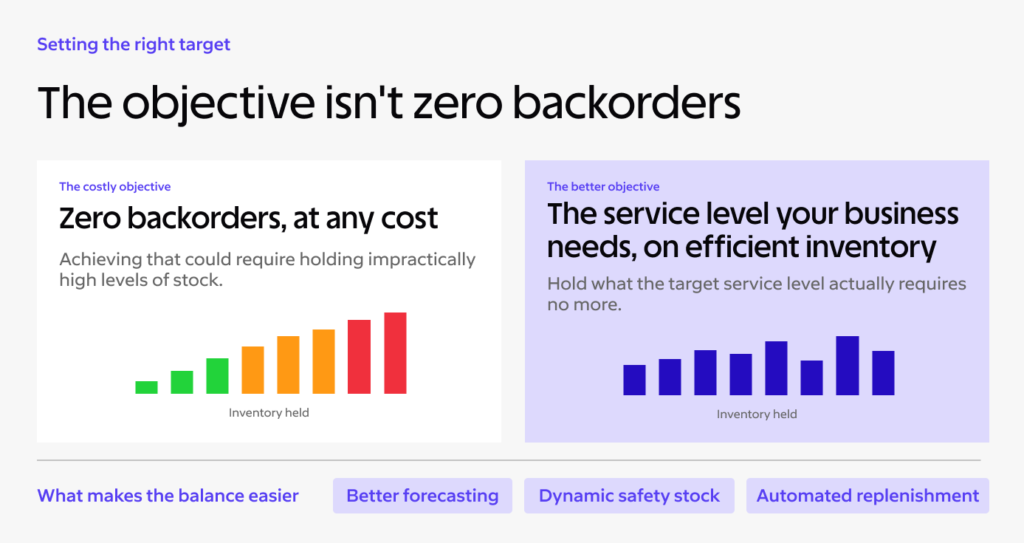
The objective isn’t necessarily zero backorders at any cost. Achieving that could require holding impractically high levels of stock.
The better objective is to maintain the service level your business needs with an efficient level of inventory. Better forecasting, dynamic safety stock and automated replenishment make that balance easier to achieve.