

Inventory reduction and service level improvement are not opposing goals. Companies can reduce inventory without sacrificing service levels. Both depend on putting the right stock in the right place at the right time. Poor forecasting encourages businesses to hold excess stock as insurance. Better forecasting, item-level safety stock and forecast-driven replenishment remove much of that insurance without reducing availability.
The trade-off businesses get wrong
Many finance and operations teams start with a familiar assumption: cutting stock increases the risk of stockouts.
That can be true when a business applies a broad percentage cut across every item. It is not true when the business improves the precision of its inventory decisions.
Stock volume and stock precision are different things. A warehouse can hold too much inventory overall and still run out of its most important products. Excess quantities may sit in slow-moving lines while fast-moving items remain understocked.
The problem is not simply how much stock the company owns. It is whether that stock matches likely demand, supplier lead times and the service targets attached to each item.
Statistical, item-level inventory optimisation replaces blanket safety stock rules with policies calculated for each SKU and location. Forecasts, service targets, lead times, order constraints and demand variability work together to determine how much protection each item needs.
Thermex provides a clear example. The manufacturer reduced its stock levels by 38.5% while maintaining a service level of 98%. Its inventory turnover ratio also increased from 2.5 to 4.5.
This result shows why the right question is not how much stock can be removed indiscriminately. It is where stock exceeds the amount required to support demand and maintain the desired service level.
Why businesses overstock in the first place
Overstock often develops as a rational response to weak information. When planners cannot trust forecasts or see future requirements clearly, they protect the business by ordering more.
Each individual decision may feel cautious, but the accumulated result is too much working capital tied up in stock.
Reactive, spreadsheet-driven purchasing
ERP systems are essential for recording transactions, but basic min/max rules may not capture seasonality, changing demand, variable lead times or different service priorities.
Teams may then export data to spreadsheets, interpret it manually and spend much of their time reacting to backorders. Uncertainty encourages buyers to order extra stock in case future demand is higher than expected.
This approach also makes it difficult to distinguish between a genuine inventory requirement and a buffer created because the team lacks reliable information.
Before using AGR, Newitts relied on Microsoft Dynamics NAV min/max stocking rules and downloaded data into spreadsheets. The process was time-consuming and contributed to excessive backorders, making purchasing more reactive than proactive.
The company wanted to forecast demand more intelligently so it could make the right products available without holding inventory it did not need.
Static safety stock applied uniformly
A single safety stock policy across an entire product range can create both excess stock and shortages.
Fast-moving, high-value or strategically important items may need more responsive protection. Slow-moving items with intermittent demand may need a different policy or closer exception management, not a large buffer that remains untouched.
Applying the same number of days or units of safety stock to every item ignores differences in:
- Demand variability
- Supplier lead times
- Order frequency
- Product value
- Customer importance
- Seasonality
- Supply reliability
- Commercial risk
ABC/XYZ analysis helps planners distinguish between these groups. ABC analysis categorises products according to their value or importance to the business, while XYZ analysis considers demand stability and variability.
Service targets can then reflect commercial importance, demand behaviour and supply risk instead of treating every SKU as equal. This makes inventory reduction selective and controlled.
How inventory optimisation reduces stock without causing stockouts
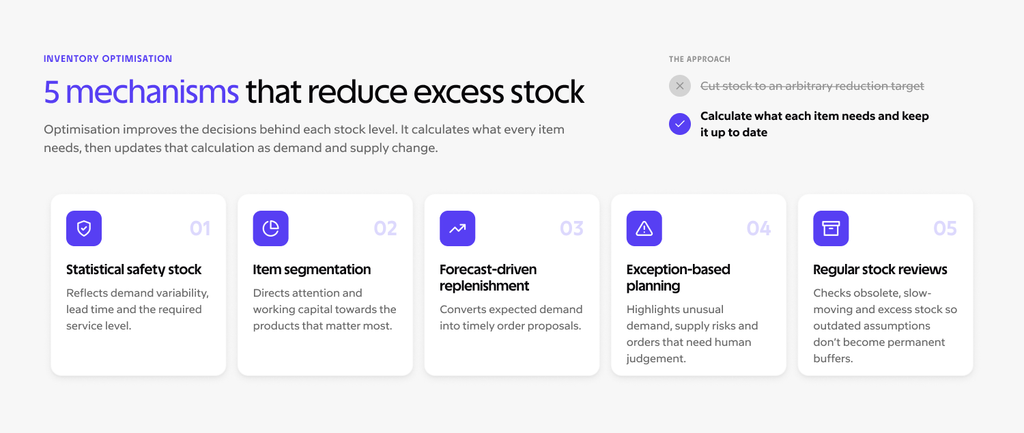
Inventory optimisation replaces broad stock buffers with calculations based on the requirements of individual products. Statistical safety stock accounts for demand and lead-time variability, while ABC/XYZ analysis helps businesses set appropriate service targets for different parts of the range.
Forecast-driven replenishment then converts expected demand into timely order proposals. Exception-based planning highlights the items that require attention, allowing planners to focus on unusual demand, supply risks and potential shortages instead of manually reviewing every SKU.
Johan Rönning used systematic forecasting and exception management to address demand fluctuations, high stock levels and limited visibility across its stores. The company lowered inventory levels by more than 35%, improved service levels and freed valuable working capital. It also reduced the workload involved in purchasing.
The result came from structured, data-led purchasing rather than a blanket stock reduction.
How companies reduce working capital tied up in inventory
Inventory is not only an operational measure. Every excess unit represents cash that cannot be used elsewhere in the business.
Excess stock may also create additional costs through:
- Warehousing and handling
- Insurance
- Damage and deterioration
- Product obsolescence
- Markdowns
- Stock depreciation
- Administrative work
Reducing unnecessary inventory can release working capital while making the operation easier to manage.
The strongest gains often come from improving capital efficiency and planning efficiency together. Better forecasts reduce unnecessary purchases. Automated replenishment reduces repetitive work. Clearer exceptions help a lean team focus on decisions with the greatest financial or service impact.
Newitts: Lower stock and greater operational efficiency
Newitts wanted to maintain high service standards while reducing its stock holding. It also needed to move away from reactive, spreadsheet-based purchasing.
After implementing AGR, the company:
- Reduced stock holding by 15%
- Cut the purchasing resource requirement by 50%
- Increased stock turns
- Achieved return on investment within six months
- Maintained very high service levels
- Added new product lines
The Newitts result demonstrates that inventory reduction does not have to constrain growth.
The company was able to introduce new products while reducing the amount of cash tied up in its existing inventory. Better planning created room for a broader range without requiring an equivalent increase in overall stock.
Securitas Iceland: Reducing stock across a complex supply network
Securitas Iceland manages products from more than 160 suppliers and distributes inventory across four warehouse locations in Iceland.
Using AGR’s forecasting and planning capabilities, Securitas Iceland reduced its stock levels by 25% while maintaining product availability.
The platform also gives the procurement team greater visibility into demand forecasts, purchasing requirements and stock across different locations. Lead time analysis helps the team track supplier delivery performance and plan purchases more accurately.
The published case study does not state the period over which the 25% reduction was achieved. It should therefore be treated as a verified but non-time-bound result rather than an annualised comparison with the other cases.
Can inventory levels and service levels improve at the same time?
Yes. Service depends on the availability of the items customers want, not the total value or volume of stock in the warehouse.
A company can reduce its overall inventory while increasing availability if it removes excess stock from the wrong items and protects the right ones more accurately.
Better forecasts help the business anticipate likely demand. Item-level safety stock accounts for differences in demand and supply risk. Automated replenishment ensures that orders are placed at the right time. Together, these capabilities improve the inventory mix.
Space NK: Availability up and inventory down
Space NK implemented AGR because it wanted to improve availability without investing more money in inventory.
After one year, availability increased from 86% to 98%, while inventory decreased by between 2% and 3%. The retailer also estimated that automation reduced the time spent on repetitive manual tasks by around 30%.
Rather than increasing stock across approximately 8,000 to 9,000 SKUs, AGR helped the business calculate forecasts, safety stock and order quantities more accurately.
This is an older AGR case study. Space NK went live with AGR in 2008, so the figures should be presented as a long-standing, historically validated example of the principle. They should not be treated as a current benchmark for AGR’s present-day product capabilities, current retail conditions or the results a new customer should expect.
The Space NK case study nevertheless demonstrates the fundamental point clearly: improving availability does not always require more inventory.
BoConcept: The same pattern without a headline percentage
BoConcept needed more accurate forecasts at individual product level across a complex international retail network.
The company previously created forecasts at product group level and used allocation keys to divide them between individual items. This did not provide the detail needed to understand why some products were overstocked while others were unavailable.
AGR introduced automatic forecasting at item level and gave the team better tools for exception reporting and analysis.
According to BoConcept’s customer story, the improved forecasts helped reduce inventory levels while increasing service levels. The company also gained a clearer overview of sales, forecasts, purchasing and stock.
The case does not provide a precise percentage for the reduction. However, it shows that the same pattern can hold across a furniture retailer with a different range, supply chain and demand profile.
The common thread across these results
These six businesses operate in different markets and manage very different product ranges. Their results nevertheless point to the same operating principle: better inventory decisions can improve capital efficiency and service levels at the same time.
| Company | Sector | Inventory reduction | Service level outcome | Notes |
|---|---|---|---|---|
| Thermex | Manufacturing | 38.5% | Maintained at 98% | Inventory turnover increased from 2.5 to 4.5 |
| Space NK | Retail | 2% to 3% | Availability increased from 86% to 98% | Older case; AGR went live in 2008 |
| Newitts | Retail | 15% | Very high service levels maintained | Purchasing resource requirement reduced by 50%; ROI within six months |
| Securitas Iceland | Security products and services | 25% | Availability maintained | Time period not stated in the case study |
| Johan Rönning | Retail and distribution | More than 35% | Service levels improved | Working capital released |
| BoConcept | Retail | Reduced, percentage not stated | Service levels increased | Item-level forecasting and exception reporting introduced |
Across the cases, static or aggregated rules gave way to forecasting and planning at item level.
Segmentation helped teams direct their attention and working capital towards the most important products. Automated replenishment and exception management reduced manual work, while better visibility helped planners act earlier.
These are the mechanisms that allow companies to remove excess inventory without removing the stock needed to protect service.
How to start reducing inventory without risking service levels
Inventory reduction should be treated as a planning improvement programme, not a one-off cost-cutting exercise. The following steps can help companies reduce stock while protecting availability.
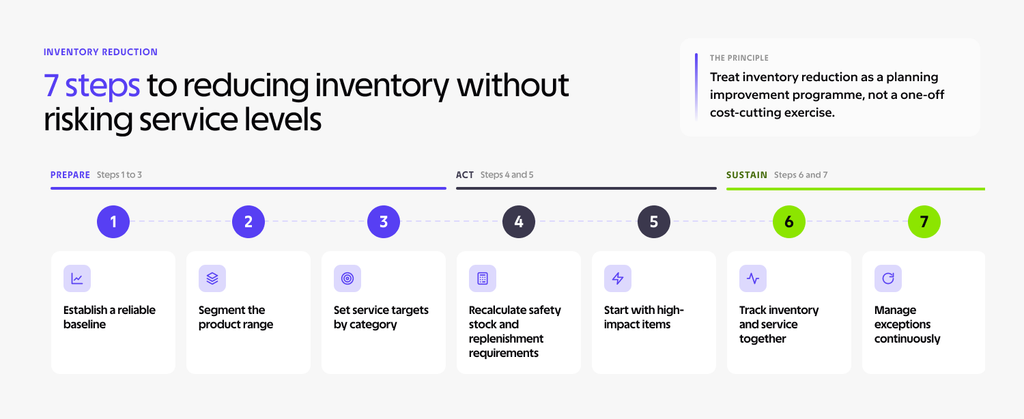
1. Establish a reliable baseline
Measure current inventory value, service level, availability, stock turn, forecast accuracy, backorders, excess stock and obsolescence.
Use consistent definitions across the business. If finance, sales and supply chain calculate service or inventory differently, it will be difficult to assess whether changes are working.
2. Segment the product range
Use ABC/XYZ analysis to identify which products generate the most value, which have stable or volatile demand and which require different inventory policies.
Do not apply the same reduction target to every SKU. A high-volume item with stable demand should not necessarily be managed in the same way as a slow-moving spare part.
3. Set service targets by category
Align service targets with customer importance, margin, product criticality, lead time and supply risk.
Higher service levels may justify additional safety stock for important products. Other items may not need the same level of protection.
The aim is not to maximise availability at any cost. It is to establish the appropriate service level for each part of the range.
4. Recalculate safety stock and replenishment requirements
Replace blanket buffers with safety stock policies that respond to demand and lead-time variability.
Forecasts should then feed into replenishment calculations that consider current stock, open orders, supplier constraints, order frequency and expected demand. This turns inventory planning into a repeatable process instead of a series of manual estimates.
5. Start with high-impact items
A phased approach allows the business to test policies and measure results before expanding the programme.
Start with the SKUs, suppliers or locations that offer the greatest working-capital opportunity. These may include:
- High-value items
- Products with consistently excessive cover
- Slow-moving stock
- Items with poor forecast accuracy
- Products with high obsolescence risk
- Categories with frequent stockouts despite high inventory
Review the effect on service levels before rolling the changes out more widely.
6. Track inventory and service together
Monitor stock value, working capital and stock turn alongside availability, fill rate, backorders and stockouts.
A reduction is only successful when the required service level is protected. Looking at inventory in isolation may encourage decisions that save cash initially but lead to lost sales or dissatisfied customers later.
Tracking both sides of the equation helps teams identify whether inventory is genuinely being optimised or simply removed.
7. Manage exceptions continuously
Forecasts and inventory policies need to change as demand, suppliers and product ranges evolve.
Exception-based planning helps teams identify where actual performance differs from the plan. Planners can then focus on unusual demand, delayed suppliers, excess orders or emerging stockout risks.
This keeps inventory policies responsive without requiring every item to be reviewed manually.
How AGR supports inventory reduction
AGR combines inventory optimisation and order management with demand planning and forecasting.
The platform helps businesses calculate item-level forecasts, set appropriate stock policies and convert expected demand into replenishment proposals. ABC analysis and exception-based planning help teams focus their time and working capital where they can have the greatest effect.
Automating routine calculations also gives planners more time to review risks, work with suppliers and make informed commercial decisions.
The objective is not simply to hold less stock. It is to hold the inventory needed to support the business without tying up unnecessary capital in products that are unlikely to sell.
Use the AGR ROI calculator to explore the potential financial effect of improving inventory performance, or request a demo to see how AGR could support your inventory planning process.