


Stockouts frustrate customers, disrupt operations and cost businesses sales. Yet preventing them is rarely as simple as ordering more inventory. The challenge is knowing which products to stock, how much to hold and when to replenish them.
Inventory optimisation reduces stockouts by continuously adjusting safety stock and replenishment decisions to reflect demand patterns, supplier lead times and variability. Instead of relying on fixed stock levels or historical averages alone, businesses can anticipate shortages and order at the right time. The result is more consistent availability, better service levels and less capital tied up in unnecessary stock.
Customer results demonstrate what this looks like in practice. BYKO reduced stockouts by more than 50%, Wessex Packaging achieved a 50% reduction, and Space NK increased availability from 86% to 98% in an earlier implementation of AGR.
Understanding availability, stockout rate, service level and fill rate
Reducing stockouts is an important objective, but businesses need to measure more than the number of times a product runs out. Several inventory KPIs help explain how reliably a company can meet customer demand.
Although these metrics are closely related, they measure different aspects of inventory performance.
| Metric | What it measures | What it does not measure |
|---|---|---|
| Availability | The percentage of products available for sale or fulfilment at a given time, or across a defined measurement period. | Whether every customer order was fulfilled successfully. |
| Stockout rate | How frequently products are unavailable when customers need them, measured using a consistent basis such as demand events or order lines. | Overall stock availability across the entire product range. |
| Service level | The probability of meeting demand without a stockout during a replenishment cycle or specified period. | The exact proportion of units shipped immediately. |
| Fill rate | The percentage of customer demand, measured in units or order lines, fulfilled immediately from available stock. | How consistently products remain available between orders. |
A company can have high overall availability while still experiencing frequent stockouts on its most popular products. Equally, a business might achieve a strong fill rate while carrying excessive inventory.
These differences matter when setting inventory policies. Availability and stockout rate help identify existing problems, while service level targets guide safety stock decisions. Fill rate shows how effectively available inventory translates into fulfilled demand.
For more detail, see our guides to supply chain service levels and inventory management KPIs.
Why traditional ordering rules cause recurring stockouts
Many businesses have established replenishment processes, yet still struggle with recurring shortages. The problem often lies in how inventory decisions are calculated and updated.
Static minimum and maximum stock levels
Traditional min/max inventory policies establish a minimum quantity that triggers replenishment and a maximum quantity to hold.
These rules can work when demand and supplier performance are relatively stable. However, a fixed minimum stock level can quickly become unsuitable when sales increase, seasonal patterns shift or supplier lead times become less predictable.
Without regular recalculation, a stock level that was sufficient six months ago may no longer provide adequate protection.
Reorder points that ignore wider supply constraints
A reorder point identifies when a new purchase order should be placed. It typically considers expected demand during lead time and the safety stock required to cover uncertainty.
Problems arise when reorder points are calculated independently for each SKU without considering shared suppliers, minimum order quantities, ordering schedules or other constraints.
A company may have suitable reorder points for individual products but still struggle to place efficient orders or secure stock when several products experience increased demand simultaneously.
Spreadsheet-based planning
Spreadsheets remain common in inventory management, particularly for businesses with large product ranges and small planning teams.
However, manually updating forecasts, lead times and reorder calculations takes time. A spreadsheet reviewed weekly or monthly may not reflect changes in demand or supplier performance that occur between planning cycles.
The larger the product range, the harder it becomes to maintain accurate calculations and identify exceptions before they cause shortages.
Treating every SKU the same
Not all products require the same inventory policy.
A high-value, fast-moving product with unpredictable demand presents a different risk from a slow-moving item with stable sales.
Applying identical service level targets or safety stock rules across an entire assortment can result in too little stock where it matters and too much stock elsewhere.
ABC analysis helps businesses prioritise products according to their importance. Combining this with demand variability analysis, often called XYZ analysis, allows planners to apply more appropriate inventory policies to different groups of SKUs.
Halving stockout frequency: How optimisation works in practice
Inventory optimisation addresses the weaknesses of traditional replenishment by connecting demand forecasts, safety stock calculations and purchasing decisions.
Three mechanisms are particularly important.
1. Dynamic safety stock responds to changing conditions
Safety stock protects against uncertainty in demand and replenishment.
Rather than relying on a fixed buffer, inventory optimisation software can calculate appropriate safety stock using factors such as forecast demand, demand variability, supplier lead times and target service levels.
When demand becomes more volatile or lead times increase, the recommended buffer can change accordingly. When conditions stabilise, unnecessary stock can be reduced.
This helps businesses protect availability without automatically increasing inventory across every product.
2. Automated replenishment removes planning delays
Even an accurate forecast cannot prevent a stockout if the business places its order too late.
Automated replenishment uses inventory policies, forecasts and supplier information to calculate when to order and how much to purchase.
It can also account for practical constraints such as minimum order quantities, order multiples and supplier ordering schedules.
Instead of manually checking every SKU, planners can focus on exceptions that require attention.
3. Demand forecasting anticipates future requirements
Historical sales averages provide a starting point for replenishment, but they do not always reflect what customers will need next.
Demand forecasting identifies patterns such as seasonality, trends and changes in purchasing behaviour. These forecasts inform inventory requirements and help determine how much stock should be available during replenishment lead times.
Connecting forecasting with safety stock and ordering creates a more responsive planning process.
Customer example: BYKO reduces stockouts by more than 50%
Icelandic home improvement retailer BYKO manages a broad product assortment across its retail operations.
With thousands of products to replenish, maintaining availability while keeping purchasing processes manageable presents a significant challenge.
BYKO introduced AGR to automate replenishment and make inventory decisions more systematic.
The results were substantial:
- More than 50% reduction in stockouts.
- 80% of store replenishment automated.
- More time for purchasing teams to focus on strategic activities instead of routine ordering.
Automating replenishment helped BYKO reduce the manual effort required to manage its assortment while improving the consistency of stock availability.
The example shows how better forecasting and automated ordering can work together to reduce shortages across a large retail product range.
Customer example: Wessex Packaging cuts stockouts by 50%
UK-based Wessex Packaging faced the challenge of managing fluctuating demand while relying on manual forecasting and spreadsheet-based inventory processes.
These processes made it harder to anticipate changing requirements and increased the risk of errors or delayed replenishment decisions.
With AGR, Wessex Packaging improved visibility into inventory requirements and gained more accurate demand forecasts. The team could identify potential shortages earlier, streamline planning and make better-informed replenishment decisions.
The company achieved a 50% reduction in stockouts, demonstrating the impact of connecting forecasting with more structured inventory planning.
Wessex Packaging’s experience is particularly relevant for wholesalers and distributors that manage changing customer demand across many products. Better forecasting helps planners anticipate requirements, while systematic replenishment reduces the likelihood that purchasing decisions will come too late.
Read the Wessex Packaging case study.
Driving up availability and service levels
Reducing stockout frequency is one way to measure improvement, but the wider goal is to make products available when customers need them.
Higher availability can improve customer satisfaction, reduce missed sales and strengthen confidence in the business.
Service levels are equally important because they help companies establish how reliably they want to meet demand. Inventory optimisation translates those targets into appropriate stock policies.
However, improving availability does not necessarily require holding more stock. Businesses can often achieve better results by distributing inventory more effectively, improving forecast accuracy and aligning replenishment with actual demand.
Customer example: Space NK increases availability from 86% to 98%
British beauty retailer Space NK needed to maintain high product availability across its retail network while managing inventory investment.
With thousands of products and multiple stores, the company needed a more effective way to forecast demand and calculate replenishment requirements.
In an earlier engagement with AGR, Space NK achieved significant improvements after its first year of using the system:
- Availability increased from 86% to 98%.
- Inventory decreased by 2–3%.
- Time spent on manual tasks fell by approximately 30%.
These historical results are particularly notable because availability improved while overall inventory decreased.
Rather than increasing stock across the board, Space NK used better forecasting and replenishment calculations to hold inventory more effectively.
The case illustrates an important principle: inventory availability depends on having the right products in the right quantities, rather than simply increasing total stock.
Customer example: Málmsteypan strengthens inventory planning
Inventory availability is just as important for manufacturers as it is for retailers and wholesalers.
Manufacturers must ensure that materials and components are available when production needs them. A shortage of one critical item can disrupt schedules, delay customer orders and create additional operational costs.
Icelandic manufacturer Málmsteypan provides another example of how AGR supports more structured inventory operations.
Its experience highlights the importance of improving inventory visibility and planning processes in an environment where stock availability directly affects operational reliability.
For manufacturers, the benefits of inventory optimisation extend beyond avoiding lost sales. More reliable replenishment can help protect production continuity, support delivery commitments and reduce the time spent responding to unexpected shortages.
Read the Málmsteypan case study.
How to stop stockouts in your business
Reducing stockouts requires a combination of accurate data, appropriate inventory policies and reliable replenishment processes.
The following steps provide a practical starting point.
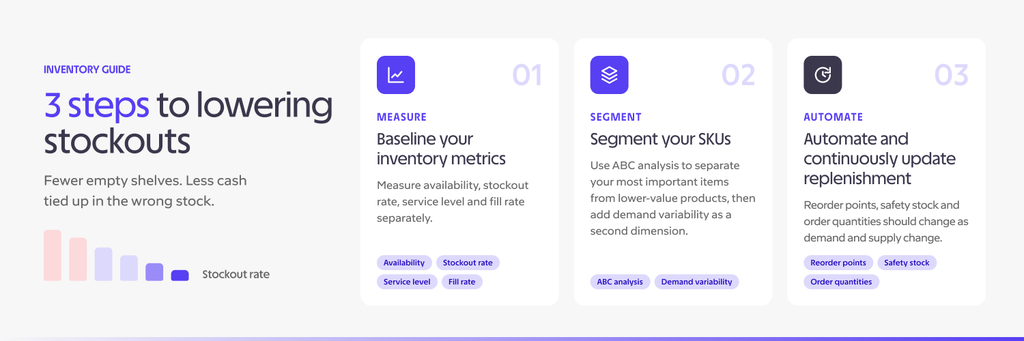
1. Establish your current stockout and availability metrics
Begin by measuring how often products become unavailable and how this affects customer orders.
Track availability, stockout rate, service level and fill rate separately. These metrics reveal different problems and help identify where improvements are needed.
Review performance by product category, location and supplier rather than relying solely on company-wide averages.
This can reveal whether shortages are concentrated among particular SKUs, suppliers or locations.
2. Segment products and set appropriate service levels
Use ABC analysis to identify the products that contribute most to business value.
Combine this with demand variability analysis to distinguish predictable products from those with more uncertain requirements.
Set service level targets according to each product group’s commercial importance, demand behaviour and supply risk.
This allows the business to prioritise availability where shortages would have the greatest impact without committing excessive inventory to every SKU.
3. Improve demand forecasting and supplier data
Reliable replenishment depends on accurate forecasts and realistic supplier lead times.
Review historical demand, seasonality, trends and known changes in customer requirements.
Also examine supplier performance. If actual delivery times frequently differ from the lead times recorded in the system, safety stock calculations may underestimate the inventory needed.
Better demand and supplier data make it possible to calculate more appropriate stock levels.
4. Recalculate safety stock and reorder points regularly
Inventory policies should change as demand and supply conditions change.
Review safety stock and reorder points using current forecasts, lead-time variability and service level targets.
Automated calculations make this practical across thousands of SKUs, helping planners maintain suitable buffers without manually updating each product.
5. Automate replenishment and manage exceptions
Connect replenishment decisions to forecasts, stock policies and supplier constraints.
Automated ordering can reduce the delay between identifying a requirement and preparing a purchase order.
Planners can then concentrate on unusual demand, supplier disruptions, critical shortages and other exceptions that require judgement.
6. Monitor results and refine your approach
Inventory optimisation is an ongoing process.
Track whether stockout frequency is decreasing, availability is improving and inventory investment remains under control.
Review the products that continue to experience shortages and investigate the underlying causes.
Some may require different service level targets, while others may be affected by unreliable lead times, unusual demand or supplier constraints.
Regular monitoring helps ensure improvements continue as business conditions evolve.
How AGR helps businesses reduce stockouts
AGR combines demand forecasting, inventory optimisation and automated replenishment in one platform, helping businesses make more consistent inventory decisions across large product ranges.
| AGR capability | How it helps reduce stockouts |
|---|---|
| Demand forecasting | Anticipates future demand using historical sales patterns, trends and seasonality so businesses can plan inventory requirements earlier. |
| Inventory optimisation | Calculates inventory requirements and safety stock based on demand, variability and service level targets. |
| Automated replenishment | Generates order recommendations using forecasts, stock policies and supplier constraints, reducing manual planning delays. |
| Supplier and lead-time management | Improves visibility into supplier performance and lead-time changes that can affect stock availability. |
| ABC analysis | Helps prioritise important products and apply differentiated inventory policies. |
| Exception-based planning | Directs planners’ attention towards unusual demand, potential shortages and decisions that need intervention. |
The customer results demonstrate how these capabilities can translate into measurable improvements.
BYKO and Wessex Packaging both reduced stockouts by at least 50%, while Space NK’s earlier results show that businesses can increase availability significantly without increasing their total inventory.
For companies managing thousands of SKUs, inventory optimisation provides a more scalable way to balance customer service, stock availability and working capital.
Explore AGR’s inventory management software or request a demo to see how forecasting and automated replenishment can help your business reduce stockouts.