


Effective supply chains are built on preparation, not guesswork. Demand planning helps businesses align inventory, purchasing, forecasting, and operations with actual customer demand so they can reduce waste, avoid stockouts, and improve profitability.
In today’s market, businesses face rising supplier costs, changing customer behaviour, shorter product lifecycles, and growing pressure to improve service levels. Companies that rely on spreadsheets or reactive planning often struggle to keep inventory balanced. The result is excess stock, tied-up capital, missed sales, and operational inefficiencies.
This guide explains what demand planning is, how the process works, the tools and forecasting methods businesses use, and the best practices that help supply chains become more accurate, agile, and resilient.
Demand planning: A simple definition
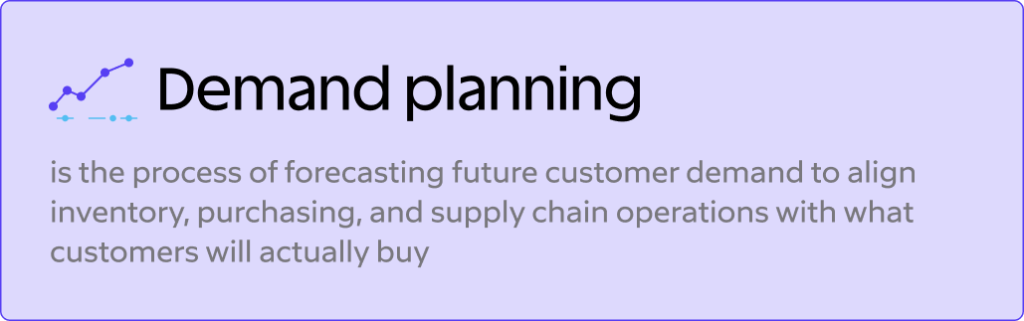
Demand planning is the process of forecasting future customer demand to ensure products are available in the right quantity, at the right time, and in the right place.
It combines historical sales data, forecasting models, market trends, inventory policies, and cross-functional collaboration to create an actionable supply plan. The goal is to balance customer demand with operational capabilities while minimising excess inventory and avoiding stockouts.
Demand planning supports purchasing, replenishment, production scheduling, warehouse operations, and supplier coordination. Rather than reacting to changes after they happen, businesses use demand planning to anticipate demand shifts and prepare proactively.
How does the demand planning process work?
Demand planning is not a one-time exercise. It is a continuous cycle that evolves as demand patterns, supplier conditions, and market dynamics change.
1. Collect and clean data
The process starts with gathering accurate data from across the business, including:
- Historical sales
- Inventory levels
- Supplier lead times
- Promotions
- Customer trends
- Point-of-sale data
- Seasonality patterns
Data quality is critical. Inaccurate stock records, outdated lead times, or duplicate product data can significantly reduce forecast accuracy.
2. Generate a statistical forecast
Businesses use forecasting models to estimate future demand based on historical patterns and trends.
These forecasts may use:
- Time series forecasting
- Regression models
- Seasonal modelling
- Machine learning algorithms
The goal is to create an initial baseline forecast.
3. Add business inputs
Forecasts should not rely on historical data alone. Commercial teams provide additional insights, including:
- Upcoming promotions
- Product launches
- Market conditions
- Customer activity
- Supplier constraints
This step transforms forecasting into true demand planning.
4. Create a consensus demand plan
Sales, finance, procurement, operations, and supply chain teams align around a shared version of expected demand.
This collaborative process reduces departmental silos and improves operational alignment.
5. Execute replenishment and supply plans
The demand plan drives:
- Purchasing decisions
- Inventory replenishment
- Supplier schedules
- Warehouse planning
- Production activities
Execution ensures inventory is aligned with expected demand.
6. Review and improve continuously
Demand planning is iterative. Businesses regularly measure:
- Forecast accuracy
- Bias
- Service levels
- Inventory performance
- Stockouts and overstocks
The process improves over time as planners refine assumptions and models.
Demand planning vs forecasting: What’s the difference?
Demand forecasting and demand planning are closely related, but they are not the same thing.
Forecasting predicts future demand using statistical methods and historical data. Demand planning takes those forecasts and turns them into operational decisions.
| Forecasting | Demand planning |
| Predicts future demand | Converts forecasts into action |
| Primarily statistical | Combines data with business inputs |
| Focuses on numerical estimates | Focuses on execution and alignment |
| Often handled by analysts | Involves multiple departments |
| Answers “what may happen?” | Answers “how should we respond?” |
Forecasting is one component of demand planning. Effective businesses combine both to improve inventory performance and supply chain agility.
Why demand planning matters for your business
Every business that manages inventory relies on demand planning to balance supply with customer demand. Without it, companies either carry too much inventory or not enough.
Reduces excess inventory
Better planning keeps stock levels aligned with real demand. This frees up working capital and reduces holding costs.
Prevents stockouts
Demand planning improves product availability by ensuring inventory is replenished before shortages occur.
Improves cash flow
Businesses avoid tying up unnecessary capital in slow-moving inventory.
Increases forecast accuracy
Structured planning processes continuously refine forecasting performance and improve decision-making.
Strengthens supplier relationships
Suppliers can plan production and deliveries more effectively when they have visibility into future purchasing needs.
Supports strategic growth
Companies gain the confidence to expand product ranges, sales channels, and geographic reach with stronger inventory visibility and planning control.
What does a demand planner do?
A demand planner is responsible for forecasting future demand and coordinating inventory planning activities across the business.
Their responsibilities typically include:
- Analysing historical sales trends
- Monitoring forecast accuracy
- Collaborating with sales and marketing teams
- Managing inventory targets
- Reviewing supplier lead times
- Adjusting forecasts based on market conditions
- Supporting S&OP processes
Demand planners work closely with procurement, finance, operations, and logistics teams to ensure inventory decisions support both customer demand and business goals.
Modern demand planners increasingly rely on advanced forecasting tools, automation, and AI-driven planning systems to manage growing supply chain complexity.
Key elements of effective demand planning
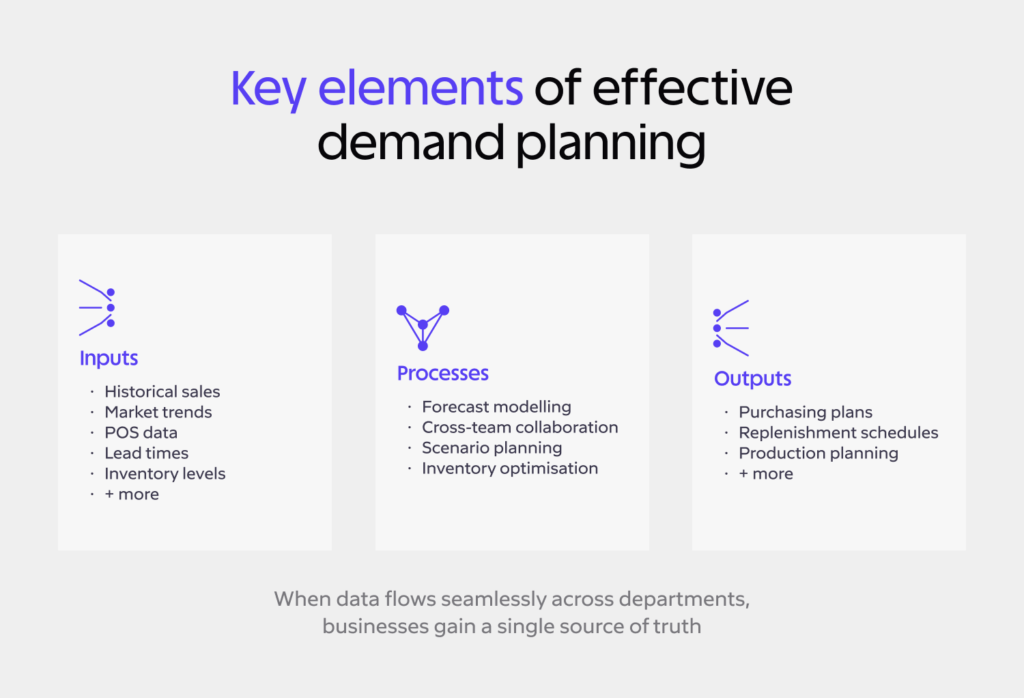
Successful demand planning depends on three core areas: inputs, processes, and outputs.
Inputs
Demand planning relies on accurate and accessible data, including:
- Historical sales data
- Market trends
- Promotional calendars
- POS data
- Supplier lead times
- Inventory levels
- Economic indicators
- Customer demand signals
Processes
Planning processes convert data into operational decisions through:
- Forecast modelling
- Collaboration across departments
- Scenario planning
- Forecast reviews
- Inventory optimisation
- S&OP alignment
Outputs
The result of demand planning includes:
- Purchasing plans
- Replenishment schedules
- Inventory targets
- Supplier forecasts
- Production planning
- Safety stock adjustments
When data flows seamlessly between departments and systems, businesses gain a single source of truth that improves collaboration and visibility.
Forecasting methods used in demand planning
Businesses use different forecasting techniques depending on product complexity, market volatility, and data maturity.
Time series forecasting
Time series models analyse historical demand patterns to predict future sales.
Common methods include:
- Moving averages
- Exponential smoothing
- ARIMA models
These approaches work well for stable, seasonal demand.
Causal forecasting models
Causal models include external variables such as:
- Promotions
- Pricing
- Weather
- Economic conditions
- Marketing campaigns
These methods help explain why demand changes.
Machine learning forecasting
Machine learning models identify complex relationships and demand drivers across massive datasets.
These systems continuously improve as new data becomes available and can detect:
- Non-linear demand shifts
- Product cannibalisation
- Seasonal changes
- Regional demand patterns
- Customer behaviour changes
Machine learning is especially valuable for SKU-level forecasting, where individual products behave differently across stores, regions, or channels.
Scenario planning and demand volatility
Scenario planning helps businesses prepare for uncertainty by modelling different demand outcomes before they happen.
Examples include:
- Sudden demand spikes
- Supplier delays
- Economic downturns
- Promotional campaigns
- Seasonal disruption
Rather than relying on a single forecast, businesses create multiple demand scenarios and define response plans for each.
Scenario planning improves resilience and reduces reactive decision-making during disruption.ding to faster decision-making and fewer errors.
Common demand planning challenges
Even experienced supply chain teams struggle with demand planning challenges.
Poor data quality
Inaccurate inventory records, duplicate SKUs, and inconsistent lead times reduce forecast reliability.
Siloed departments
Sales, operations, finance, and procurement often work from different datasets and assumptions.
Over-reliance on spreadsheets
Manual planning processes become difficult to manage as businesses grow in complexity.
Forecast bias
Human assumptions and outdated forecasting logic can distort planning decisions.
Demand volatility
Customer behaviour changes quickly due to economic conditions, promotions, seasonality, and external disruption.
Limited supplier visibility
Without clear supplier communication and lead-time visibility, replenishment becomes reactive.
Businesses that address these challenges build more agile and resilient supply chains.
How demand planning differs across industries
Demand planning varies significantly between industries.
Wholesale distribution
- Supplier lead times
- Bulk purchasing
- Service levels
- Inventory availability
Planning accuracy directly affects fill rates and customer retention.
Retail
Retailers manage:
- Promotions
- Seasonality
- Omnichannel demand
- SKU-level variability
Retail demand planning requires high forecasting granularity.
Manufacturing
Manufacturers align demand planning with:
- Production scheduling
- Raw material availability
- Capacity planning
- Procurement cycles
Poor planning can disrupt entire production operations.
Technology and ERP integration
Modern demand planning requires more than spreadsheets.
Integrated planning platforms connect:
- ERP systems
- POS platforms
- CRM systems
- Warehouse management systems
- Supplier data
This creates real-time visibility across the supply chain and reduces manual work.
The best demand planning tools typically include:
- AI-driven forecasting
- Automated replenishment
- Exception alerts
- Scenario planning
- Collaboration workflows
- Forecast accuracy monitoring
Seamless ERP integration ensures every team works from the same data, improving decision-making speed and accuracy.
How to implement demand planning in your supply chain
Best practices
Implementing demand planning isn’t just about installing software. It requires cultural and process shifts. Here are key steps:
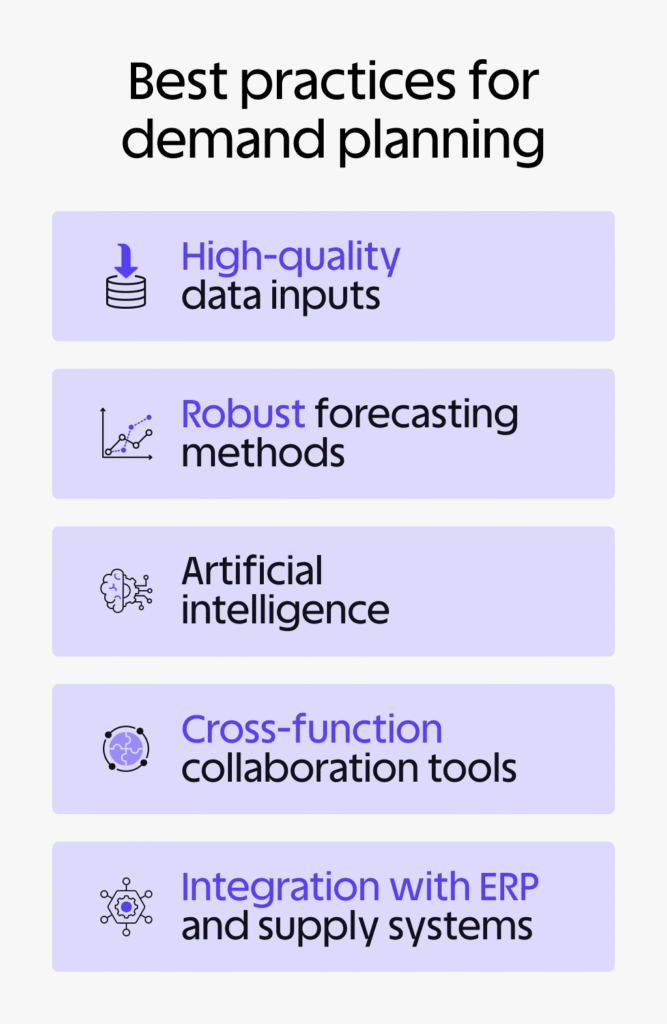
- Start with a pilot: Select a product category or region to test the process. Build early wins and learn what works.
- Build cross-functional alignment: Include stakeholders from sales, marketing, finance, and operations. Demand planning isn’t a solo activity.
- Standardize data sources: Ensure everyone uses the same metrics and definitions.
- Define clear ownership: Assign accountability for forecasts, inputs, and overrides. Transparency supports trust in the numbers.
- Create a review cadence: Monthly or quarterly S&OP (Sales and Operations Planning) meetings help refine forecasts and align plans.
- Invest in training: Equip teams with the skills to use demand planning tools effectively.
- Measure performance: Track forecast accuracy, bias, and other KPIs to improve over time.
The goal is to build a repeatable process that improves continuously as your team gains experience.
Demand planning tools and features to look for
Forecast modelling and AI capabilities
The best systems support:
- Statistical forecasting
- AI-driven planning
- Machine learning recommendations
- Scenario simulation
Collaboration tools
Demand planning involves multiple stakeholders. Strong collaboration features improve alignment and transparency.
ERP integration
Real-time data integration reduces manual entry and improves visibility across inventory, purchasing, and supplier planning.
Scalability
Planning tools should adapt as businesses grow in:
- SKU count
- Warehouse locations
- Sales channels
- Planning complexity
Real-time visibility
Modern supply chains require dynamic planning based on current data, not outdated spreadsheets.
How AGR helped Vital Pet Group improve availability from 75% to 95%
Vital Pet Group, one of the UK’s leading pet product wholesalers, needed a more effective way to manage inventory across a growing product portfolio. As demand became harder to predict and inventory complexity increased, the business faced challenges balancing stock availability with efficient inventory investment.
By implementing AGR’s demand planning and inventory optimisation platform, Vital Pet Group gained greater visibility into demand patterns, improved forecasting accuracy, and automated key replenishment processes. This allowed the team to make faster, more informed inventory decisions and focus their efforts on managing exceptions rather than routine ordering.
- Increased product availability from 75% to 95%
- Improved forecast accuracy and inventory visibility
- Reduced manual planning effort through automation
- Stronger supplier planning and purchasing decisions
- Better inventory control without compromising service levels
With AGR, Vital Pet Group transformed its inventory planning process, achieving substantially higher availability while creating a more scalable and efficient supply chain operation.
FAQs about demand planning
What is demand planning?
Demand planning is the process of forecasting customer demand and aligning inventory, purchasing, and supply chain operations to meet that demand efficiently.
What is the difference between forecasting and demand planning?
Forecasting predicts future demand using data and statistical models. Demand planning uses those forecasts to guide operational decisions such as purchasing, replenishment, and inventory management.
How does AI support demand planning?
AI improves demand planning by identifying hidden demand patterns, adjusting forecasts automatically, and analysing multiple demand drivers simultaneously.
What are the best demand planning tools?
The best demand planning tools combine forecasting models, ERP integration, automation, collaboration features, and real-time inventory visibility.
When should a business invest in demand planning software?
Businesses should consider demand planning software when they experience frequent stockouts, overstocks, growing SKU complexity, or heavy reliance on spreadsheets.
Why is demand planning important?
Demand planning helps businesses reduce inventory costs, improve product availability, increase forecast accuracy, and strengthen supply chain resilience.