
Retailers are under pressure from every direction. Customer expectations change quickly, supply chains remain volatile, and margins are tighter than ever. At the same time, retailers manage thousands of SKUs across stores, warehouses, and online channels.
That complexity creates a planning problem. Traditional forecasting methods and manual processes struggle to keep up with fast-moving demand signals, promotions, seasonality, and omnichannel shopping behaviour.
This is where machine learning in retail becomes valuable.
Machine learning helps retailers analyse large volumes of data, identify patterns, and make faster inventory and planning decisions with greater accuracy. From demand forecasting and automated replenishment to assortment optimisation and supply chain planning, machine learning is becoming a core part of modern retail operations.
What Is Machine Learning in Retail?
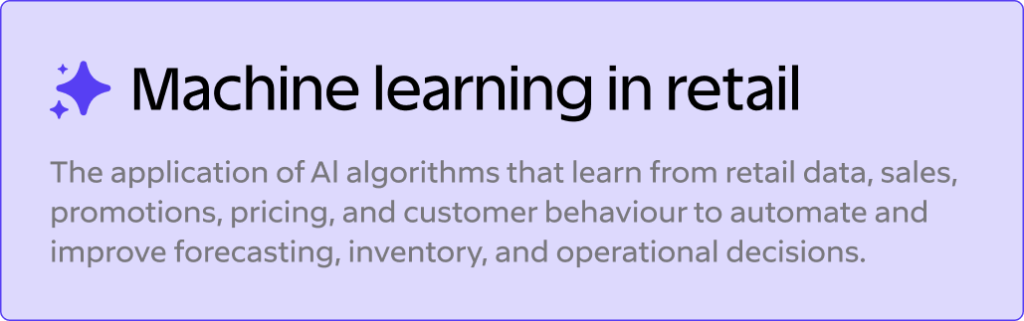
Machine learning is a branch of artificial intelligence (AI) that allows systems to learn from data and improve predictions over time without being explicitly programmed for every scenario.
In retail, machine learning models analyse patterns across large datasets such as:
- Historical sales
- Promotions
- Seasonal demand
- Weather data
- Pricing changes
- Store performance
- Customer behaviour
- Supplier lead times
Unlike traditional rule-based systems, machine learning adapts continuously as new data becomes available. Instead of relying on static assumptions, it identifies relationships and trends that humans or traditional forecasting models may miss.
For example, a traditional forecasting model may assume that sales increase every December because of historical patterns. A machine learning model can go further by recognising that sales rise differently depending on promotions, local weather, online activity, and regional buying habits.
This makes forecasts more dynamic and responsive.
It is also important to separate AI from machine learning:
- Artificial intelligence is the broader concept of systems performing tasks that normally require human intelligence.
- Machine learning is one method used within AI, focused specifically on learning from data patterns.
Retailers increasingly combine machine learning with inventory optimisation to improve forecasting accuracy, replenishment, and operational efficiency. For a deeper look at AI-driven planning, see AGR’s guide to AI inventory optimisation.
Why Machine Learning Matters for Modern Retailers
Retail planning has become significantly more difficult over the past decade.
Consumer behaviour changes faster than traditional planning cycles can handle. Retailers now manage:
- Physical stores
- Ecommerce channels
- Marketplaces
- Click-and-collect operations
- Multiple fulfilment locations
At the same time, external factors constantly affect demand:
- Promotions
- Inflation
- Weather
- Local events
- Social media trends
- Supplier disruptions
This creates fragmented and unpredictable demand signals.
Traditional forecasting methods often struggle with this complexity because they rely heavily on historical averages and manual adjustments. That approach becomes difficult to scale across thousands of SKUs and locations.
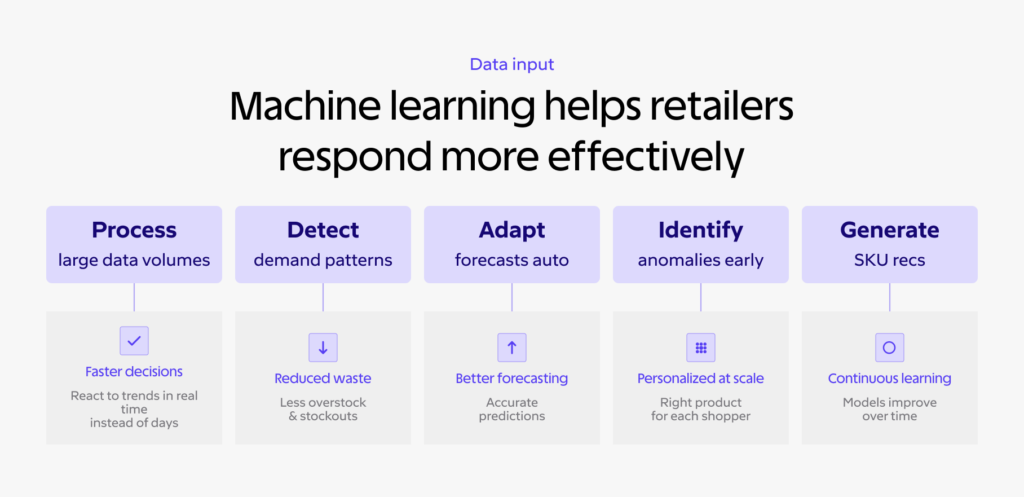
Machine learning helps retailers respond more effectively because it can:
- Process large volumes of data quickly
- Detect hidden demand patterns
- Adapt forecasts automatically
- Identify anomalies earlier
- Generate SKU-level recommendations
- Improve continuously as new data arrives
For retailers, inventory mistakes are expensive. Overstocking ties up working capital and increases storage costs. Understocking leads to lost sales and lower customer satisfaction.
Machine learning helps reduce both risks.
Top Machine Learning Use Cases in Retail
1. Demand forecasting
Demand forecasting is one of the most common applications of machine learning in retail.
Machine learning models analyse historical sales alongside external variables such as:
- Promotions
- Price changes
- Weather patterns
- Seasonal trends
- Holidays
- Channel performance
- Local events
This allows retailers to generate more accurate forecasts at SKU, store, and channel level.
Traditional forecasting often works at category level. Machine learning forecasting can operate much more granularly, helping retailers manage complexity across thousands of products.
Retailers using machine learning forecasting often improve:
- Forecast accuracy
- Inventory turnover
- Service levels
- Replenishment efficiency
For a more detailed look at forecasting models and retail demand prediction, see AGR’s guide to retail demand prediction using machine learning.
2. Automated inventory replenishment
Replenishment decisions are difficult to manage manually at scale.
Machine learning helps automate decisions about:
- What to order
- When to order
- How much to order
Instead of relying on fixed reorder rules, machine learning models continuously adapt recommendations based on:
- Demand shifts
- Supplier lead times
- Inventory availability
- Service-level targets
- Sales velocity
This reduces both stockouts and excess inventory.
Automated replenishment also allows planners to focus on exceptions and high-risk items rather than manually reviewing every SKU.
3. Assortment optimisation
Not every product performs equally well across every store or channel.
Machine learning helps retailers optimise assortments by analysing:
- Regional demand
- Customer preferences
- Store performance
- Product affinity
- Margin contribution
- Seasonal patterns
This helps retailers decide:
- Which SKUs to carry
- Where to stock them
- Which items to phase out
- Which products should be promoted
Assortment optimisation improves inventory productivity by focusing capital on products that generate the best results.
Retailers often combine assortment planning with replenishment and inventory optimisation strategies.
4. Price and markdown optimisation
Pricing decisions directly affect profitability, inventory levels, and customer demand.
Machine learning models can estimate demand elasticity by analysing how customers respond to:
- Price changes
- Discounts
- Competitor pricing
- Seasonal trends
- Inventory availability
This helps retailers optimise:
- Promotional pricing
- Markdown timing
- Clearance strategies
- Margin protection
For example, machine learning can recommend earlier markdowns for slow-moving inventory before products become obsolete.
5. Personalised customer experiences
Retailers also use machine learning to personalise customer interactions.
Common examples include:
- Product recommendations
- Personalised promotions
- Loyalty targeting
- Cross-selling suggestions
- Search result optimisation
These models analyse browsing behaviour, purchase history, and customer preferences to improve conversion rates and customer engagement.
Although personalisation receives significant attention, inventory and supply chain applications often generate larger operational value for retailers.
6. Fraud detection and loss prevention
Machine learning helps retailers identify unusual behaviour patterns that may indicate fraud.
This includes:
- Suspicious transactions
- Return fraud
- Payment anomalies
- Inventory shrinkage patterns
Machine learning models are particularly effective because they can identify subtle behavioural patterns that rule-based systems often miss.
7. Supply chain optimisation
Machine learning also improves upstream supply chain planning.
Retailers use machine learning for:
- Supplier performance analysis
- Lead time prediction
- Warehouse allocation
- Distribution planning
- Route optimisation
- Exception management
For example, models can detect when supplier lead times begin drifting upward and recommend earlier ordering before service levels are affected.
This creates a more proactive supply chain.
How Machine Learning Improves Retail Inventory Management
Inventory management is one of the areas where machine learning delivers the clearest operational value.
| Retail inventory challenge | How machine learning helps | Business impact |
|---|---|---|
| Forecast uncertainty | Analyses historical sales, seasonality, promotions, and external variables to generate more accurate demand forecasts | Better forecast accuracy and improved service levels |
| Manual planning bottlenecks | Automates repetitive planning tasks and prioritises exceptions | Faster planner workflows and improved productivity |
| Excess stock | Identifies slow-moving items and optimises order quantities | Lower excess inventory and reduced carrying costs |
| Stockouts | Detects demand shifts early and improves replenishment recommendations | Fewer stockouts and stronger customer satisfaction |
| Slow-moving inventory | Highlights declining SKU performance and recommends action | Reduced waste and improved inventory turnover |
| Poor inventory visibility | Consolidates inventory, sales, and supply chain data into clearer operational insights | More confident purchasing and planning decisions |
| Replenishment complexity | Continuously adjusts recommendations based on demand, lead times, and stock levels | More accurate replenishment planning |
| Reactive decision-making | Provides earlier warnings and predictive insights | Faster response to demand and supply chain changes |
| Margin pressure | Optimises stock investment and availability simultaneously | Improved GMROI and profitability |
Planners still provide commercial judgement, supplier context, and strategic oversight. Machine learning simply helps them process more information faster and make more scalable decisions.
Retailers using machine learning effectively often combine it with broader retail KPI tracking and inventory performance metrics.
Benefits of Machine Learning in Retail
The biggest benefits of machine learning in retail include:
Improved forecast accuracy
Machine learning models process more variables than traditional forecasting methods, improving demand predictions across stores and channels.
Reduced stockouts
Better forecasting and replenishment recommendations help maintain availability and improve customer satisfaction.
Lower excess inventory
Retailers can reduce overstocking by aligning purchasing decisions more closely with actual demand patterns.
Faster decision-making
Machine learning helps planners identify exceptions and prioritise high-risk issues faster.
Better inventory productivity
Retailers can improve inventory turnover and working capital efficiency by focusing stock investment more effectively.
Improved scalability
Machine learning supports planning across large SKU assortments and multiple locations without requiring proportional increases in manual effort.
More responsive supply chains
Retailers can react more quickly to changing demand conditions and supply disruptions.
Common Challenges of Implementing Machine Learning in Retail
The biggest challenge is rarely the algorithm itself.
Most retailers struggle more with data readiness, operational processes, and adoption.
Poor data quality
Machine learning depends on clean, structured data.
Problems such as inconsistent product naming, inaccurate stock records, or missing sales history reduce forecasting accuracy significantly.
Siloed systems
Retail data often sits across disconnected ERP, ecommerce, POS, and warehouse systems.
Without integration, machine learning models cannot access the full operational picture.
Change management
Retail teams may resist automated recommendations if they do not trust the outputs or understand how models work.
Successful implementation requires both technology and process alignment.
Choosing the wrong use case
Some retailers attempt large-scale AI transformations too early.
Most successful projects begin with focused use cases such as:
Balancing automation with human oversight
Machine learning should support decision-making, not remove human expertise entirely.
The best results typically come from combining automated insights with planner judgement.
Examples of Machine Learning in Retail Inventory Decisions
Example 1: Forecasting seasonal demand
A retailer uses machine learning to analyse:
- Historical Christmas sales
- Weather forecasts
- Promotional activity
- Regional buying trends
The model predicts demand spikes earlier than traditional forecasting methods, allowing inventory teams to order stock proactively.
Example 2: Preventing stockouts
A replenishment model detects that sales velocity for a product is increasing faster than expected.
Instead of waiting for manual intervention, the system recommends earlier purchasing before inventory reaches critical levels.
Example 3: Reducing overstock
Machine learning identifies a group of slow-moving SKUs with declining demand.
The retailer responds by:
- Reducing future purchase quantities
- Introducing markdowns earlier
- Reallocating stock across locations
This helps reduce carrying costs and free working capital.
Conclusion
Machine learning is becoming a core capability for modern retail operations.
Retailers face increasing complexity across forecasting, replenishment, inventory planning, pricing, and supply chain management. Traditional planning methods struggle to scale effectively in this environment.
Machine learning helps retailers improve forecasting accuracy, automate repetitive planning tasks, reduce stockouts, and optimise inventory decisions at scale.
The retailers gaining the most value are not replacing planners with automation. They are combining machine learning with operational expertise to make faster, more informed decisions.
For retailers focused on inventory optimisation, demand forecasting, and replenishment efficiency, machine learning provides a practical path toward more resilient and data-driven retail operations.
FAQs About Machine Learning in Retail
What is machine learning in retail?
Machine learning in retail refers to systems that analyse retail data patterns to improve forecasting, inventory management, pricing, customer experiences, and operational decision-making.
How is machine learning used in retail?
Retailers use machine learning for demand forecasting, automated replenishment, assortment optimisation, pricing, fraud detection, supply chain planning, and customer personalisation.
What are examples of machine learning in retail?
Examples include predicting seasonal demand, automating replenishment orders, recommending markdowns for slow-moving inventory, and identifying fraud patterns.
How does machine learning improve inventory management?
Machine learning improves inventory management by increasing forecast accuracy, reducing stockouts and excess inventory, automating replenishment decisions, and helping planners identify risks earlier.
Can machine learning reduce stockouts?
Yes. Machine learning models detect demand shifts earlier and generate more accurate replenishment recommendations, helping retailers maintain availability and avoid stockouts.
What data do retailers need for machine learning?
Retailers typically use sales history, promotions, pricing data, inventory levels, supplier lead times, customer behaviour, seasonal trends, and external variables such as weather or local events.