

Tools for demand planning help businesses forecast customer demand, plan inventory and make better purchasing decisions. They range from spreadsheets and forecasting functions within ERP systems to dedicated software that uses statistical models, AI and automation.
The right tool depends on the size and complexity of your business, the number of products and locations you manage and how much control you need over forecasting and replenishment. While spreadsheets may be sufficient for straightforward planning, businesses managing thousands of SKUs, changing demand patterns and multiple suppliers often need more sophisticated tools to maintain availability without tying up unnecessary capital in stock.
What are demand planning tools?
Demand planning tools are systems used to analyse historical sales, identify demand patterns and estimate how much of each product customers will need in the future. They help businesses make informed decisions about what to purchase, when to order and how much inventory to hold.
Demand planning goes beyond predicting sales. An effective planning process also considers promotions, seasonality, product launches and changing customer behaviour. The resulting forecasts inform inventory targets, purchasing schedules and broader supply chain decisions.
Businesses generally use three types of demand planning tools.
| Type of tool | Strengths | Limitations | Best suited for |
|---|---|---|---|
| Spreadsheets and manual planning tools | Familiar, flexible and inexpensive to start using | Time-consuming to maintain, vulnerable to errors and difficult to scale | Smaller businesses with limited product ranges and relatively stable demand |
| ERP-based forecasting and planning | Uses existing business data and connects planning with operational processes | Forecasting depth, automation and planning flexibility vary between systems | Businesses with relatively straightforward requirements or those wanting to use existing ERP functionality |
| Dedicated demand planning software | Advanced forecasting, automated calculations, exception management and integration with inventory planning | Requires software investment, data integration and implementation planning | Businesses managing complex inventories, multiple locations or changing demand patterns |
Spreadsheets are often where demand planning begins. A planner exports sales history, calculates average demand and adjusts future estimates based on experience. This can work well when there are relatively few products and demand is predictable. Problems arise as the business grows. Each additional SKU, supplier, location or sales channel adds complexity. Forecasts need regular updating, formulas become harder to maintain and planners spend increasing amounts of time preparing data rather than making decisions.
ERP systems provide a more structured foundation by keeping purchasing, sales and inventory information together. However, the forecasting and optimisation capabilities available within an ERP depend on the system and its configuration. Dedicated demand planning software builds on this operational data, applying more sophisticated forecasting methods and helping planners translate expected demand into purchasing and inventory decisions.
For a broader explanation of the planning process, read our guide to what demand planning is.
What features should you look for in demand planning software?
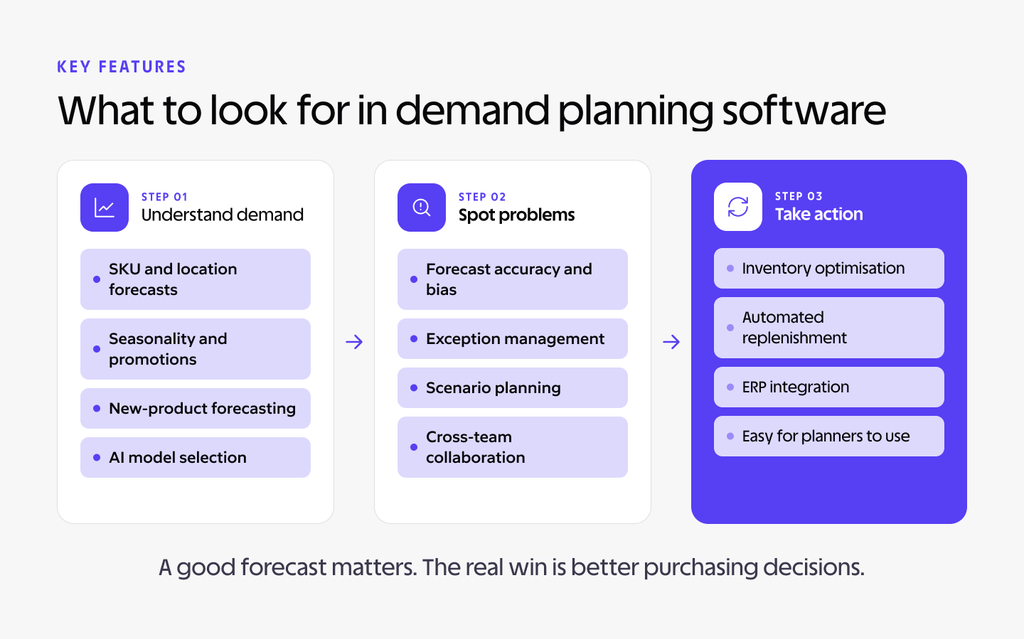
The most useful demand planning software does more than produce a forecast. It should help planners understand demand, identify potential problems and take appropriate action. The following capabilities are particularly important when comparing solutions.
Demand forecasting at SKU and location level
Overall sales forecasts can be useful for budgeting, but inventory decisions usually happen at a much more detailed level. A business needs to know how many units of a particular product are likely to sell at a particular location, not simply whether total revenue is expected to increase.
Look for software that can forecast demand at the individual SKU and location level. Businesses operating across several sales channels may also need separate forecasts for wholesale customers, retail stores or e-commerce. This level of detail helps prevent a common problem: having enough stock across the business but not enough in the locations where customers need it.
Seasonality, promotions and new-product forecasting
Demand rarely follows a perfectly consistent pattern. Some products experience predictable seasonal peaks, while others are affected by promotions, customer contracts or changes in buying behaviour. New products create another challenge because there may be little or no sales history to analyse.
Demand planning software should be able to recognise seasonal patterns and allow planners to account for known future events. Useful capabilities include promotional planning, forecast adjustments and methods for estimating demand for new products using information from comparable items. The important consideration is whether the system can distinguish between normal demand and temporary changes, rather than allowing an unusual sales period to distort future forecasts.
AI-assisted forecasting and automated model selection
Different products behave differently, so applying one forecasting method across an entire inventory is rarely the best approach. Some products have stable demand. Others show strong seasonal patterns, gradual trends or intermittent sales.
Software that automatically evaluates forecasting models can select an appropriate method for each item rather than requiring planners to make these decisions manually. AI and machine learning can also help identify complex patterns, analyse additional demand signals and support forecasting when historical information is limited.
However, automation should not come at the expense of transparency. Planners need to understand the assumptions behind a forecast, see where adjustments have been made and retain the ability to apply their own business knowledge.
Forecast accuracy, bias tracking and exception management
A forecast is only useful if the business can evaluate how well it performs. Forecast accuracy measures the difference between predicted and actual demand. Forecast bias identifies whether predictions consistently overestimate or underestimate sales.
Both matter. A forecast that regularly overestimates demand can lead to excess stock, while persistent underestimation increases the risk of stockouts. Look for tools that make forecast performance visible and help planners identify the products that need attention.
Exception management is particularly valuable for businesses with large inventories. Rather than reviewing every SKU individually, planners can concentrate on unusual demand changes, potential shortages and other situations requiring a decision.
Scenario planning and collaboration
Demand planning involves more than the purchasing team. Sales teams may know about upcoming promotions or changes in customer demand. Finance needs visibility into expected inventory investment. Operations needs to understand how purchasing decisions affect warehouse capacity and supply requirements.
A good demand planning tool should allow relevant teams to contribute information without losing control of the planning process. Scenario planning can also help businesses assess potential changes, such as a major customer increasing orders, a supplier extending lead times or a promotional campaign generating higher-than-expected demand.
The level of scenario modelling required will depend on the business. Some organisations need detailed cross-functional simulations, while others primarily need the ability to adjust forecasts and immediately understand the impact on inventory.
Inventory optimisation and automated replenishment
This is where forecasting becomes operationally useful. Knowing that demand for an item is likely to increase next month does not automatically tell a purchasing team how much to order today.
That decision also depends on current stock, outstanding purchase orders, supplier lead times, minimum order quantities, order cycles and the level of availability the business wants to maintain. Inventory optimisation uses this information to determine appropriate stock levels. Replenishment functionality then helps translate those requirements into purchasing recommendations.
Software that connects forecasting with replenishment can reduce the manual work involved in calculating orders while helping businesses balance stock availability with inventory investment. An accurate forecast is valuable, but its real benefit comes from helping the business make better purchasing decisions.
ERP integration, usability and implementation
Demand planning software needs reliable information to work effectively. That usually means integrating with an ERP system to access sales history, inventory balances, purchase orders, product information and supplier data.
When evaluating software, consider how information moves between systems, how frequently it is updated and what happens when data is missing or incorrect. Usability matters just as much as technical capability. A system with sophisticated forecasting methods will deliver limited value if planners cannot understand its recommendations or use it effectively in their daily work.
Ask prospective providers about implementation requirements, data preparation, training and the resources your team will need to maintain the system.
Best demand planning software tools to consider
There are several established demand planning platforms, but they are not all designed to solve the same problems. Some concentrate on forecasting, inventory optimisation and replenishment. Others support broader planning processes across finance, sales, operations and complex supply chain networks.
The following comparison provides a starting point for evaluating five options.
| Platform | Main planning focus | Typical business fit | Relevant capabilities or considerations |
|---|---|---|---|
| AGR | Demand forecasting, inventory optimisation and automated replenishment | Wholesalers, distributors and retailers seeking to connect forecasting with day-to-day inventory and purchasing decisions | Item-level forecasting, automated model selection, inventory planning, supplier lead-time considerations and ordering recommendations |
| Anaplan | Connected, cross-functional planning and demand forecasting | Organisations needing collaborative planning across departments and complex business structures | AI-driven forecasting, scenario assessment, planning across product and customer segments and collaboration between teams |
| Netstock | Demand planning, inventory optimisation and ordering | Inventory-focused businesses looking to improve forecasting and purchasing decisions | Statistical forecasting, collaborative demand planning, forecast performance monitoring and integration with inventory optimisation |
| RELEX Solutions | Forecasting and replenishment across retail and supply chain operations | Retailers and other businesses with complex product-location and replenishment requirements | Granular forecasting, replenishment proposals, lead-time considerations and planning for product lifecycles |
| SAP Integrated Business Planning (SAP IBP) | Integrated demand, supply, inventory and sales and operations planning | Organisations requiring broad supply chain planning and coordination | Statistical forecasting, demand sensing, scenario planning, inventory optimisation and integration with other SAP processes |
Comparison based on the vendors’ published product information. Individual capabilities, integrations and implementation requirements should be confirmed directly with each provider.
The distinction between these platforms is largely about the scope of the planning problem. Specialised inventory planning platforms such as AGR and Netstock concentrate on helping businesses connect demand forecasts with inventory levels and replenishment. They are worth evaluating when the main challenge is deciding what to stock, how much to buy and when to place orders.
RELEX offers forecasting and replenishment capabilities designed for complex retail and supply chain environments, where demand may need to be planned across extensive product and location networks. Anaplan and SAP IBP support broader planning requirements. They may be appropriate when an organisation needs to coordinate demand forecasts with financial plans, supply constraints, business scenarios and multiple departments.
These categories are not mutually exclusive. The platforms have overlapping capabilities, and the right choice depends on how the business operates. A company with a small planning team and thousands of SKUs may prioritise automation, ease of use and ERP integration. A multinational manufacturer coordinating production capacity, regional demand and financial planning may have a different set of requirements.
Implementation is another important consideration. Buyers should evaluate the data, internal resources, configuration and ongoing maintenance each solution requires rather than comparing functionality alone.
Vendor information is available from AGR, Anaplan, Netstock, RELEX Solutions and SAP.
Which demand planning models and methods do these tools use?
Demand planning software uses forecasting models to estimate future customer demand based on historical information and other relevant factors. These models are not separate categories of software. They are mathematical and statistical methods used within the broader demand planning process.
Different methods are suited to different demand patterns.
| Forecasting method | How it works | When it is useful |
|---|---|---|
| Moving averages | Calculates average demand across a defined number of historical periods | Products with relatively stable demand and limited variation |
| Exponential smoothing | Uses historical demand while giving greater weight to more recent observations | Products where recent changes are relevant to future demand |
| Seasonal forecasting | Identifies recurring demand patterns across weeks, months or seasons | Products affected by predictable seasonal peaks and declines |
| Causal forecasting | Uses relationships between demand and other variables, such as promotions, prices or economic conditions | Businesses where external factors significantly influence sales |
| AI and machine learning | Analyses patterns and relationships in data to generate demand predictions | Complex demand patterns, larger datasets or forecasting problems involving multiple variables |
A moving average might work well for a product that sells approximately the same quantity every month. However, it may be less suitable for an item with a strong Christmas sales peak. Seasonal forecasting can recognise recurring fluctuations, while exponential smoothing can help forecasts respond to changing demand patterns.
Causal models introduce additional information. For example, a retailer might use historical promotional activity alongside sales data to estimate how a future campaign could affect demand. AI and machine learning can identify relationships that are difficult to capture through simpler models. They can also support forecasting for new products by analysing information from similar items.
No single method is universally best. Forecast performance depends on the quality of the available data, the characteristics of the product and the business environment. This is why automated model selection can be valuable. Instead of applying one approach to every SKU, software can evaluate different forecasting methods and select those that perform best for individual demand patterns.
Even the most sophisticated model needs regular monitoring. Demand changes, product ranges evolve and unusual events can make historical patterns less reliable.
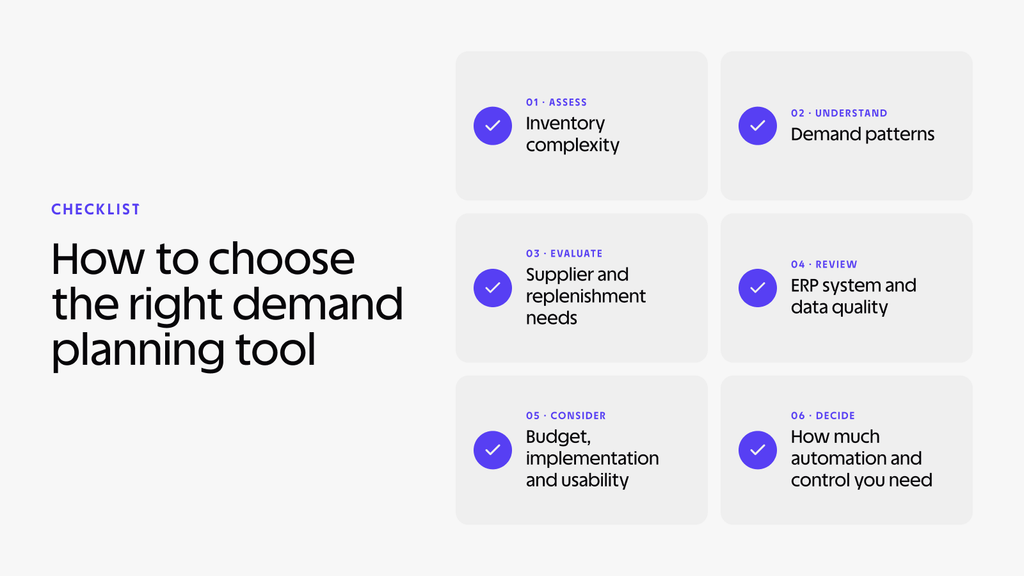
How do you choose the right demand planning tool for your business?
Choosing demand planning software starts with understanding what your business needs to improve. A long list of features is less useful than a clear picture of the planning problems your team encounters every day.
1. Assess your inventory complexity
Start with the number of SKUs, locations and sales channels you manage. A business with 200 products in one warehouse has different requirements from a distributor managing 20,000 SKUs across several locations.
Consider whether your team needs to forecast demand separately for individual locations, customers or sales channels. Also assess how frequently products are introduced, discontinued or replaced. As inventory complexity increases, automated forecasting and exception-based planning generally become more valuable.
2. Understand your demand patterns
Consider how predictable customer demand is. If most products sell at a consistent rate, relatively simple forecasting methods may be sufficient.
If your business experiences seasonal fluctuations, promotional peaks, intermittent demand or frequent changes in customer orders, you will need more flexible forecasting capabilities. Look at the time your team currently spends correcting forecasts and investigating unusual demand patterns.
3. Evaluate supplier and replenishment requirements
Forecasting is only part of the inventory planning process. Supplier lead times, delivery schedules, minimum order quantities and purchasing constraints all influence how much stock the business needs.
A company importing products with long and variable lead times may need more sophisticated inventory optimisation than one replenishing stock from local suppliers several times a week. Consider whether you need software that simply generates forecasts or a platform that also recommends purchasing quantities and helps automate replenishment.
4. Review your ERP system and data quality
Your existing systems will influence which demand planning tools are practical. Identify where sales, inventory, purchasing and supplier information is stored. Check whether the data is sufficiently accurate and complete to support automated forecasting.
Pay particular attention to product identifiers, historical sales, stockout periods and supplier lead times. Ask software providers how their platforms integrate with your ERP and what data preparation is required before implementation.
Good integration reduces manual data handling, but it cannot automatically resolve every underlying data quality problem.
5. Consider budget, implementation and usability
Software costs are only one part of the investment. You should also consider implementation, integration, training, ongoing administration and the amount of time employees will spend using the system.
A sophisticated planning platform may offer extensive functionality, but that functionality needs to be relevant to your business and manageable for your team. Ask for a realistic explanation of implementation requirements and the resources needed from your organisation.
6. Decide how much automation and control you need
Automation can reduce repetitive work, particularly when planners manage large product ranges. However, businesses also need visibility into how forecasts and recommendations are calculated.
Look for a balance between automation and planner control. Your team should be able to understand forecasts, identify exceptions and make adjustments when business knowledge suggests a different outcome. Transparency is particularly important when AI contributes to planning decisions.
Example: Moving from spreadsheets to demand planning software
Consider a growing wholesaler managing 5,000 SKUs across two warehouses. Its purchasing team currently exports sales data from the ERP system into Excel. Planners calculate demand estimates, adjust them for known seasonal changes and manually determine purchasing quantities.
As the business expands, the process becomes increasingly difficult to manage. Forecast updates take several days, stockouts occur despite high inventory levels and planners struggle to keep up with supplier lead-time changes.
The business could evaluate a dedicated demand planning platform against several practical requirements:
- Can it automatically forecast demand for every SKU and warehouse?
- Can it recognise seasonality and account for planned promotions?
- Does it calculate replenishment recommendations using stock levels, outstanding orders and supplier lead times?
- Can planners identify which items need attention without reviewing every forecast?
- Does it integrate with the existing ERP system and reduce manual data preparation?
- Can the team understand and adjust forecasts when necessary?
The wholesaler should test prospective systems using its own data and typical purchasing scenarios. Rather than relying exclusively on demonstrations or vendor claims, it can measure potential improvements against its current process.
Relevant KPIs might include forecast accuracy, stock availability, inventory turnover, inventory value and the time spent preparing forecasts and purchase orders. This approach makes it easier to determine whether the software will solve real operational problems and justify the investment.
How can AGR support demand planning?
AGR connects demand forecasting with inventory optimisation and automated replenishment, helping businesses turn predictions about future sales into practical purchasing decisions.
The platform uses ERP data to analyse demand at item and location level, automatically evaluates statistical forecasting models and accounts for changing demand patterns, including seasonality. Planners can monitor forecast accuracy, review the underlying data and adjust demand plans based on their business knowledge. AGR also supports promotional planning and AI-assisted forecasting for products with limited sales history.
Forecasts feed into inventory planning and replenishment calculations that consider factors such as supplier lead times, stock availability, outstanding orders and purchasing requirements. AGR then generates ordering recommendations, helping purchasing teams spend less time on routine calculations and more time managing exceptions and making informed decisions.
By connecting forecasting, inventory optimisation and replenishment, AGR helps businesses improve stock availability while keeping inventory investment under control.