


Every product starts with an idea. But to move from design to delivery, businesses need a detailed plan of the materials, components, and processes required. That’s the role of a bill of materials (BOM). Dive into the types of BOM.
A BOM is much more than a shopping list of parts. It’s a structured document that ensures every department — from engineering and procurement to production and after-sales service — is working from the same blueprint. Without it, errors multiply, costs rise, and efficiency suffers.
But not all BOMs are created equal. Depending on industry, product complexity, and business goals, companies rely on different types of BOMs. In this guide, we’ll break down 10 key types of BOMs, explain where they’re used, and why they matter for supply chain and inventory management.
What is a bill of materials?
A bill of materials is a comprehensive list of all the items, assemblies, and instructions needed to produce a finished product. It provides structure to complex supply chains and acts as the single source of truth across teams.
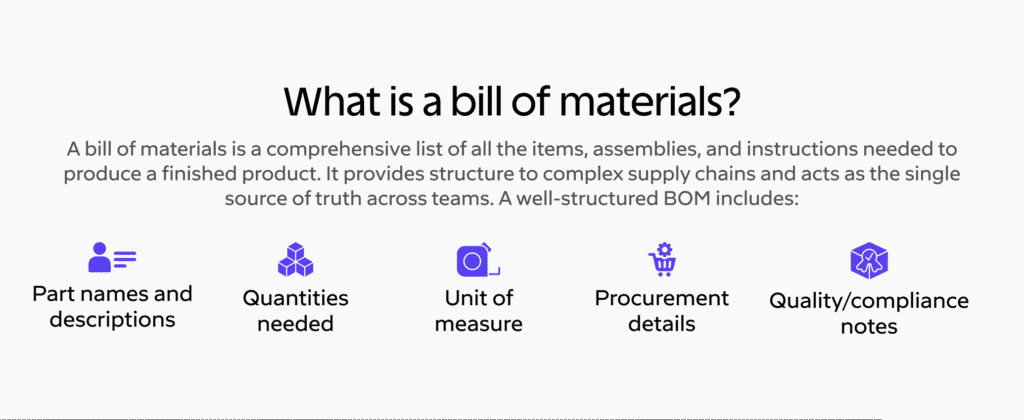
A well-structured BOM includes:
- Part names and descriptions
- Quantities needed
- Unit of measure
- Procurement details (buy, make, subcontract)
- Notes on quality standards or compliance
For a full overview, see our bill of materials guide.
Manufacturing BOM (MBOM)
The manufacturing BOM (MBOM) is central to production. It details the raw materials, parts, and assemblies required for manufacturing. Each item is tied to a unique identifier so shop floor systems can track it.
Key use case: enabling manufacturing execution systems (MES) to order and allocate resources efficiently.
Engineering BOM (EBOM)
An engineering BOM (EBOM) is created during product design and development. It represents the product from an engineering perspective, often linked to CAD drawings. EBOMs show design intent, version control, and how the product should function.
Key use case: ensuring the design aligns with production capabilities.
Service BOM
A service BOM lists parts needed for maintenance, repairs, or upgrades. It often excludes production-specific items but includes consumables and spare parts.
Key use case: keeping equipment operational throughout its lifecycle.
Sales BOM
A sales BOM defines how a product is sold and represented in the sales process. It shows the finished product alongside its components. Unlike an MBOM, it’s designed for pricing and fulfilment.
Key use case: configurable products where customers choose specific options (e.g. furniture sets, electronic kits).
Assembly BOM
An assembly BOM details sub-assemblies that combine into a finished product. It’s particularly useful for modular production, where standardised assemblies can be reused across multiple product lines.
Key use case: electronics, automotive, or machinery manufacturing.
Configurable BOM
A configurable BOM supports products with multiple variants. It allows businesses to generate custom BOMs on demand based on chosen features or specifications.
Key use case: products with high variability, such as custom PCs or industrial machinery.
Production BOM
This type of BOM is built for planning and procurement. It ensures the right parts are available when production begins, aligning closely with materials requirement planning (MRP).
Key use case: bridging the gap between engineering and shop floor execution.
Template BOM
A template BOM serves as a starting point for new product designs. Instead of creating a BOM from scratch, teams adapt a standardised template to fit new projects.
Key use case: companies with similar product families that share components.
Software BOM
A software BOM (SBOM) lists software elements, libraries, and licences used in building an application. It’s critical for managing vulnerabilities and ensuring compliance.
Key use case: software developers and businesses subject to cybersecurity audits.
Single-level vs multi-level BOM
Not all BOMs need the same level of detail. For simple products, a single-level BOM may be enough. For complex assemblies, a multi-level BOM is essential.
Here’s how they compare:
| Feature | Single-level BOM | Multi-level BOM |
| Structure | Flat list of components | Hierarchical, showing parent-child relationships |
| Detail level | Only top-level parts included | Includes sub-assemblies, sub-parts, and raw materials |
| Best for | Simple products or one-off items | Complex products with multiple layers of assemblies |
| Advantages | Easier to create and maintain | Provides full visibility into every component |
| Limitations | Lacks detail for complex production | More complex to manage and update |
Creating bills of materials with AGR
Tracking different BOM types manually is time-consuming and prone to error. AGR connects BOM management with inventory and demand planning. That means you can:
- Forecast demand for both components and finished goods
- Reduce the risk of stockouts across multiple BOMs
- Improve collaboration between engineering, purchasing, and production
By centralising BOM data, AGR helps businesses turn product complexity into a competitive advantage.
Advantages of BOMs
A well-structured BOM supports every stage of the supply chain:
- Single source of truth: all teams rely on the same product data.
- Fewer stockouts and overstocks: inventory needs are clearer and better aligned.
- More demand planning control: planners can predict requirements with higher accuracy.
- Better cost management: improved visibility of material usage and spend.
- Higher product quality: consistency across batches and production runs.
For more detail, see our bill of materials examples and templates.
FAQs about BOMs
How many types of BOM are there?
There are more than ten in total, but these ten represent the most common and practical types across industries.
What are two levels of BOM?
Single-level BOMs show only the top-level items. Multi-level BOMs break down every assembly into sub-parts, creating a full hierarchy.
What is the BOM item type?
Item type refers to how each component is classified in the BOM, such as raw material, semi-finished product, or finished good.
What is a BOM in AGR?
In AGR, a BOM helps you manage demand for both finished goods and their underlying components. A single-level BOM tracks the direct link between a finished product and its parts, while a multi-level BOM goes deeper by including sub-components and assemblies. This way, AGR lets you plan stock needs across the full structure. Read more in AGR’s help article.