


When we’re struck by the streamlined beauty of a sculpture like Michelangelo’s David, we can’t see the artist’s most crucial choice: what to remove.
The same principle applies to inventory management. Building a profitable and resilient product portfolio is not just about adding more SKUs. It is about understanding which products truly create value, which ones drain resources, and where simplification improves performance.
That is where SKU rationalisation comes in.
SKU rationalisation helps businesses reduce unnecessary inventory complexity by identifying underperforming, redundant, or low-value products. Done correctly, it improves inventory turnover, frees working capital, reduces operational friction, and helps planners focus on the products that matter most.
In this guide, we cover:
- What SKU rationalisation is and why it matters
- Signs your product portfolio may need rationalisation
- A step-by-step SKU rationalisation process
- The most important SKU rationalisation formulas
- Common challenges and how to overcome them
- How technology supports smarter SKU decisions
What is SKU rationalisation?
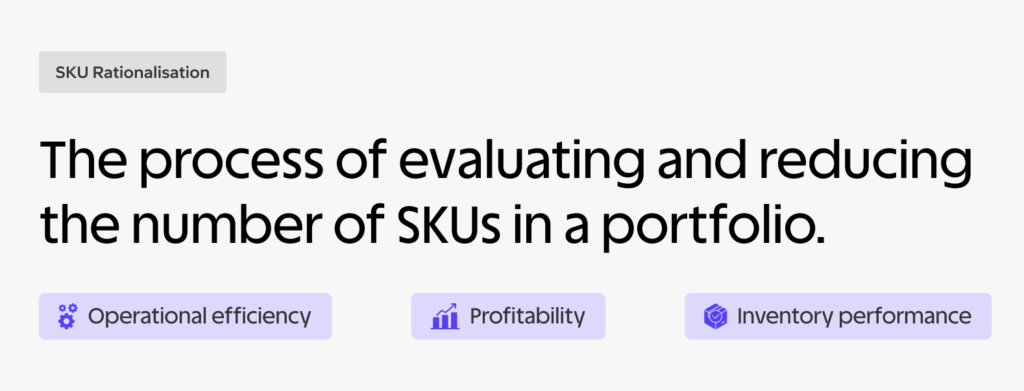
SKU rationalisation is the process of evaluating and reducing the number of stock keeping units (SKUs) in a product portfolio to improve operational efficiency, profitability, and inventory performance.
The goal is not simply to remove products. The goal is to create a healthier inventory mix by focusing on the SKUs that generate the greatest value for customers and the business.
SKU rationalisation often involves analysing:
- Sales performance
- Inventory turnover
- Profitability
- Demand variability
- Storage and handling costs
- Supplier complexity
- Product lifecycle performance
If you are new to SKU structures and product identifiers, our guide to what a SKU is explains the fundamentals and how businesses use SKUs to manage inventory.
SKU rationalisation vs SKU optimisation
These terms are often used interchangeably, but they are not identical.
SKU optimisation focuses on improving the performance of existing SKUs through forecasting, pricing, replenishment, assortment changes, or operational improvements.
SKU rationalisation focuses on deciding whether a SKU should continue to exist in the portfolio at all.
In practice, the two processes work together. Optimisation improves performance. Rationalisation reduces unnecessary complexity.
SKU rationalisation vs product rationalisation
Product rationalisation operates at a broader level. It focuses on product categories, brands, or ranges.
SKU rationalisation is more granular. It looks at individual variants, sizes, colours, packaging formats, or location-specific products.
For example, a retailer may continue selling a product category while rationalising low-performing size or colour variants within that category.
Why SKU rationalisation matters
Most businesses accumulate SKUs over time.
New customer requests, seasonal launches, supplier promotions, sales opportunities, and expansion into new channels often increase product counts faster than businesses evaluate performance.
The result is frequently an inventory portfolio that becomes more difficult and expensive to manage.
Research consistently shows that a relatively small percentage of SKUs often drives the majority of revenue and profit. In many businesses, 20% of SKUs generate around 80% of sales value.
That imbalance creates significant operational consequences.
Reduce inventory carrying costs
Every SKU adds cost.
Additional products require:
- Warehouse space
- Purchasing activity
- Replenishment planning
- Forecasting effort
- Supplier management
- Counting and auditing
- Storage and handling
Low-performing SKUs can quietly consume working capital while contributing very little revenue.
SKU rationalisation helps businesses reduce excess inventory, lower storage costs, and minimise obsolete stock.
Free up working capital
Slow-moving inventory ties up cash that could be invested elsewhere.
By reducing low-value SKUs, businesses can:
- Improve cash flow
- Increase purchasing flexibility
- Invest in high-performing products
- Reduce markdown pressure
- Improve return on inventory investment
Improve forecasting accuracy
Large and fragmented SKU portfolios make forecasting significantly harder.
The more products planners must manage, the more difficult it becomes to identify meaningful demand signals.
Reducing unnecessary SKUs simplifies forecasting and improves planning precision.
Simplify inventory management
Complex portfolios create operational friction.
Warehouse teams handle more locations. Buyers manage more suppliers. Planners review more exceptions. Customer service teams navigate more product confusion.
A leaner SKU portfolio improves operational clarity and reduces administrative overhead.
Improve customer availability
Many businesses assume more SKUs automatically improve customer satisfaction.
In reality, excessive complexity often creates poorer availability because working capital becomes spread too thinly across too many products.
Rationalisation allows businesses to concentrate inventory investment into the products customers actually buy.
Signs your portfolio needs SKU rationalisation
Many companies continue adding products without regularly reviewing portfolio performance.
Over time, warning signs begin to appear.
Rising storage costs
If warehousing and carrying costs continue increasing faster than revenue, excessive SKU complexity may be part of the problem.
Declining inventory turnover
Low turnover across growing sections of the portfolio often indicates too many slow-moving products.
Planners spend excessive time managing exceptions
When planning teams spend most of their time manually adjusting low-value SKUs, portfolio complexity is likely too high.
High SKU count with flat revenue growth
Adding more products should support growth.
If SKU counts continue rising without corresponding revenue growth, rationalisation may be necessary.
Frequent obsolete stock issues
Businesses with high levels of aged inventory or write-offs often carry too many poorly performing SKUs.
Customers struggle with product complexity
Too many similar options can reduce purchasing confidence and create confusion.
In some cases, simplifying the assortment improves customer experience.
The SKU rationalisation process step-by-step
Effective SKU rationalisation requires structure.
Removing products without data or alignment can create supply chain disruption, customer dissatisfaction, or missed revenue opportunities.
The best approach combines operational, financial, and customer insights.
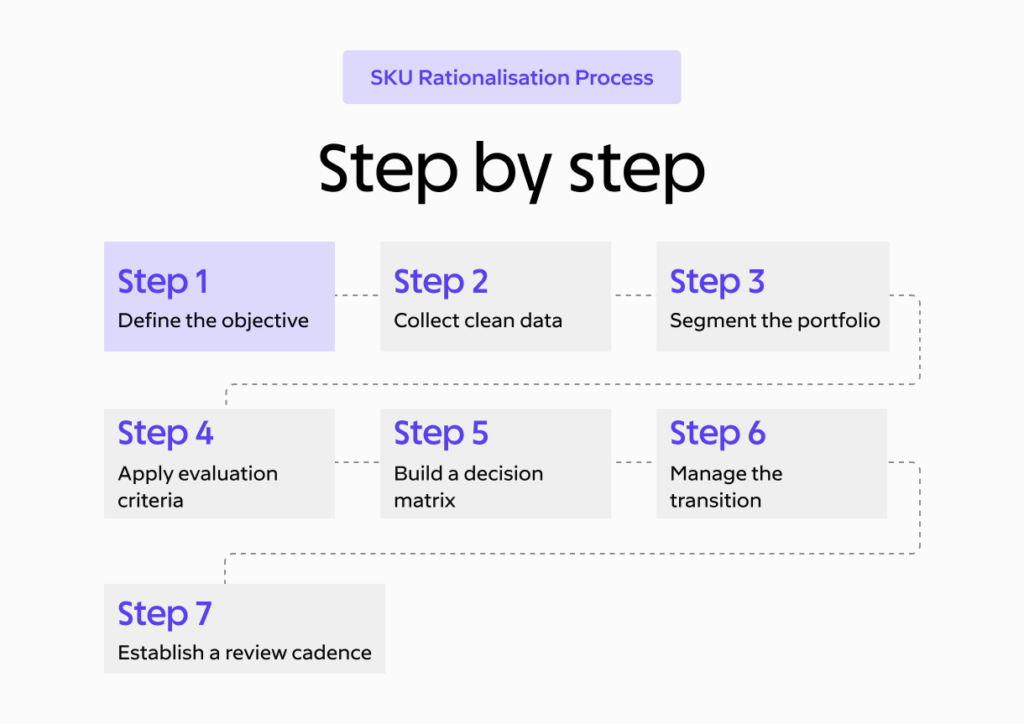
Step 1: Define the objective
Start by clarifying why rationalisation is happening.
Different businesses prioritise different outcomes.
Common goals include:
- Reducing inventory carrying costs
- Improving margins
- Simplifying operations
- Freeing warehouse capacity
- Improving service levels
- Reducing obsolete stock
- Increasing inventory turnover
Clear objectives help determine which evaluation criteria matter most.
Step 2: Collect clean data
Good decisions depend on good data.
Businesses should gather SKU-level information including:
- Sales history
- Gross margin
- Inventory value
- Inventory turnover
- Order frequency
- Demand variability
- Storage costs
- Supplier lead times
- Return rates
- Forecast accuracy
Poor master data creates poor rationalisation decisions.
Before starting analysis, ensure item records, lead times, and cost information are accurate and standardised.
Step 3: Segment the portfolio
Segmentation helps businesses prioritise attention.
Many companies use ABC analysis to classify products based on revenue contribution or consumption value.
Typical segmentation includes:
- A-items: high-value, high-priority products
- B-items: moderate contributors
- C-items: low-value or slow-moving products
ABC classification creates a clearer view of where complexity exists.
Step 4: Apply evaluation criteria
Once the portfolio is segmented, businesses can evaluate individual SKUs using quantitative and operational criteria.
Questions often include:
- Does this SKU generate acceptable margin?
- Is demand stable or highly volatile?
- Does the SKU create operational complexity?
- Does it support strategic customers?
- Can it be replaced by another item?
- Does it contribute to assortment differentiation?
This stage is where formulas and performance metrics become essential.
Step 5: Build a decision matrix
Every SKU does not require the same outcome.
Most businesses categorise products into four groups:
Decision | Meaning |
Keep | High-performing or strategically important |
Modify | Improve pricing, sourcing, packaging, or replenishment |
Review | Requires further analysis or monitoring |
Phase out | Candidate for discontinuation |
This structure helps teams make consistent decisions.
Step 6: Manage the transition
Rationalisation affects suppliers, planners, warehouse operations, and customers.
Businesses should carefully manage:
- Existing stock liquidation
- Supplier communication
- ERP and inventory system updates
- Customer communication
- Product substitutions
- Forecast and replenishment adjustments
A phased transition reduces disruption.
Step 7: Establish a review cadence
SKU rationalisation is not a one-time project.
Customer preferences, market conditions, and product performance change constantly.
Most businesses benefit from:
- Quarterly light portfolio reviews
- Annual deep rationalisation analysis
- Continuous monitoring of slow-moving items
Four formulas for SKU rationalisation
SKU rationalisation should be driven by measurable performance indicators, not instinct.
These formulas help businesses identify which products contribute value and which create unnecessary complexity.
- Sales velocity
Sales velocity measures how quickly a SKU sells over a given period.
Sales Velocity = Units Sold ÷ Number of Days in Period
Example
If a SKU sells 500 units over 90 days:
Sales Velocity = 500 ÷ 90 = 5.6 units per day
Higher sales velocity usually indicates stronger demand and healthier inventory movement.
Low sales velocity products often become rationalisation candidates.
- Inventory turnover
Inventory turnover measures how efficiently inventory converts into sales.
Inventory Turnover = Cost of Goods Sold ÷ Average Inventory Value
Example
If annual cost of goods sold equals £240,000 and average inventory value equals £60,000:
Inventory Turnover = 240,000 ÷ 60,000 = 4
This means inventory turns four times annually.
Low-turnover products may indicate overstocking, weak demand, or unnecessary assortment complexity.
- SKU profitability
Revenue alone does not determine SKU value.
Some products sell well but contribute very little profit after operational costs.
SKU Profitability = Revenue − (COGS + Storage Costs + Handling Costs)
Example
If a SKU generates:
- Revenue: £20,000
- Cost of goods sold: £12,000
- Storage costs: £2,000
- Handling costs: £1,000
SKU Profitability = 20,000 − (12,000 + 2,000 + 1,000)
SKU Profitability = £5,000
This calculation helps businesses identify products that consume operational resources without
delivering sufficient margin.
- ABC classification thresholds
ABC analysis helps prioritise inventory attention.
A-items = top 80% of revenue
B-items = next 15% of revenue
C-items = bottom 5% of revenue
Example
A company with 5,000 SKUs may discover:
- 500 A-items generate most revenue
- 1,500 B-items contribute moderate value
- 3,000 C-items contribute minimal revenue
This insight often reveals where rationalisation opportunities exist.
Best practices for effective SKU rationalisation
Successful rationalisation balances financial performance with operational reality.
The goal is not aggressive SKU reduction at any cost.
The goal is smarter portfolio management.
Focus on customer demand
Rationalisation decisions should align with real customer behaviour.
Products with low volume may still matter strategically if they support key accounts or strengthen assortment differentiation.
Combine multiple metrics
No single formula tells the whole story.
Businesses should evaluate:
- Sales performance
- Margin contribution
- Forecast stability
- Operational cost
- Customer importance
- Strategic relevance
Looking at only one metric can create misleading conclusions.
Align teams early
Sales, operations, procurement, finance, and marketing often view SKU portfolios differently.
Cross-functional alignment prevents internal conflict and improves decision quality.
Rationalise continuously
Waiting several years between reviews creates unnecessary complexity.
Ongoing monitoring prevents SKU proliferation from becoming unmanageable.
Use scenario planning
Before removing products, businesses should model operational and financial impacts.
Questions may include:
- Will customers substitute products?
- Will order frequency change?
- Will supplier contracts be affected?
- Will availability improve elsewhere?
Common SKU rationalisation challenges
Even well-planned rationalisation initiatives face resistance and operational complexity.
Inaccurate demand forecasting
Poor forecasting can result in businesses removing products that still have meaningful future demand.
Improving demand planning accuracy helps reduce this risk.
Supplier disruption
Portfolio changes may impact supplier agreements, pricing structures, or minimum order quantities.
Early communication with suppliers helps minimise disruption.
Internal resistance
Sales and marketing teams often fear SKU reduction may hurt revenue or customer satisfaction.
Clear communication, shared KPIs, and data-driven decision-making help build alignment.
Poor data quality
Bad inventory data leads to bad rationalisation decisions.
Inaccurate lead times, inconsistent item naming, or unreliable stock records distort analysis.
Clean master data should always come first.
How technology improves SKU rationalisation
Manual spreadsheet analysis becomes increasingly difficult as SKU counts grow.
Modern inventory planning platforms help businesses evaluate product portfolios more dynamically and accurately.
Technology supports SKU rationalisation by enabling:
- SKU-level forecasting
- ABC classification
- Demand segmentation
- Inventory visibility
- Carrying cost analysis
- Replenishment optimisation
- Automated exception management
Rather than relying on intuition, planners gain access to measurable inventory insights.
This allows businesses to make rationalisation decisions based on demand signals, profitability trends, and operational performance.
How AGR supports SKU rationalisation
AGR helps businesses rationalise inventory portfolios using data-driven planning and forecasting tools.
Instead of relying on manual analysis, planners gain:
- SKU-level demand visibility
- Advanced ABC classification
- Forecasting models tailored to item behaviour
- Inventory optimisation insights
- Visibility into slow-moving and excess stock
- Automated replenishment recommendations
AGR helps businesses reduce unnecessary complexity while improving service levels and inventory performance.
With better visibility into demand, carrying costs, and replenishment risk, rationalisation decisions become faster, more accurate, and easier to scale.
If your business wants to improve inventory efficiency while reducing excess complexity, AGR can help you build a smarter SKU strategy.
FAQ about SKU rationalisation
What is the difference between SKU rationalisation and SKU optimisation?
SKU rationalisation focuses on reducing unnecessary or underperforming products. SKU optimisation focuses on improving the performance of existing products through forecasting, pricing, replenishment, or operational improvements.
How often should businesses rationalise their SKUs?
Most businesses should perform light portfolio reviews quarterly and conduct a deeper rationalisation assessment annually.
How many SKUs are too many?
There is no universal number. The problem occurs when SKU complexity outpaces operational capability, profitability, or customer value.
What is the 80/20 rule in SKU rationalisation?
The 80/20 rule, also called the Pareto Principle, suggests that a small percentage of SKUs often generates the majority of revenue or profit.
Can SKU rationalisation improve inventory turnover?
Yes. Removing slow-moving and low-value SKUs often improves inventory turnover by concentrating working capital into higher-performing products.
Does SKU rationalisation reduce customer choice?
Not necessarily. Effective rationalisation removes redundancy and low-value products while protecting the assortment customers actually need.