Long and variable lead times require inventory planning that looks months ahead. When products take three, six or even 12 months to arrive, businesses need accurate demand forecasts, lead-time-aware purchasing, flexible safety stock and visibility into future inventory requirements to maintain availability without tying up unnecessary working capital.
International sourcing adds further complexity. Production schedules, container shipments, customs, supplier performance and changing freight routes can all affect when inventory becomes available. The challenge is knowing what to order, how much to order and when to commit, despite uncertainty months into the future.
The core challenge: Navigating long and variable lead times and extended horizons
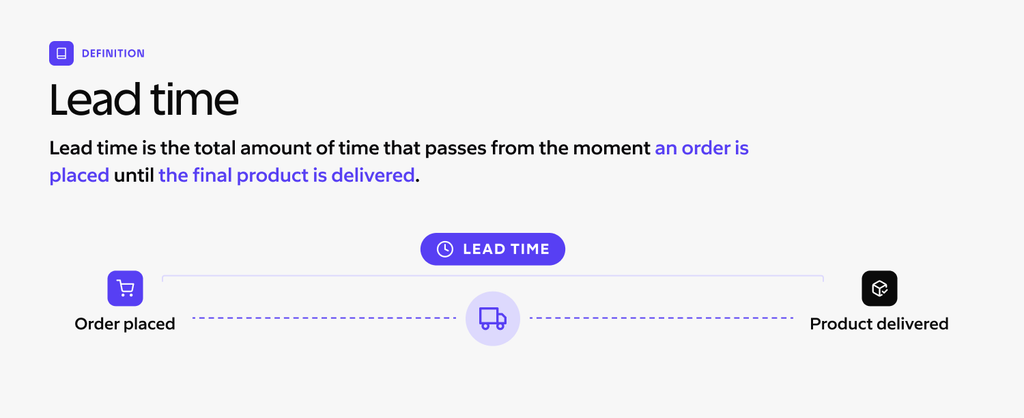
A purchase order placed today may not arrive for several months. That means the buyer is making an inventory decision based on demand that has not happened yet.
With a short, predictable lead time, a business has more opportunity to respond to changes in sales. With a nine-month lead time, a demand shift that becomes obvious in month three may already be too late to address through the normal supply route.
Traditional approaches such as static minimum and maximum stock thresholds can struggle in these conditions. A fixed reorder point assumes that the conditions behind the calculation remain reasonably stable. If actual lead times regularly change, the point at which inventory needs to be reordered changes too.
The result can go in either direction. Order too late and the business risks a stockout before replenishment arrives. Add large buffers just in case and the company can end up tying significant working capital up in inventory.
Sundqvist works with lead times ranging from around one month to as long as 12 months. AGR helps the team with long-term forecasts and provides visibility eight to 12 months ahead, supporting better conversations with suppliers.
A single company-wide reorder rule would make little sense in that environment. An item available in one month and an item that takes a year to replenish carry very different risks.
Rosendahl faces a different version of the challenge. Its suppliers are located across Southern Europe, Turkey and Asia, with delivery times ranging from three to eight months. Some suppliers require production capacity to be reserved months in advance, making accurate forecasts essential for purchasing and supplier planning.
The distinction between these examples is important. Sundqvist manages a portfolio with lead times varying from one to 12 months, while Rosendahl must plan three to eight months ahead across an international supplier network. Both demonstrate why planning horizons and reorder calculations need to reflect the requirements of individual suppliers and SKUs rather than a single company-wide assumption.
Managing overseas production and Asia sourcing complexity
International sourcing adds several stages to the lead-time calculation. The time between deciding that inventory is needed and having it available to customers can include:
- Supplier or factory production time
- Time waiting for a production slot
- Consolidation before shipment
- Sea or air freight
- Port handling
- Customs clearance
- Domestic transport
- Warehouse receiving
Each stage can introduce delays, and the stages do not necessarily vary together. A supplier might manufacture on schedule while a shipment is delayed at a port. Alternatively, freight may run smoothly while factory capacity adds several weeks to the production schedule.
Planners therefore need to understand total replenishment time rather than relying only on the supplier’s quoted manufacturing lead time.
Planning when you control overseas production
Etman provides an example of another variation on this problem. The electrical wholesaler has its own factory in China, creating long lead times between production decisions and inventory becoming available for sale.
Owning or closely controlling production changes the relationship with lead time, but it does not eliminate the planning challenge. Instead, the forecast becomes an important input into production scheduling.
The business needs enough visibility to decide what should be manufactured well before the expected demand occurs.
Reliable lead-time data also helps planners understand whether actual performance matches expectations. Tracking the difference between expected and actual lead times can reveal recurring delays and provide better information for future production and purchasing decisions.
When long lead times meet seasonality
Seasonality makes the problem even harder.
GripGrab sources products from the Far East and manages almost 2,000 SKUs with varying levels of seasonality. Long supplier lead times mean the company cannot wait for a seasonal increase in sales to confirm that demand has arrived. By that point, the window for placing the necessary production order may already have passed.
Seasonal demand needs to be identified in the forecast before purchasing decisions are made. GripGrab uses AGR to bring historical inventory and sales data together with predicted demand, giving the team visibility into the coming 12 months.
This illustrates an important difference between planning domestic and long-lead-time overseas products. The further away replenishment is, the more important the forecast horizon becomes.
Planners may also need to consider supplier minimum order quantities, production constraints and container requirements at the same time.
The objective is not simply to forecast demand. It is to turn that forecast into a realistic purchasing plan. For companies managing thousands of products, that becomes difficult to do manually.
Responding to shipping volatility, container logistics and route changes
Factory lead time is only part of the equation for companies importing inventory.
International freight adds another source of variability. Sea freight schedules can change, ports can become congested and shipping routes can be disrupted.
The lead time that matters to an inventory planner is ultimately the time between placing an order and having usable stock available.
Three capabilities are particularly important.
Container fill optimisation
International purchasing often involves balancing inventory requirements against container capacity.
Simply filling unused container space with additional stock may improve freight utilisation, but it can also create excess inventory. Slow-moving items ordered only to maximise container fill still consume cash and warehouse space once they arrive.
Container optimisation needs to consider recommended order quantities alongside constraints such as minimum order quantities and container capacity.
The aim is to use shipping capacity efficiently without turning freight efficiency into an overstock problem.
Lead-time tracking
Planning assumptions improve when businesses compare expected lead times with what actually happens.
Supplier performance can change. So can transit times and shipping routes. Tracking actual lead time gives planners a stronger basis for future orders than maintaining one static assumption indefinitely.
If a supplier that promises a 10-week lead time routinely takes 13 weeks, the planning system needs to reflect that reality.
The same principle applies to freight. Supplier production time may remain unchanged while the shipping portion of the total lead time increases.
Dynamic safety stock
Safety stock provides protection against uncertainty, but that does not mean the same buffer should remain in place indefinitely.
If lead-time variability increases, the risk of running out before replenishment arrives also increases. Safety stock can therefore be adjusted according to the level of uncertainty rather than relying on a fixed number of days or units.
The reverse also matters. When lead times become more consistent, continuing to carry an oversized buffer can unnecessarily increase inventory investment.
When supplier and shipping lead times both vary
NoMorePly imports products using international container shipping, which means its planning process has to account for both supplier and transport lead times.
These variables can move independently. A supplier may be ready on schedule while shipping takes longer than expected, or production may be delayed even when freight is running normally.
For the planner, it is the combined purchase-to-availability window that matters.
The business therefore needs visibility into future requirements early enough to place orders, consolidate shipments and respond when one part of that timeline changes.
Responding when shipping routes change
The Mad Group provides another example of why lead-time assumptions cannot be treated as permanent.
The company operates a global supply chain, and changes to shipping routes have added two to three weeks to replenishment in some circumstances. The team has responded by adjusting lead times and safety stock in AGR.
A reorder point calculated around the old route may trigger an order several weeks too late once the route changes. The business then has a gap between running out of stock and receiving the next shipment.
Updating lead times and the inventory policies that depend on them allows planning to reflect the new supply chain rather than continuing to operate on outdated assumptions.
Key features required for long lead-time inventory planning
Managing long lead times is not one calculation. It requires several planning capabilities working together.
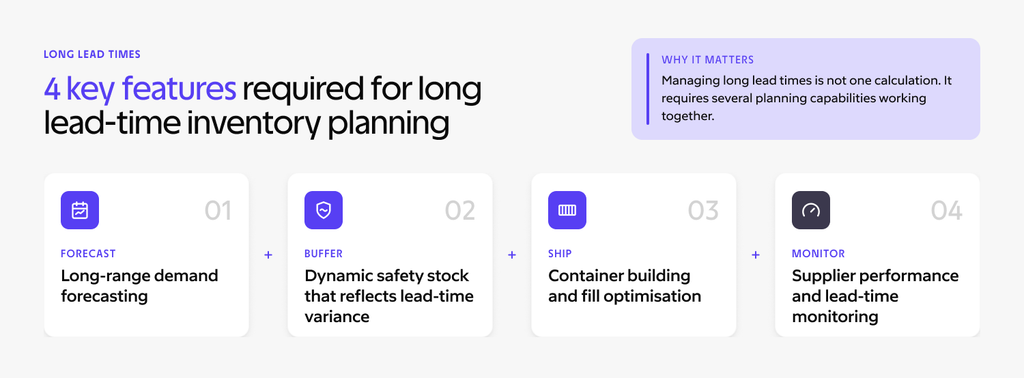
1. Long-range demand forecasting
Your forecast horizon should extend beyond the longest relevant lead time.
If some products take 12 months to replenish, a three-month forecast cannot provide enough information for purchasing. Companies such as Sundqvist need visibility eight to 12 months into the future precisely because purchasing decisions have to be made so far in advance.
SKU-level forecasting also matters. Different products have different demand patterns, seasonality and lead times. Forecasting only at category level can hide individual items that are likely to run short.
AGR’s demand planning and forecasting capabilities help companies create forward-looking forecasts and translate expected demand into purchasing requirements.
2. Dynamic safety stock that reflects lead-time variance
Safety stock should protect the business against uncertainty, not simply add a fixed buffer to every item.
Lead-time variability is one of the factors that determines how much protection an item needs. A supplier that consistently delivers in eight weeks creates a different inventory risk from one whose deliveries vary between six and 12 weeks.
Statistical safety stock can account for this variation and adjust inventory protection accordingly.
This helps businesses avoid two common extremes: carrying too little stock for volatile supply lines or holding unnecessarily large buffers for reliable ones.
3. Container building and fill optimisation
Container orders introduce physical constraints into inventory planning.
Planners need to balance:
- Forecast demand
- Current inventory
- Safety stock
- Minimum order quantities
- Supplier constraints
- Container capacity
- Expected future orders
AGR’s automated ordering capabilities can generate order proposals while accounting for order constraints and provide container optimisation suggestions.
This allows planners to assess how to build orders efficiently rather than simply adding more stock to fill remaining capacity.
The distinction matters. A full container is not automatically an optimised container if the additional inventory will sit unused for months.
4. Supplier performance and lead-time monitoring
A quoted lead time is an assumption. Actual delivery performance tells you whether that assumption is reliable.
Tracking supplier lead times over time allows planners to compare expected and actual performance and identify where variability is increasing.
That information can then inform purchasing decisions, reorder settings and safety stock.
It also improves supplier conversations. Instead of discussing delivery performance based on individual late orders or anecdotal experience, teams can work from historical data.
For businesses with international supply networks, this visibility can extend beyond the supplier itself. Changes in production, shipping and routes can all affect the total time required to replenish inventory.
Operational matrix: How companies manage long lead times with AGR
The following examples show how businesses with different sourcing and logistics models use inventory planning to manage extended replenishment cycles.
| Company | Sourcing and logistics challenge | Lead-time horizon | AGR capability or solution focus |
|---|---|---|---|
| Sundqvist | Wide variation in supplier lead times and need for long-term supplier planning | 1–12 months, with 8–12 months of forward visibility | Long-range forecasting and purchase planning |
| NoMorePly | International container shipping with variable supplier and transport lead times | Varies across supplier and shipping stages | Purchase planning, lead-time visibility and container planning |
| Rosendahl | Global suppliers across Europe, Turkey and Asia, combined with seasonal demand | 3–8 months | Forecasting, purchasing visibility and supplier planning |
| GripGrab | Far East sourcing combined with strong seasonality across a large SKU range | Long lead times with a 12-month planning view | Seasonal forecasting and SKU-level inventory visibility |
| Etman | Own factory in China and long production-to-availability cycles | Long overseas production lead times | Forecasting, replenishment and production planning visibility |
| The Mad Group | Global sourcing and shipping route changes extending replenishment times | Routes can add an additional 2–3 weeks | Lead-time adjustment, safety stock and inventory planning |
These companies operate in different markets, but the underlying planning challenge is similar: the further inventory is from the point of demand, the more important forward visibility becomes.
Explore more examples on our customer case study page.
Stabilise your long-horizon supply chain
Long lead times are not necessarily a problem that can be eliminated. For many companies, they are simply part of the sourcing model. The goal is to plan around them more effectively.
Start by identifying the longest and most variable lead times in your portfolio. Look beyond supplier estimates and compare them with actual performance. Then make sure your forecast horizon extends far enough to support the decisions you need to make before those products arrive.
Review whether reorder points and safety stock still reflect current lead-time behaviour. If shipping routes or supplier performance change, the assumptions behind those calculations need to change as well.
Finally, connect forecasting with purchasing constraints. Minimum order quantities, production schedules and container capacity all influence what can actually be ordered.
A forecast becomes much more useful when it can be translated directly into a realistic purchasing plan.
AGR brings these processes together, helping businesses forecast demand, plan purchases, manage safety stock and lead times, and generate orders using data from their existing ERP.
Explore AGR’s demand planning and forecasting capabilities or request a demo to see how the platform can support long and variable lead times.